The structure of a text is the sequence of ideas it contains and how it is put together. No text will make sense unless it is structured clearly. It should have a well-chosen opening, middle and end.
Sections of a text
When discussing the structure of a text, it is important to consider the effects created by the areas mentioned below, as well as how it looks on the page.
The opening of a text usually introduces the writer’s main topic or subject. In most text types, the writer wants to catch the reader's attention and hint at what is to come. If the opening is not effective, the reader might lose interest and stop reading.
The middle section is often a balance between liveliness and detail. It is where the writer must develop the main ideas and even include explanations and support. These will often be presented in stages or with several twists and turns of argument.
The ending generally sums up the main idea of the text, that is, its writer’s ‘controlling idea’. It can make a final point, or bring a conclusion, for example to a story.
Openings
The opening of a text is usually crucial to its success. When you read the opening of a text, consider what the writer is trying to do.
Here is the opening paragraph of a text about boxing:

This is an effective opening because:
- it links with and begins to develop the topic highlighted by the title
- it uses a confident, formal and impersonal tone that suits an argumentative text such as a media article
- it is more persuasive because the writer seems fair-minded, summarising each side of the argument
But what is the writer is trying to achieve with this style of opening? You might notice how the use of a fact adds a sense of authority because it helps make the writer seem knowledgeable.
Also, the phrase ‘bare fist fighting’ adds a useful sense of violence that could help the argument. The explanation that the fight was 'for the entertainment of others' helps explain its purpose - that the boxers were not fighting out of personal anger.
The writer also gives two opposing points of view: 'some people…' and 'others claim…'. Readers can be more easily persuaded by this sense of fairness and it suggests the argument is likely to be balanced.
Alternative openings
There are many different ways to start a text. Consider these alternative openings for the example 'Boxing - sport or spectacle?' and see if they are suitable. Decide what you think of each one and then reveal the comments below.
Alternative 1
Boxing - sport or spectacle?
This article will talk about the damage that can be inflicted when two people stand face-to-face with the sole intention of knocking each other out with their fists. It will go on to argue that boxing, or legitimate assault, has no place in the twenty-first century.
Comments:
This opening gets straight to the point. Although it is quite formal, it is certainly not impersonal as the writer lets the reader know exactly what he or she thinks about boxing. The reader can be sure about what the answer to the question in the title will be from the first sentence. However, some of the phrasing in the opening could be more sophisticated, for example, “This article will talk about…” would sound more effective as, “We need to talk about the…*
Alternative 2
Boxing - sport or spectacle?
The bell goes and the two warriors approach each other. They are quick. They are strong. They are hard. They are ready to hurt and be hurt.
A left fist launches and connects with a nose. The crowd are on their feet. Cheering. Wanting more. Wanting blood.
Comments:
This is more like a fictional story than a non-fictional argument. The writer uses colourful descriptive language that might confuse the reader, who may begin to wonder if it is an argument. However, using descriptive imagery within writing can also be a good technique, as long as it does not work to confuse the reader about the genre or purpose of the text. This writing would be more in keeping with the genre conventions of a media article if it read:
Picture this: a bell goes and the two warriors approach each other. They are quick. They are strong. They are hard. They are ready to hurt and be hurt. This is boxing!
Boxing is a sport where fists launch and connect with noses. It is a sport where the crowd are on their feet. Cheering. Wanting more. Wanting blood. Is this what we want in our civilised country?
In this re-drafted version, the writer is using descriptive imagery to help rather than confuse the reader.
Middle
The middle section is where the writer develops the main ideas. It will usually include explanations and support.
This is the heart of the piece and it contains the key points. It will probably have three to five ‘body’ paragraphs.
Each paragraph will likely start with a clear topic sentence that introduces its main point, one that is developing the overall point of the piece.
Endings
How a text ends can be as important as how it begins. Good endings should leave the reader feeling satisfied.
Take a look at the final paragraph of the article about boxing.

This ending is effective as it summarises the whole of the text that has gone before it. It brings all of the arguments together and the writer gives his final opinion.
When analysing this ending, you would focus on the writer’s final opinion, what they say and how they say it.
Layout
Certain texts, especially non-fiction, follow genre conventions regarding layout. To be effective they need to be laid out in ways that capture interest and draw attention to important information, make information clear, or help the reader find what they want to read.
Scan over the following text and look for at least four things the writer has done to try to make it easier to read and consider which parts of the article catch your eye first.
Haunted by a Fiddler
Position: St James' Park, King's Lynn, Norfolk.
OS Map: North West Norfolk, Sheet 132, 1:50,000.
Map Ref: TF 625 198.
Access: Red Mount Chapel is on a mound on "The Walks" in the park.
Red Mount Chapel is a superb example of the Gothic style in architecture and even boasts its own musical ghost!
Built in 1485 at the time of Henry VII, the first Tudor king, the chapel was a stopping-off place for pilgrims on their way to the shrine at Walsingham via the port of King's Lynn. Octagonal in shape, it is very small, and has three floors. The top floor is a chapel with ‘fan tracery’ much like that in Cambridge university’s King's College.
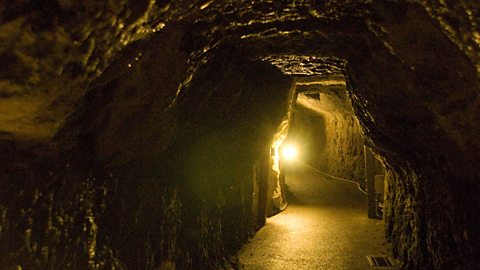
Underneath the chapel building there is reputed to be a long tunnel (not unusual), running to the town of Castle Rising - a distance of 18km/12 miles (very unusual). An unfortunate, drunken fiddler once decided to explore the dark passageway carrying his instrument, his dog and his pint! He never reached the end of the tunnel, wherever it went, but his spirit is said to remain and to be heard on occasions playing his tunes and singing, accompanied by the whining of his poor dog!
Places of interest in the neighbourhood:
•The Shattered Maid's Heart (King's Lynn)
• Killed by a Pinprick (Stow Bartolph)
• Detached Church Tower (West Walton)
East Anglican Curiosities by Rick O'Brien
Did you spot them? Here are the techniques that the writer has used:
- Bold writing is used for the subheadings, which list the location details. This is so that readers know where they are expected to go.
- The details are separated from the rest of the text so they are easy to follow.
- The most interesting fact, about the haunting, is mentioned first, and kept in a short paragraph of its own. This is to add emphasis to this interesting piece of information.
- An image of the haunted tunnel is used to draw the reader's attention and give readers a really good idea of what they can expect to see there.
- Another bold subheading is used to draw attention to "Places of Interest in the Neighbourhood" – so readers can plan their day around other available activities.
- These places are listed, using bullet points, to make them clear and easy to read.
Take Care:
Be careful to note there is a difference between structural features and presentational features in a text you are analysing.
Structural features like the ones discussed in the Red Mount Chapel leaflet – the location of facts and details, the subheadings and use of bullet points, for example – are features that the writer of the piece will choose and organise. The writer shapes these to get their points across in the way they want and to make sure the writing is structured in the way they think is best for the text and the audience.
Presentational features are ones that are used to make the written piece look attractive to its audience. This includes colour scheme, choice of font, images, graphics, columns and text boxes. A leaflet for an amusement park, for example, will have a writer to make it sound exciting, but it will also have a designer who deals with the presentational features, organising the colours and images to make the park look bright and fun to those who read the leaflet.
Sometimes structural features and presentational features may overlap a little; for example, an image is a presentational feature, but the writer may adapt their writing to a chosen image or even write a caption specifically for the image. Generally though, structural features are in the writing and presentational features are the visual images and effects.
Think about typing up a piece of homework. You would write your introduction using interesting techniques to hook the reader, fill in factual information and develop your argument in paragraphs, then write a strong conclusion – all structural features of your writing. When you’ve redrafted and are happy with the piece, you might then add a border to the page, change the typed font, make the title big and bold and insert some images to make it more interesting – all presentational features.
Analysing structure
When analysing the structure of a text, which refers to the effect created by the chosen sequencing of ideas, you need to explain your own ideas.
An effective way of doing this is to use the PEAtechnique, where PEA stands for: Point, Evidence, Analysis
- Point - Make a point about the effects of the sequencing of a section, about the text's beginning, middle or end, or about the overall make-up, layout or structure of the piece. It is important that your point is one that will help develop the argument you are creating as your answer to the essay question. For example, 'The photograph occupies the most space within the article and the page'.
- Evidence - Provide some evidence to support your point. This can be a quotation or a description. For example, 'The picture shows a cave that is clearly very dark and looks very old. Because there is only one light, it looks incredibly spooky.'
- Analysis - Analyse and explain how the evidence works (you might expand further on aspects of its effect, method and the writer’s purpose). For example 'This picture seems to be used for two reasons. The first is to show what the reader can expect if they visit this place and the second is make a visit enticing as the image hints that the place might well be ghostly, with haunting shadows and an old-fashioned appearance. This helps add persuasiveness to the text.'
Poems
Poems are an unusual genre of text because the poet can make many more choices about their visual form in order to create useful effects. It is, therefore, always important to analyse the visual aspects of a poem, ie the way it is laid out.
The poet may deliberately create the poem to sprawl across the page, to offer a feeling, for example, of its taking over; or to make it look free flowing and thus hint maybe at the writer being a free spirit, unconstrained by formal layout.
Alternatively, a poet may copy an older form or structure, for example, a sonnet. As a sonnet was traditionally a love poem, even if the content has nothing to do with love, this link with tradition could be used to hint at romance.
Sonnet 18: Shall I compare thee to a summer’s day?
More on Reading skills
Find out more by working through a topic
- count2 of 4

- count3 of 4
- count4 of 4
