Key points about marriage and the family
The The five books of Moses, known as the Hebrew Bible., Also known as Prophets. The second division of the Tenakh, the Hebrew Bible., and Also known as Writings. The third and final section of the Tenakh. (collectively known as the Tenakh) teach Jewish people that the nature and purpose of family is to provide security and a foundation of faith.
Most Jews see marriage as an important and necessary part of life. Judaism also has the mechanism for divorce when needed and the opportunity for remarriage.
According to the Torah, God made male and female to complete each other and procreate. However, there are differing Jewish views on sexuality, sex before marriage and the use of A method used to prevent pregnancy e.g. using a condom or a contraceptive pill..
Judaism teaches that humans have been created in the image of God and therefore men and women are equal. However, not all Jews agree on the roles that men and women have in worship and in the home.

Remember
There are different denominations of Judaism, for example Orthodox, Conservative (Masorti) and Reform and Liberal. These last two are sometimes called 'Progressive'.
Find out more about the largest branches of Judaism.
Videos
Watch the videos below to see how Jewish attitudes and teachings compare with other religions.
This video compares Jewish, Muslim and Sikh attitudes and teachings towards educating children within a faith.
Muslim
Hi, I'm a Muslim.
Jewish
I'm Jewish.
Sikh
And I'm a Sikh.
Muslim
And we all believe children are a gift from God…
Jewish
…and that families are the building blocks of our communities…
Sikh
…and society in general. But is it really a family's job to educate their children about their faith?
Muslim
Muslims try to follow the example of Prophet Muhammad (sala Allahu alayhi wasalam), who believed teaching children how to behave is really important. He said, 'a father gives his child nothing better than good manners'. And education starts straight after a baby is born, when the call to prayer is said into the baby's ears, often by the father. Seven days later, the Aqiqah ceremony takes place when the parents choose a Muslim name for their child.
Jewish
It's very similar for Jews. We believe it's a mitzvah, a commandment, to bring children up in the faith. And soon after we're born, we are usually given Hebrew names. For boys this happens on the seventh or eighth day after birth at the brit milah ceremony. Some Jews also have a special ceremony for girls called the simchat bat, which happens on the first Shabbat after her birth.
Sikh
The Sikh code of conduct, Rehat Maryada, says that it's a parent's duty to educate their children in Sikhi, and this starts as soon as possible after a baby's birth, when the parents say the Mool Mantar, the first words of the Sri Guru Granth Sahib Ji, into the baby's ears. A few weeks later, a naming ceremony called the Naam Karan takes place at the Gurdwara, our holy place of worship. Traditional Sikh names are gender neutral, so the name 'Singh', which means lion, is added for a boy and 'Kaur', princess, for a girl. So all three of us began life with a religious identity given to us by our families.
Muslim
And our education continued at home. My parents taught me my first Arabic phrases and how to pray. I learned what was halal, allowed, especially when it came to food.
Jewish
I celebrated the Shabbat every week with my family and there are lot of festivals in Judaism. Sukkot, Hanukkah, Passover, and so on that we also celebrated at home. My parents taught me what they meant and why they were important.
Sikh
When I was a baby, my parents gave me my first kara, a bangle like this, and I've worn one ever since. And they left my kesh, my hair, uncut, so it grew long.
Muslim
But educating children in a faith can't be the only purpose of a family. Because not all families are religious.
Jewish
A lot of people would say that the main purpose of a family is to raise children with love and keep them safe…
Sikh
…and that there are other people who have the responsibility to educate them in the faith.
Muslim
Yes, the Qur'an says, 'let there be a group among you who call others to goodness'. So there are people in the wider Muslim community whose job it is to teach us. Every weekend I'd come to a madrassah like this, a school where children are taught how to write Arabic, recite the Qur'an and learn more about our faith.
Jewish
And it's similar in Judaism. Our holy building is often called a shul, which means school, because we believe that education continues our whole lives. This is where I was taught how to read and write Hebrew, and was told stories from the Torah.
Sikh
And here at the Gurdwara I enjoyed the support of the Sangat, the community of Sikhs. I learned about the Ten Gurus and was taught how to read Gurmukhi which is the written form of Punjabi, the language of the Sri Guru Granth Sahib Ji.
Muslim
So in most religious families, children are educated about the faith at home and in the wider community.
Jewish
But some people think children shouldn't be brought up in a religion. They should be free to choose their own beliefs when they're older.
Sikh
For me, it was sometimes hard growing up within a religious family, especially when other people didn't know why I did some things differently. But the religious teachings I got from my family are precious to me. Even though I used to receive comments about my long hair, which I used to tie up in a top knot, I believe challenges like that can make us stronger in our faith.
Muslim
All of our religions agree that a child's first teacher is their parent, and that our beliefs are an important part of family life.
Jewish
But the wider community also helps families to bring up their children in the religion.
Sikh
So what do you think?
Learn more about Christian, Jewish and Buddhist attitudes and teachings towards procreation in this video.
Buddhist
Hello. I'm a Buddhist.
Christian
I'm a Christian.
Jewish
And I'm Jewish.
Buddhist
And our religions all agree that sex is an important part of a loving relationship.
Christian
So in the UK, the age of consent is 16. And when religions talk about a loving relationship, they usually mean marriage.
Jewish
One of the main reasons for that is to provide safe and secure conditions for procreation…
Buddhist
…which means having a baby…
Christian
…or babies.
Jewish
Some religious people say that whenever a couple has sex they should always be open to the possibility of procreation, because they believe that's what sex is for.
Buddhist
And this affects what they think about contraception…
Christian
…the methods that people use to prevent having children.
Jewish
So are there any circumstances where religious people accept the use of contraception?
Buddhist
Unlike most other religions, getting married and having children is not expected in Buddhism. In fact, some Buddhists believe that celibacy, not having sex and not getting married, is something to aim for. But if you choose to have sex, Buddhism teaches that it should be part of a committed relationship.
Christian
Christianity teaches that sex should only happen between people who are married. The Catechism of the Roman Catholic Church, which lists all its beliefs and rules, says that every time a couple has sex, they should be open to the possibility of pregnancy.
Jewish
And many Jews would agree with that. The Torah says that God told his people to 'Be fruitful and multiply'. So many of us take that as a mitzvah, a commandment to get married and have children.
Buddhist
But many Buddhists would disagree. Sex doesn't always have to be about having children. We believe it can help a couple to develop 'metta', loving kindness and 'karuna', compassion. So some forms of contraception are accepted. We try to live by the principle of 'ahimsa', which means non-violence or non-harming. And Buddhism teaches that life begins at conception. So barrier methods of contraception are accepted, non-barrier methods are generally not.
Christian
Many Christians would agree that life begins at conception. In the Bible, the writer of Psalm 139 talks about God seeing my 'unformed body' in the womb. So the Roman Catholic Church teaches that if a married couple wants to avoid pregnancy temporarily, then they should use natural family planning methods rather than contraception. The only exception to the no contraception rule is if a pregnancy would put a woman's health in danger. Protestant churches, like the Church of England, the Methodist Church and the Baptist Church, generally do accept that most couples will use contraception, but they also encourage them to have families when they feel ready.
Jewish
Orthodox Judaism generally instructs couples not to use contraception, so that pregnancy remains a possibility. However, an ancient collection of Jewish writings, called the Talmud, does allow it if there are good medical reasons for not getting pregnant. Many Conservative and Reform Jews accept the use of contraception, but it’s still seen as the couple's duty to have children.
Buddhist
As a Buddhist, I believe human life is precious. I think all people do. So I'd need to think carefully about bringing a baby into the world. Contraception is definitely something I would want to consider so I can plan when to have a family.
Christian
So all our religions agree that sex should be part of a loving and committed relationship.
Jewish
But we don't agree that sex always has to be open to the possibility of procreation.
Buddhist
Some religions accept the use of contraception either to prevent having children…
Christian
…or to space out their births…
Jewish
but the kind of contraception used and the reasons for using it can depend on when a religion believes that life begins. But what do you think?
The nature and purpose of the Jewish family
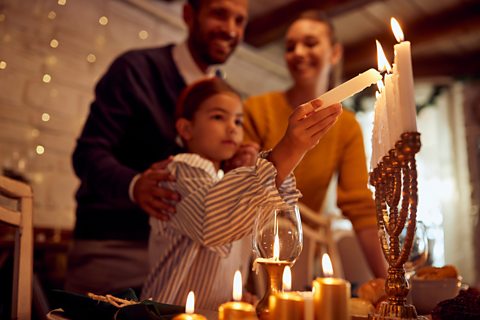
For Jews, the family is an important institution. Depending on the branch of Judaism, these can include traditional A family unit consisting of two adults and any number of children living together. The children might be biological, step or adopted., stepfamilies, extended families and same-sex parents.
Based on the teachings of Moses, the foundations of the Jewish family are:
Kavod – Treating each other with respect and dignity within and outside the home.
Chessed – Kindness, or love between people.
Shalom bayit – Marital reconciliation and the desire for peace and stability within the home.
The purpose of the Jewish family
There are various important roles of the family in Judaism. Some of those roles include preserving and growing the faith. This might achieved by:
Preserving the faith – Within Judaism, it is seen as the ideal if both parents are Jewish, to preserve the faith. Mothers in Judaism are of great importance. Orthodox Jews believe the line of religious descent passes through the mother. However, Liberal Jews believe it can also be passed through the father.
Growing the faith – The Torah contains the command from God: “Be fruitful and multiply,” (Genesis 1:28). This is interpreted by many Jews that a main role of the family is to procreate.
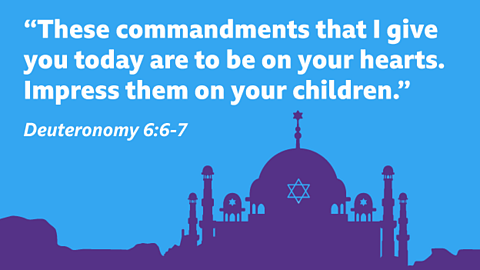
Raising children in the faith – Parents have a responsibility to share the faith with children and encourage them to attend synagogue and Religious education provided by the community, usually run by the synagogue. The direct translation is ‘room’.. Children may be taught to take part in various rituals at home, such as the The Jewish holy day and day of rest; It runs from sundown on Friday and ends when stars are visible on Saturday evening. Except for certain cases, work and using electrical devices is not allowed in Shabbat. or keeping The preparation and eating of kosher food., some may learn Hebrew so they can read and understand scriptures. Deuteronomy states:
These commandments that I give you today are to be on your hearts. Impress them on your children.”
Deuteronomy 6:6-7
Answer this question about the Mezuzah
Why do many Jews have a Mezuzah on the door of their home?
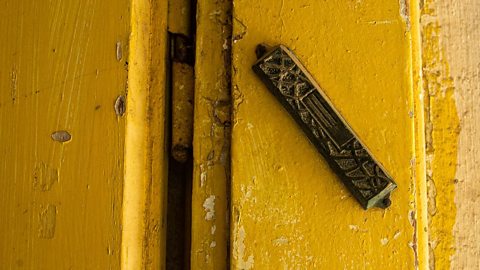
The Mezuzah is a small box which contains a scroll with inscriptions from the Book of Deuteronomy. Many Jews fix it onto the right-hand doorpost of their homes. It acts as a reminder of God’s covenant (promise) made with His people, the Jews. It is also an important sign of the home being Jewish and acts as a reminder to the family that home is a holy place.
Remember
The Mezuzah is a sign that Jewish commitment and identity exists in the home.
The Torah teaches that the family is vital in passing on, and educating children in, the Jewish faith.
Marriage and the family key terms quiz
Marriage in Judaism
The nature and purpose of marriage
Many Jews view marriage as a gift from God and a promise between him and the couple. As stated in Genesis: "God said, 'It is not good for the Human to be alone; I will make a fitting counterpart for him',” (Genesis 2:28). According to teachings in A central Jewish text that is the source of civil and ceremonial Jewish Law. , marriage is a commitment of love and companionship, and a bond to create a Jewish home for the glory of the God.
For many Jews the principal purpose of marriage is to have children:
And God said unto them, be fruitful, and multiply."
Genesis 1:28
Some key elements of a Jewish wedding
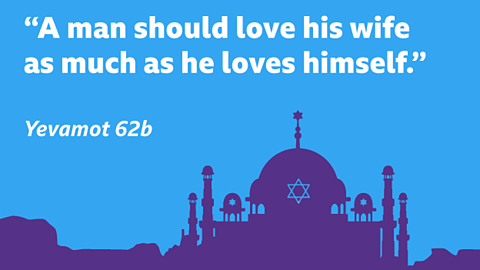
The Talmud gives advice on how married couples should treat each other:
A man should love his wife as much as he loves himself, and honour her more than he honours himself”
Yevamot 62b
A wife… brings him good, not harm, all the days of her life. She is clothed with strength and dignity … When she speaks, her words are wise, and she give instructions with kindness.”
Proverbs 31:10-12;25-26
According to Rabbinic teaching, if these commands are followed, they will lead to great rewards from God.
Polygamy
Polygamy is the act of marrying multiple partners. Polygamy is illegal in the UK and was declared illegal within Judaism by Rabbenu Gershom in the 11th Century.
GCSE exam-style question
Explain the importance of marriage for most Jews.
You should refer to sources of wisdom and authority in your answer.
Judaism teaches that marriage is a spiritual joining together of a couple. Jews believe it is important to have a strong foundation for a marriage and spending time together at the start of their marriage helps the couple build this foundation. The Torah states: “If a man has recently married … for one year he is to be free to stay at home and bring happiness to the wife he has married,” (Deuteronomy 24:5).
The Talmud states: “Any man who has no wife, lives without the joy, without blessing, and without goodness," (Babylonian Talmud, Yevamot 62b). Many Jews believe that this highlights the importance of a marital relationship and that it is beneficial to prioritise marriage as a life goal.
Many Jews believe that the nature and purpose of marriage is to have children and raise them in the faith. This means that traditions and beliefs will be passed on through the generations: “These commandments that I give you today are to be on your hearts. Impress them on your children,” (Deuteronomy 6:6-7).
Divorce and remarriage
Divorce is a legal process that ends marriage.
Judaism teaches that marriage is a sacred commitment and union, however the religion does accept divorce.
Many Jews will view divorce as a last resort that even causes God to feel the pain of the couple:
Malachi 2:16 states: “For I hate divorce, says the Lord the God of Israel”. The Talmud speaks of: “When a man puts aside the wife of his youth, even the very altar weeps,” (Gittin 90b).
In Judaism, a certificate of divorce is called a 'A document that seals a Jewish divorce according to religious law.' and it must be witnessed by two Jews. In the UK, there must also be a legal divorce to ensure the proceeding is in accordance with the law.
In Orthodox Judaism, a ‘get’ is given from the man to the woman, but the divorce does have to be mutually agreed:
If a man marries a woman who becomes displeasing to him because he finds something indecent about her … he writes her a certificate of divorce, gives it to her and sends her from his house.”
Deuteronomy 24:1
Once a legal divorce has been completed and a ‘get’ has been granted, a divorcee can remarry according to The commandments, rules and practices that a Jewish person is expected to follow. Also known as halakhah., however there are some restrictions.
GCSE exam-style question
Explain why Jews might have different views on divorce and remarriage.
You should refer to sources of wisdom and authority in your answer.
Answers could include:
Judaism teaches that marriage is a sacred commitment and union, and therefore if divorce is necessary it is seen as a sad necessity that even causes God to feel the pain of the couple: “When a man puts aside the wife of his youth, even the very altar weeps,” (Gittin 90b).
Progressive and Conservative Jews emphasise the teaching in Genesis 1:27 that: “All humanity is made in the image of God,” which some Jews believe means that if everyone is equal, all different types of families are equal and accepted.
In pictures: Family, marriage and divorce in Judaism
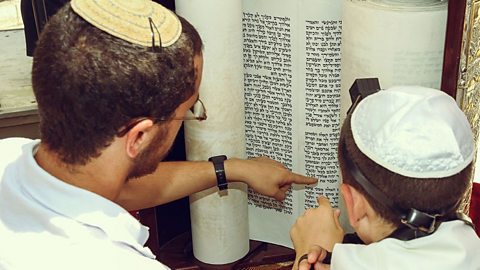
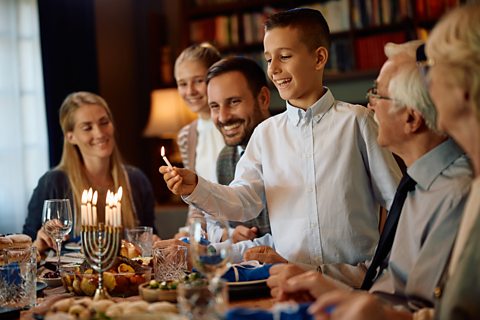
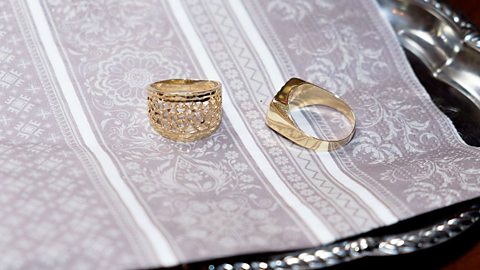
Image caption, Judaism teaches it's the family's duty to bring children up in the faith which may involve reading Holy Scriptures and learning Hebrew.
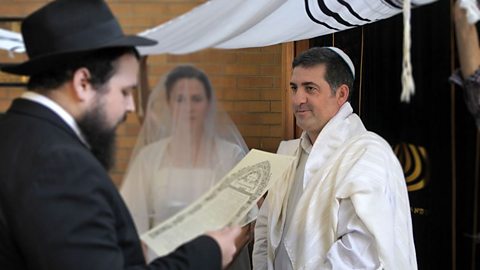
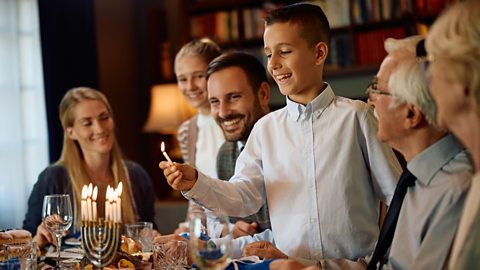
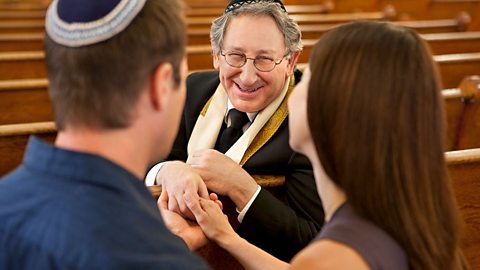
1 of 5
What does Judaism teach about same-sex marriage?
Due to the change in UK A particular law, or a group of related laws passed by Parliament. in 2013, legal marriage in the UK now includes same-sex marriages. However, some Orthodox Jews use teachings from the Torah and religious traditions to oppose same-sex marriage.
In Leviticus (18:22), Jews are told: “Do not have sexual relations with a man as one does with a woman”. Many Jews will see this verse as forbidding homosexual relations and same-sex marriage.

For some Jews, there is a debate between inclination and practise. This could mean that a Jew who is homosexual may choose not to be sexually active and instead practise Refraining from all sexual relations. so as not to go against religious teachings.
Many Liberal, Reform and Masorti Jews accept same-sex marriage and use the teaching from Genesis, "God created man in his own image,” (Genesis 1:27) to support their views. Some synagogues offer same-sex couples a Shutafut, which is a partnership ceremony.
GCSE exam-style question
Explain why Jews might have different views about same-sex marriage.
You should refer to sources of wisdom and authority in your answer.
Answers could include:
Many Orthodox Jews consider same-sex relationships unacceptable. This is seen through the words of Leviticus (18:22) which states: “Do not have sexual relations with a man as one does with a woman," therefore they view marriage as being reserved only for a man and woman.
Most Progressive and Conservative Jews emphasise the teaching in Genesis 1:27 that: “All humanity is made in the image of God,” which could be interpreted to mean that if everyone is equal, all different types of marriages are equal and accepted.
Sex before marriage
Many Jews believe that sexual relationships should only happen within marriage, this is because by becoming “one flesh”, (Genesis 2:24) the husband and wife become the closest of relatives, as described by A Jewish philosopher (1138-1204) whose interpretation of Judaism and writings fundamentally shaped Jewish practice..
Although marriage is considered the ideal state for a sexual relationship between a couple, some Liberal Jews accept that cohabitation and sex before marriage can happen in a loving, faithful and committed relationship.
Adultery
One of the Ten Commandments is: “You shall not commit adultery,” (Shemot 20:14). It is seen as one of the foundational principles of Judaism.
Marriage can be viewed as a part of a relationship with God and therefore sexual unfaithfulness is also a betrayal of God’s will.
Jews believe that sexual unfaithfulness is a betrayal of trust and of God’s gift of marriage.
Contraception
Judaism teaches that children are a gift from God and should be brought into a marriage union.
Children are a heritage from the Lord, offspring a reward from him.”
Psalm 127:3
Many Jews believe that as the main purpose of sex within marriage is to have children a couple should carefully consider whether to use contraception. Orthodox Jews often consult with a Rabbinic authority as to whether to use contraception and take advice as to which methods are appropriate. The Rabbinic figure takes each couple’s unique circumstances into account when consulted.
Genesis 38:6–10 tells the story of Oman, who: “Spilled his seed on the ground” rather than impregnate a woman: “And the thing which he did was evil in the sight of the Lord". This story is widely seen as the basis to broadly restrict certain methods of contraception.
Liberal and Reform Jews believe it’s up to the couple to decide whether to use contraception and also which type of contraception to be used.
Question
Explain one Jewish view on contraception.
Answers could include:
Based on the teaching in Genesis (1:28) to: “Be fruitful and multiply,” most Jews believe that a primary purpose for marriage is to have a family and this should be prioritised. Having a large family is seen by many Jews as evidence of being blessed by God. Some Jews caution against using contraception as they believe it is up to God to decide how many children the family should have.
The roles of men and women
Many Jews interpret the creation story, which shows God creating male and female at the same time, as evidence of equal status between men and women.
Then God said, ‘Let us make mankind in our image’ … So God created mankind in his own image, in the image of God he created them; male and female he created them.”
Genesis 1:27
However, Genesis 3:16 states: “Your desire will be for your husband, and he will rule over you”. This is interpreted by some Jews as evidence that men and women have different roles.
Both Liberal and Reform Judaism teach that the Torah needs to be reinterpreted in light of modern views and support the view that men and women are equal. Female rabbis are allowed in Liberal Jewish synagogues.
GCSE exam-style question
How can Jewish teachings be used to support gender equality?
You should refer to sources of wisdom and authority in your answer.
Answers could include:
Based on teachings from the Torah, that all humanity was made in the image of God, many Jews believe that men and women are equal: "God created mankind in his own image,” (Genesis 1: 27). Many Reform and Liberal Jews believe that men and women can carry out roles and responsibilities based on their ability and interests and not on their gender. For example, women can be rabbis and sit with the men in the synagogue.
However, some denominations interpret the Jewish teachings to mean that there are different roles for men and women. For example, many Orthodox Jews prescribe different roles for men and women, particularly in relation to worship and religious practice. In a synagogue, men and women sit separately and men lead services. Only where there is a women’s only prayer group, is there the opportunity for a woman to lead the service.
Judaism scripture quiz
Marriage and the family Judaism quotes
1 of 5
More on Judaism
Find out more by working through a topic