Watch: Figurative language
Poetry can be used to create a clear image in your reader's mind. You can use figurative language in your poems to help you do this.
Learn how to use literal and figurative language.
Literal and Figurative Language
Literal language is when we say what we mean. Like “The news van is parked outside,” or “Meeting new people makes me nervous.”
Figurative language can be anything that doesn't mean what it says literally.
Daisy and Rachel are chatting over dinner.
Daisy admits she was nervous about meeting Rachel. Rachel tells Daisy that she also has a few butterflies in her stomach.
“What an odd thing to say,” Daisy thinks.
“Did she eat some butterflies?”
Unfortunately, Daisy doesn't realise Rachel is speaking figuratively, not literally.
After dinner, Rachel offers Daisy a lift back because the weather forecast says it's going to rain cats and dogs.
Obviously, Rachel is not going to physically lift Daisy all the way home, nor does she mean pets are going to fall from the sky.
She's speaking figuratively.
“Aha, I think I've finally got the hang of figurative language,” says Daisy, “Though it literally does look like it's rained cats.”
Rachel laughs because she thinks Daisy is making a joke.
She hasn't spotted the tiger.
Now they literally have a big problem.
That tiger looks hungry.
ROAR!
To avoid a cat-astrophe, just remember:
Literal language is when we say what we mean.
Figurative language can be anything that doesn't mean what it says literally.
What's the matter, Daisy?
Cat got your tongue?
What is figurative language?

Figurative language is a kind of descriptive language that doesn’t mean what it says literally.
Here are some figurative language techniques that you might already know.
Similes describe something by comparing it to something else, using like or as.
- For example: The grass was as green as an emerald.
Metaphors are words or phrases used to describe something as if it actually is something else.
- For example: He was a ray of sunshine.
Personification is when we describe objects as if they act and feel like people do.
- For example: The flower drooped sadly towards the soil.
Hyperbole is used to exaggerate, intensify and emphasise different ideas.
- For example: I've got a million things to do today.
Watch: Figurative language in poetry
Watch this video of poet Joseph Coelho explaining how figurative language can be used when writing a poem.
Making pictures with words with Joseph Coelho.
Joseph Coelho:
Writing a poem is like taking a photo with words.
When you take a photo, you find something that looks interesting, find the best angle, frame it up in the viewfinder, hold your breath and… Click.
It's the same with a poem.
You see or hear something of interest—like this statue.
You think about the best way to approach this statue, which angle to take.
Do I imagine the statue is alive?
Do I write a poem from the point of view of the sculptor?
Or a child passing by?
Or a drop of rain falling on its surface?
You frame up your angle and start making notes.
Let’s imagine the statue is alive.
What is it thinking?
How is it feeling?
What does it want to do?
Where does it want to go?
Carved out of molten rocks, it's cold to the touch, but he feels warm inside.
Every day, I sit and stare at the people passing me by.
The cold wind wants to erode me, the rain wants to rust me, children climb up on me.
I want to be left alone where the elements can't get me.
Take me away from the cold, cold, cold, wet outdoors.
Now that the statue is alive with thoughts and feelings, we can underline the bits we like:
Carved out of molten rock and cold to the touch.
Warm inside.
I sit and stare.
People pass.
The cold wind wants to erode, the rain wants to rust.
Children climb up on me.
I want to be left alone, where the elements can't get me.
Take me away from the cold, cold, cold, wet outdoors.
Some descriptive words can help make the meaning of a poem clear. Words that will help those listening to my poem know exactly what I mean.
I am carved out of molten rock, frostbitten to the touch, but toast-warm inside. I sit and stare. People pass me by. The wind is desperate to erode me, the rain excited to rust me. Children clamber up me with sticky fingers and muddy shoes. I want to be left alone where the weather can't get me. Take me away from the cold, cold, cold, wet outdoors.
Using frostbitten instead of cold gets across the idea that the statue is very, very cold to the touch—so cold you may get frostbite.
We could have used other words, like: "as cold as ice." That's a simile, because we're comparing the statue's temperature to ice. Or we could have said "snowman frosty."
Adding more detail to how the children clamber up the statue gives a sense as to why the statue might not like that. I wouldn't want anyone climbing up me with muddy shoes or sticky fingers.
Every time I write a poem, I imagine I'm taking a photo with words.
What words will best put the image that's in my head into the head of the person reading or hearing my poem?
How can I take a photo with words?
Figurative writing techniques

Here are some more figurative writing techniques that you might know.
Alliteration is when you repeat the sounds at the start of words.
- For example: The tall tree towered over them.
Onomatopoeia is when words sound like the noise they are describing.
- For example: Roar! Whizz! Pop!
You can also write about the five senses (smell, taste, touch, sight and sound) to bring a poem to life for your reader.
Try including some of them in your own poems to make them even more interesting.
Activity 1
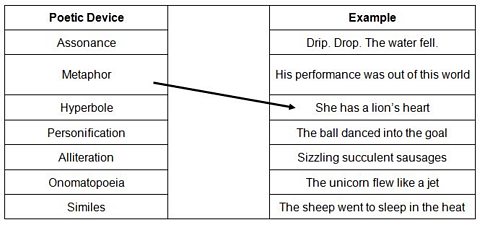
Can you match the different types of figurative language to the correct example? One has been done for you.
Top tip! Assonance is when a vowel sound is repeated in words close together. You might want to match this one up last.
Activity 2

Think about a familiar setting. It could be your classroom, the playground, the park, the supermarket or your home. Close your eyes and imagine you are there.
Now, write three examples of personification and three examples of onomatopoeia related to your setting.
Here are some examples about a garden:
| Personification | Onomatopoeia |
|---|---|
| The lights seemed to wink at each other. | Crunch (leaves) |
| The flowers danced in the wind. | Crash (bins) |
| The leaves chased each other into the gutter. | Splash (rain) |
Challenge:
Can you write a sentence using alliteration related to your chosen setting.
For example: The hungry, hedgehog hovered and hesitated near the plant pots.
Play our fun English game Crystal Explorers! game
Use grammar, punctuation and spelling skills to explore jungles, caves and tombs on your mission.

More on Poems
Find out more by working through a topic
- count3 of 4

- count4 of 4

- count1 of 4