What is intonation?

When we read something out loud we need to make it sound interesting to keep the listener’s attention.
We can do this by speaking with intonation.
This means saying the words in an expressive, lively way to bring what you’re reading to life.
Watch: Intonation
Watch Mr McPartlin give his top tips about reading aloud with intonation.
Hello, I'm Mr McPartlin.
And today we're going to find out about intonation.
If I read like this with my voice all at one note, you will soon lose interest.
It's boring.
Dull.
You are not a robot.
So, why read like one?
Reading in a lively, interesting and natural way is all down to your intonation.
That's the rise and fall in your tone of voice.
When you read out loud, it's good to use your voice expressively, like I'm doing now.
It gives life to what you read and makes it interesting for your listeners.
It helps them understand and picture what is on the page.
But how do you read expressively?
And are there any tips or tricks?
Absolutely.
When we start a new sentence, we usually begin on a slightly higher note and then on a slightly lower one.
And if we ask a question, our tone of voice usually rises a little at the end of the sentence.
Doesn't it?
Let's practice.
Start on a slightly higher note and end on a slightly lower one.
Try copying my intonation.
Let's say it together.
Start on a slightly higher note and end on a slightly lower one.
Now, listen to me reading the sentence.
With a question, your tone of voice gets a little higher at the end, doesn't it?
And now let's read the sentence together.
Try copying me.
With a question, your tone of voice gets a little higher at the end, doesn't it?
Excellent!
But question marks aren't the only clues to how to read a sentence expressively.
There are plenty more helpful hints hidden.
Let's check them out.
Punctuation gives you clues for what to do with your voice.
If there's an exclamation mark coming up, you end the sentence forcefully, whether that would be with excitement, terror or anger.
It all depends on what the sentence says.
If you spot a comma, it's telling you to pause for a moment before carrying on.
And if you spot an ellipsis… three dots in a row, that tells you to slowly let your voice trail away like this.
And leave a pause before you start speaking again.
Let's put it all together.
Next up is a section of a story.
Your job?
To transform it into a thrilling story with lively intonation.
Let's take a look at the punctuation first.
There are commas, ellipses, an exclamation mark and a question mark in the text.
All of which help tell where and how to be expressive.
Ready to read the section aloud?
Excellent.
Good luck!
And remember, you can pause the video if you'd like more time.
Finished your reading out loud?
Excellent.
It's an exhilarating moment, isn't it?
Let's read together.
This time I'm going to join in with you.
I promise I won't be a robot.
Here we go.
Slowly, slowly, the snow began to fall.
Bright stars glittered.
Like tiny diamonds in the dark blue sky.
Jay listened.
What was that?
Something was coming; the soft pad of wild paws, getting closer…
and closer…
and closer…
And then, by the trees, he saw it.
A wolf!
Well done!
You really brought the words to life.
So, whether you're reading to your friend, classmate, dog or teddy,do it as expressively as you can.
Look out for punctuation marks and remember to take your time.
Take a breath at the full stops and wait a moment when you come…to a blank line between paragraphs.
That gives your listeners time to take in what you've read.
And it creates suspense, excitement about what will happen next.
Well done, everyone.
That was fun.
Exclamation marks, commas.
For more help, challenges and games on this subject, visit bbc.co.uk/bitesize.
Punctuation marks
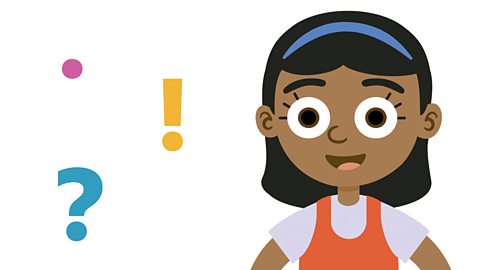
When we start a new sentence we usually begin on a slightly higher note and end on a slightly lower one.
Punctuation marks give you clues about what to do with your voice.
Take a breath at full-stops and wait a moment when you come to a blank line between paragraphs.
With a question mark our tone of voice usually rises a little at the end of the sentence.
For an exclamation mark you end the sentence forcefully – whether that be with excitement, terror or anger!
With a comma take a little pause before carrying on.
For an ellipsis (…) let your voice slowly trail away and take a longer pause before starting again.
Watch: Reading with expression
Now watch this video in which The Worst Witch's Mildred Hubble sings a song about using feeling and emotion when reading aloud.
Learn how to read aloud expressively with Mildred Hubble.
Activity 1
Go back to the Teacher Talks video at the start of the lesson and watch from 2.50 onwards.
Mr McPartlin asks you to read a passage from a story about a wolf using lively intonation.
Pause the video at 3.21 and practise saying the passage out loud.
Use the punctuation to show you what to do with your voice and when to pause.
Then try reading the passage along with Mr McPartlin. Can you match his intonation?
Activity 2
Using emotion is a great way to give intonation to your reading.
Read each sentence below out loud using the emotion that is mentioned.
Also use the punctuation to show you what to do with your voice and when you need to pause.
If you can, read each sentence to someone at home and see if they can guess the emotion you are trying to show in your voice.
Angry:I don’t want to go to bed. I’m not tired!
Happy:My favourite thing is cuddling up with my dog on the couch.
Tired:I couldn’t get out of bed this morning. I only got three hours sleep last night.
Frightened:What was that noise… could it be a ghost?
Excited:I can’t wait as tomorrow I am going to the beach, getting ice cream and swimming in the sea!
Play our fun English game Crystal Explorers! game
Use grammar, punctuation and spelling skills to explore jungles, caves and tombs on your mission.

More on Comprehension
Find out more by working through a topic
- count4 of 6
- count5 of 6
- count6 of 6
- count1 of 6