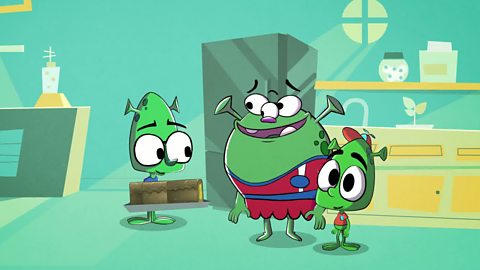
Snoot, Fin and Plimble use fractions, decimals and percentages when fueling their saucer.
NARRATOR: Hello Snoot.
Hello Fin.
Hello cousin Plimble.
PLIMBLE: Plimble!
NARRATOR: What are you up to?
SNOOT: (ALIEN LANGUAGE)
NARRATOR: Mixing up some nitroplasm for your flying saucer?
It looks like powerful stuff.
How much nitroplasm do you have?
SNOOT: (ALIEN LANGUAGE)
NARRATOR: I see.
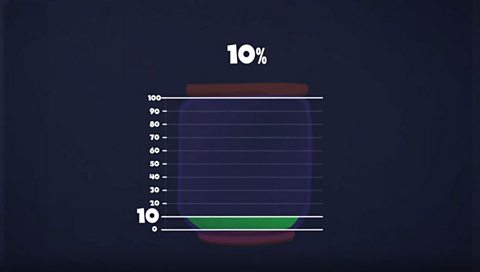
Your drum of nitroplasm holds 100 blompules and the fuel tank on your flying saucer holds 10 blompules.
So how much of the drum do you need to use to fill up the tank?
SNOOT: (ALIEN LANGUAGE)
NARRATOR: That’s right Snoot, 10 per cent.
10 out of 100 is exactly 10 per cent of the drum.
FIN: (ALIEN LANGUAGE)
NARRATOR: What’s that Fin?
Oh, I see.
There’s a rule that goes up the side of the drum that marks the amount in tenths.
10 is exactly one tenth of 100, so you’ll need to use one tenth of the drum.
PLIMBLE: Plimble!
NARRATOR: Have you got another idea Plimble?
Ah…
Your laser tape measure says you need to use exactly 0.1 of the drum to fill your tank.
Well, if that’s what the tape measure says…
ALL: (ALIEN LANGUAGE)
NARRATOR: OK, no need to argue – you’re all right!
10 out of a hundred can be described as 10 per cent as a percentage, one tenth as a fraction and as 0.1 as a decimal fraction.
They all mean exactly the same thing!
ALL: Aha!
NARRATOR: OK, let’s add the nitroplasm.
Just one thing…
Does your flying saucer actually take nitroplasm?
(BANG!)
NARRATOR: Ah… I guess that’s a no.
What are percentages?
Per means out of. You might have seen cent as part of centimetre. A centimetre is one hundredth of a metre.
Percent means out of 100 and percentages are shown with the symbol %.
For example 10% is 10 out of 100.
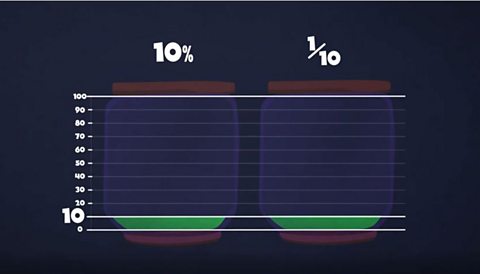
Percentages are a bit like fractions with the number of percent on top and 100 underneath.
So 10% is the same as ¹⁰⁄₁₀₀.
You can sometimes make fractions easier to work with by dividing top and bottom by the same number.
10 and 100 both divide by 10, so ¹⁰⁄₁₀₀ = ¹⁄₁₀. That means 10% = ¹⁄₁₀
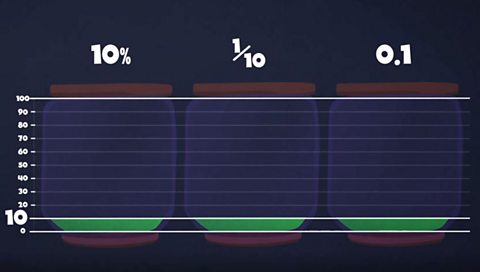
Decimals (or decimal fractions) are written using numbers and a dot.
Numbers to the left of the dot are whole numbers.
In 1.0 the 1 just means one.
Numbers to the right of the dot are parts (or fractions) of a number.
Numbers one space to the right of the dot are tenths.
For example:
0.1 is the same as ¹⁄₁₀
0.3 is the same as ³⁄₁₀
Numbers two spaces to the right of the dot are hundredths.
For example:
0.01 is the same as ¹⁄₁₀₀
0.07 is the same as ⁷/₁₀₀
More on Fractions
Find out more by working through a topic
- count5 of 5
- count1 of 5
- count2 of 5
- count3 of 5