What is structure?

Most music is made up of different sections. Individual sections can be identified by The different related musical ingredients that make a piece of music. Can include rhythm, melody, harmony, dynamics, texture, timbre and structure. of the music such as their Different pitched notes played one after another making a tune., The combination of voices or pitches together. and even The words to a song. .
Structure is the order that different sections of a song or piece of music are played in.
Certain structures were used in different musical periods. Certain styles of music can follow a particular structure too.
Structure is important because it gives shape and balance to the music.
What is ternary form?
Ternary form means music that is made up of three sections. It's sometimes called song form.
Musicians and composers started using it over 300 years ago, particularly in dances during the Term used to describe the period in Western music from around 1600 to 1750..
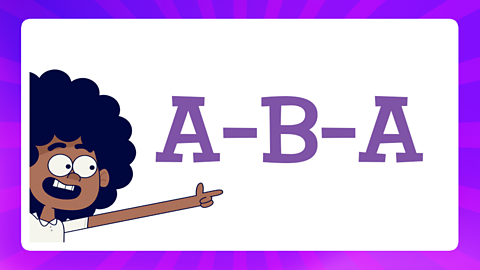
A simple ternary form will have:
- a section A
- followed by a new section B
- then back to section A again
Watch: Explore ternary form
Mr Smith: A simple ternary form would have a section A, a section B and then it would repeat section A again.
Mwaksy: But why wouldn’t you have a different third section. Section C for example.
Mr Smith: Well, let’s listen to a ternary form in action with a nice simple rhyme to see why it works so well. Do you know twinkle twinkle little star?
Mwaksy: Yeah, i know it.
Mr Smith: Oh brilliant well please play us the first section of that song. You can watch the notes appears on the staves as Mwaksy plays.
Mwaksy: Okay.
SINGSTwinkle twinkle little star,How i wonder what you are.
Mr Smith: Brilliant, very good. Now that will become our section A. Okay, can we have our next section please.
Mwaksy: Okay
SINGSUp above the world so high,Like a diamond in the sky.
Mr Smith: Oh, i like it. Very good. And we can see from the stave the notes you were playing are different.
Mwaksy: Hmm yeah that’s a different pattern, and the words were different too.
Mr Smith: Yeah, exactly. So now that can become our section B. and now of course we just need to finish of the song so do you remember what comes next?
Mwaksy: Isn’t it just.
SINGSTwinkle twinkle little star,How i wonder what you are.
Mwaksy: I’ve jsut repeated section A.
Mr Smith: Yeah that’s right. The start and end of the song are exactly the same, with the same notes and lyrics.
Mwaksy: And this is ternary form where it goes A,B,A?
Mr Smith: Yes, that’s it. Now I like to imagine music forms using cars by focusing on their colours. To help me remember ternary form I just think of a red car, then a blue car, and then a red car.
A, B, A.
Mwaksy: Oooh, I like that.
What is rondo form?
Rondo form is another musical form.
Like above, we can use letters to describe the different sections of a piece of music in rondo form.
Rondo form can have different designs but will always repeat the main section (A).
A common rondo form:
- begins with a section A
- followed by a new section B
- back to section A
- then a new section C
- back to A again and so on
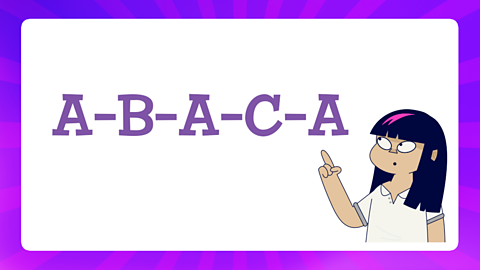

Rondo form was particularly used by musicians in the Term used to describe the period in Western music from around 1750 - 1820. in pieces of music like a A long piece of music for an orchestra, or A piece of classical music that features a solo instrument which is accompanied by an orchestra..
One of the most famous uses of ABACArondo form is by Beethoven in 'Fur Elise'.
Watch: Explore rondo form
Mr Smith: Rondo form just like ternary form we can use letters to show the different sections of rondo form. Now i’ve written the pattern of rondo form on this board, but I want to see if you can work it out for yourself using these cars.
Mwaksy: Mr Smith how are these cars going to help me? There not exactly musical.
Mr Smith: Now well the cars show the different sections of rondo form, start from this side and then when there is a new colour give it a new letter. Remember if it’s the same colour, it gets the same letter.
Mwaksy: So, we’ve got a red car, thats section A?
Mr Smith: Yep.
Mwaksy: Okay then there’s a blue car that’s section B.
Mr Smith: Got it.
Mwaksy: Ooh, red car that’s section C. Wait we have already had a red car, ooh so that’s the section A.
Mr Smith: You’ve got it, thats right. Good, okay then after that one.
Mwaksy: Okay, this orange car is new though, so that’s section C?
Mr Smith: Ah, yep great work.
Mwaksy: Red car again another seciton A? Now the yellow car is new as well so that must be section D?
Mr Smith: Yeah, you are good at this. And to finish it of.
Mwaksy: It’s the red car so section A again?
Mr Smith: You got it.
Mwaksy: Yay, it’s A, B, A, C, A, D, A.
Mr Smith: Let’s take a look to see if it matches up.
Mwaksy: Yeah.
Mr Smith: It’s rondo form. A, B, A, C, A, D, A. Brilliant well done Mwaksy.
How to identify the structure
To work out the structure of a piece of music you need to identify the different sections.
To do this, you can:
- Look for sections that are repeated and you are able to work out a pattern (like in ternary or rondo form).
- Identify sections because they have the same or a different melody.
- Listen for words that are repeated such as the chorus in a song.
- Identify sections that have the same sequence of chords.
Activities
Play BBC Bitesize educational games! game
Fun, interactive games for children aged 4-11, with maths, English, science, history and many more subjects.

More on Playing and Performing
Find out more by working through a topic
- count8 of 12

- count9 of 12

- count10 of 12

- count11 of 12