What are tones?
Tones are a key part of pinyin, which was invented to help those learning Mandarin with pronunciation.
Tones with Burt Bessington
Burt: Hello and welcome to Totally Tones!
Can you tell me the first tone in Mandarin?
Boy:(Bored) What?
Burt: Correct! The first tone is flat.
(Flat tone) What. What.
You're a natural! Now what's the second tone?
Boy:(Rising tone) Whaaat?
Burt: Correct again! Totally tone-tastic! The second tone is rising.
(Rising tone) Whaaat? Whaaat?
All we need now is the third tone and you and your family will be heading home with this 1975 collection of encyclopedias.
Boy:(Dipping tone) Whaa-at?
Burt: Correct again! The third tone goes down and then up!
(Dipping tone) Whaa-at? Whaa-at?
Now if you can just sign here, here and here with a deposit of £499.99 the prize will be yours.
Boy:(Falling tone) WHAT!
Burt: I don't believe it! You just answered this week's… HIDDEN QUESTION!
The fourth tone in Mandarin!
(Falling tone) What! What!
This tone falls. But you don't fall for anything do you?
Now, every Mandarin word has a tone and the tone you use determines the word you are saying. Like this - tū, tú, tǔ, tù.
Now, let's really put you to the test. Just tell me which tone I am using.
Burt: Tū.
Dad: Flat.
Burt: Tú.
Boy: Rising!
Burt: Tǔ.
Dad: Down then up!
Burt: Tù.
Both: Falling!
Burt: Wow you did it! Congratulations! See you next time!
How many tones are there?
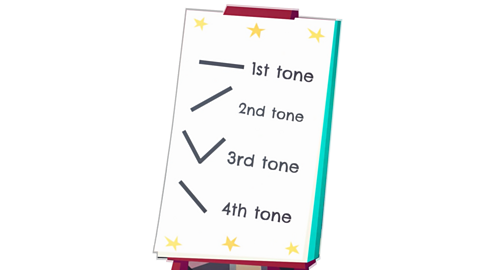
There are four tones in Mandarin, plus a neutral tone:
The first tone (-) is flat
The second tone (´) rises
The third tone (v) goes down then up
The fourth tone (`) falls
The neutral tone is light
The use of tones makes more sounds available in Mandarin, which has fewer than many other languages.
They are an essential part of how you say a word in Mandarin, and if you use the wrong tone you end up saying a completely different word from the one you meant.
For example:
妈mā (mother)
麻má (linen cloth)
马mǎ (horse)
骂mà (tell off)
吗ma (question particle)
You can hear how those tones affect the sound: ma and what it means, below:
Exception rules
There are only three exceptions for how tones are said in Mandarin.
These help make the sounds flow better:
Rule one:
If there are two third tones in a row, the first third tone becomes a second tone, for example:
Check your connection, refresh the page and try again.nǐ (you) + Check your connection, refresh the page and try again.hǎo (good) = Check your connection, refresh the page and try again.ní hǎo (hello)
Rule two:
If Check your connection, refresh the page and try again.bù (not) comes before a fourth tone, Check your connection, refresh the page and try again.bù becomes a second tone, for example:
Check your connection, refresh the page and try again.bù (not) + Check your connection, refresh the page and try again.duì (correct) = Check your connection, refresh the page and try again.bú duì (wrong)
Rule three:
Check your connection, refresh the page and try again.Yī (one) is a first tone when alone, a second tone when it comes before a fourth tone and a fourth tone before any other tone, for example:
Check your connection, refresh the page and try again.yī (one) + Check your connection, refresh the page and try again.gè (measure word) = Check your connection, refresh the page and try again.yí gè (a or an)
Check your connection, refresh the page and try again.yī (one) + Check your connection, refresh the page and try again.bǎi (hundred) = Check your connection, refresh the page and try again.yì bǎi (one hundred)
This change of tone only affects the pronunciation of the words, not how they are written down.
For example, you would write ‘你好 nǐ hǎo’, but you would say Check your connection, refresh the page and try again.ní hǎo.
More on Language skills: Knowledge about language
Find out more by working through a topic
- count1 of 4

- count2 of 4

- count3 of 4