Calculating the angles
The three angles in a triangle add up to \(180^\circ\).
If two of the angles are known then the third can be calculated by following these steps:
- Add the two known angles together.
- Subtract the total from \(180^\circ\).
Example
Calculate the size of angle a.
Add the two known angles together\(60^\circ + 40^\circ = 100^\circ\)
Subtract the total from \(180^\circ\)
\(180^\circ – 100^\circ = 80^\circ\)
\(a = 80^\circ\)
Question
Calculate the size of angle x.
Answer
\(70^\circ + 60^\circ = 130^\circ\)
\(180^\circ – 130^\circ = 50^\circ\)
\(x = 50^\circ\)
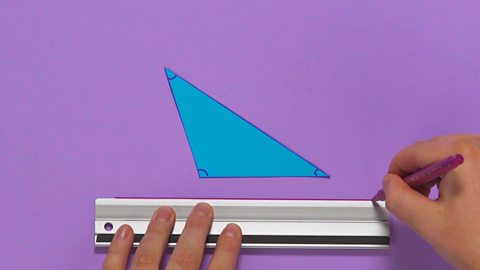
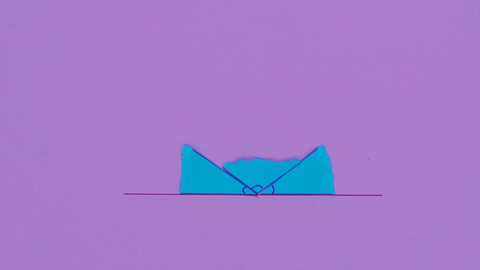
A short video on how to show the angles in a triangle add up to 180°.
Triangles up to 180 degrees slideshow

Image caption, Click to see a step-by-step slideshow.





1 of 8
Angles in equilateral triangles
The three angles in an equilateral triangle are equal and they add up to \(180^\circ\).
To find the size of each of these angles divide 180 by 3.
\(180 ÷ 3 = 60^\circ\)
Each angle in an equilateral triangle is \(60^\circ\).
Angles in isosceles triangles
Two of the angles in an isosceles triangle are equal.
Example
Calculate the size of angle p.
If the equal angles are known then the third can be calculated by following these steps:
- Add the two equal angles together.
- Subtract the total from \(180^\circ\)
Therefore:
Add the two equal angles together:\(70^\circ + 70^\circ = 140^\circ\)
Subtract the total from \(180^\circ\): \(180^\circ – 140^\circ = 40^\circ\)
\(p = 40^\circ\)
Example
Calculate the size of angles d and e.
If the equal angles are not known they can be calculated by following these steps:
- Subtract the known angle from \(180^\circ\).
- Divide the answer by 2.
Since the triangle is isosceles
d = e
- Subtract the known angle from \(180^\circ\)
\(180^\circ – 50^\circ = 130^\circ\)
- Divide the answer by 2.
\(130^\circ ÷ 2 = 65^\circ\)
\(d = 65^\circ\) and \(e = 65^\circ\)
Question
Calculate the size of the angle at S.
Answer
\(64^\circ + 64^\circ = 128^\circ\)
\(180^\circ – 128^\circ = 52^\circ\)
\(S = 52^\circ\)
Test section
Question 1
Calculate the size of angle x.
Answer
\(109^\circ + 32^\circ = 141^\circ\)
\(180^\circ - 141^\circ = 39^\circ\)
Angle x is \(39^\circ\)
Question 2
Calculate the size of angle C.
Answer
\(90^\circ + 25^\circ = 115^\circ\)
\(180^\circ – 115^\circ = 65^\circ\)
Angle C is \(65^\circ\)
Question 3
What is the size of each angle in an equilateral triangle?
a) \({45}^\circ\)
b) \({180}^\circ\)
c) \({60}^\circ\)
Answer
The correct answer is c) \({60}^\circ\).
Question 4
Calculate the size of the angle at A.
Answer
The correct answer is \({30}^\circ\)
More on Angles
Find out more by working through a topic
- count4 of 5
- count5 of 5
- count1 of 5
- count2 of 5