Causes of food instability
A long time ago, people started farming instead of hunting and gathering. This meant people needed more land to grow crops and raise animals. To get this land, they had to clear out forests, grasslands, and other natural places. They cut down trees and made fields to plant things like wheat, rice, and corn.
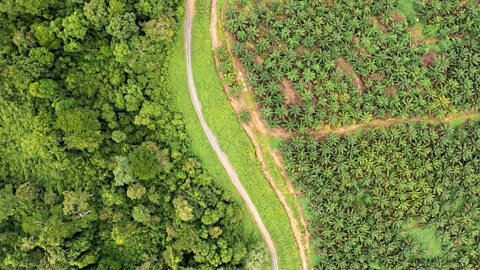
Today, almost half of the liveable land on Earth is used for growing food, which can damage the homes of animals and create problems for local plants.
In some places, the plants that naturally grow there are replaced with a Crops which are sold for profit.. Palm oil is an example of this. It's grown in huge quantities in the Amazon rainforest even though it's originally from western Africa, not South America. The tropical rainforest has been The removal of forests, often to make space for farming, industry, settlements, roads and use of wood as fuel. to make way for palm oil plantations, simply because this crop is more profitable than the native Amazonian trees.
The way we farm now can pollute water and damage the soil’s natural fertility, which makes it difficult to grow crops naturally. This means that sometimes farmers use artificial fertilisers and Chemicals used to kill pests. which can cause some animals and some plants to disappear from the landscape.
Video: Sustainable food
Most of us enjoy eating tasty food, but we might not always think about how what we eat affects the environment.
Early humans hunted and gathered their food.
They only got what they needed for each day, and they didn’t always eat breakfast, lunch and supper.
When we learned to farm, we started growing more food and began to store it for when it was needed.
Having extra food around meant more people could be fed and the population could grow.
Since then, the population has continued to grow and making food has become a huge industry.
Now, nearly half of all habitable land in the world is used for food production.
On every continent, the natural habitats animals and plants are cleared to make way for farming.
Food production also uses large amounts of water.
When food crops are grown in large quantities, they can damage or kill other plants.
This can then lead to the loss of wildlife, water pollution and a shortage of soil.
Vehicles that deliver food create greenhouse gases, which make climate change worse.
And livestock produce a lot of methane, which also impacts climate change.
In Wales there are many sustainable farms which help the environment by doing things like improving the soil and using technology to help reduce waste.
But when it comes to factory farming, producing 1kg of beef creates up to 100kg of greenhouse gases.
Whereas, in comparison, producing 1kg of peas only creates around 1kg of greenhouse gases.
So, while it might be tasty, the average burger has a big impact on the environment and we haven’t even looked at the problem of food waste.
Did you know that roughly a quarter of all food is wasted, either before it gets to us or because we throw it away?
All that wasted food ends up in landfills, which create methane, one of the greenhouse gases that makes climate change worse.
Luckily, organisations across Wales are working to make food production more sustainable.
Some help farmers make the switch to more sustainable methods of growing food.
Some groups share information about how food production affects the environment, and what we can do to improve things.
More and more people are learning about the impact of their food on the environment, and making changes to what they eat as a result.
By working together, we can help the environment, and enjoy good food too.
Activity: How has farming changed throughout history?
What problems can be created by unsustainable food production?
Unsustainable food production can cause a lot of problems for our planet. These problems not only affect the environment, including the landscape and animals, but also impact our ability to grow food in the future. So, it's important, if possible, to find methods that are better for the planet and for us.
| Impacts on society | Impacts on the environment |
|---|---|
| The quality of soil can be damaged (if overused) leading to reduced crop yields, affecting food availability and access for communities. | Transportation of food over long distances worsens climate change, due to the fact that vehicles that are used to transport food emit CO₂. |
| Pesticides and fertilisers used in the growing of crops can sometimes pose health hazards to farmworkers and nearby communities. | Clearing land for farming destroys natural habitats, leading to loss of biodiversity and disruption of ecosystems |
| Food waste can contribute to food insecurity, impacting vulnerable populations and leading to inequalities in levels of development between countries. | Intensive farming practices can occasionally To take away and reduce the amount of something. soil nutrients, degrade soil structure, and lead to The wearing away of pieces of rock, soil or other solid materials.. |
| Large-scale unsustainable farming operations may occasionally exploit labour, leading to poor working conditions and unfair wages for farmworkers. | Water that runs off from agricultural fields containing fertilisers and pesticides can contaminate water sources, harming A community of plants and animals that live in, on or near water.. |
| Methane from livestock and carbon dioxide from deforestation, contribute to global warming and climate change. |
Video: Sustainable food in action
Researchers think that food production is responsible for creating around a quarter of all the earth’s greenhouse gases.
These are the gases that make climate change worse.
Why is this happening, and what can we do to make things better?
Nearly half of all habitable land in the world is used for food production.
A lot of this land used to be home to natural wildlife.
And cows produce a lot of greenhouse gases like methane.
How?
Yeah, you guessed it.
By farting.
Vehicles also produce greenhouse gases when they deliver food.
Your food choices have an impact, but you can still eat tasty food and help the planet at the same time.
Lots of people are trying to change the food cows eat, to reduce how much they fart.
But you might want to think about eating less meat.
Could you go meat-free one day every week?
Could you talk to the adults in your life about how they could help?
You could ask them to consider buying more food that’s locally produced and in season where you live.
Buying more from zero waste shops would help cut down on all the unnecessary packaging on food.
Why not try to find out where your nearest shop is located?
What could your school do to help?
Could the canteen food be more environmentally friendly?
If so, how could things change?
Why not talk to the cafés and businesses in your local area about the type of food they sell and the packaging they use?
There are many good projects in Wales actively working on issues like sustainable farming and reducing food waste.
Why not see if there’s something going on in your area, and how you could get involved?
And finally, why not share what you’ve learned and what you’re doing with your friends and family?
That way, everyone’s next meal could be kinder to the environment.
Sustainable food production
Sustainable food production is necessary because it can help protect our environment, preserves biodiversity, support local communities, and ensure that we have enough healthy food to eat both now and in the future.
Organic farming involves farmers producing crops without artificial chemicals.
Crop rotation and diversification helps improve soil health, reduce pests and diseases, and enhance The variety of different plants and animals in an area..
Agroforestry integrates trees and shrubs into farm land, providing multiple benefits such as soil conservation and improved biodiversity of animal and plant life in the area.
Urban farming, allotments and community gardens utilises vacant A place within a city or town that is not built on, for example a roof top or a disused car park. for food production, promoting local food, community engagement, education and food security.
Fair trade and ethical farming practices ensures fair wages, safe working conditions, and sustainable livelihoods for farmers and workers, promoting social Fairness for everyone..
Activity: What can we do to make food more sustainable?
There is a lot being done to promote sustainability in the food industry but what can you do to help?
