What is a remainder?
Sometimes, it is not possible to divide one number by another exactly.
Anything left over that cannot be divided exactly is called a remainder.
When you are solving problems and there is a remainder, you need to know what to do with it.
Activity: What is division with remainders?
Complete this interactive activity to learn about division with remainders. Then put your knowledge to the test.
Division with remainders
When you divide, the numbers don't always divide exactly. Anything left over after dividing is called the remainder.
For example, look at this division calculation:
7 ÷ 2
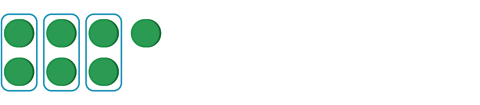
If you divide 7 by 2, you can make 3 groups of 2, which equals 6. However, there is 1 left over.
You would write it like this:
7 ÷ 2 = 3 r1
The 'r1' shows there is one left over.
When solving problems with division, you have to decide what to do with the remainder.
Sometimes you have to round the answer up to the next number. Sometimes you round down.
Which action you take depends on the problem that you've been given.
Look at this question.
'How many pairs can you make out of seven socks?'
As a calculation, this would be:
7 ÷ 2 =
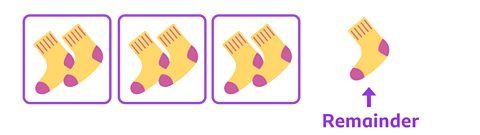
The answer would be 3. This is because you can't use the one left over sock, shown as the remainder, to make another pair!
Example 1

A train carriage can take up to 4 people. There are 9 friends who want to get on the train.
How many carriages will they need to use?
✓ They will need to use 3 carriages.
The calculation would be:
9 ÷ 4 = 2 r1
The remainder tells you that 1 person from the group will be sitting in the third carriage without their friends.

Example 2

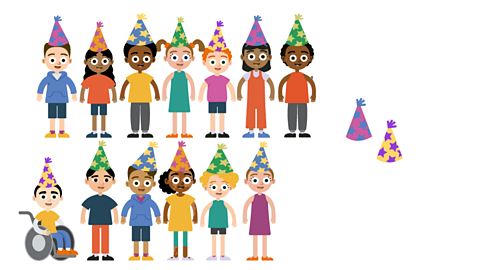
There are 13 children coming to your party and everyone needs a hat.
Party hats come in packets of 3.
How many packets do you need?
✓ You need 5 packets of hats.
The calculation is:
13 ÷ 3 = 4 r1
You can't leave one child without a hat, so you would need to have 5 packets of hats.
Example 3
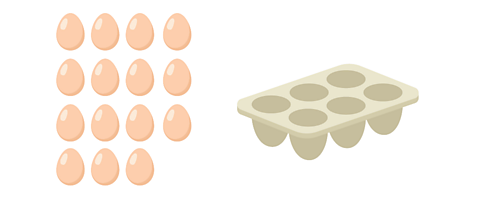
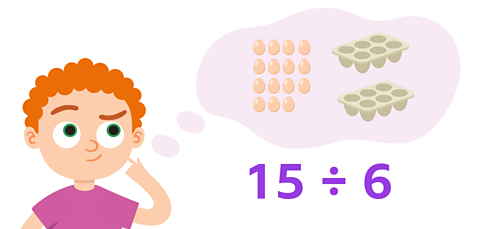
Eggs come in boxes of 6. A farmer has 15 eggs.
How many boxes can she fill completely?
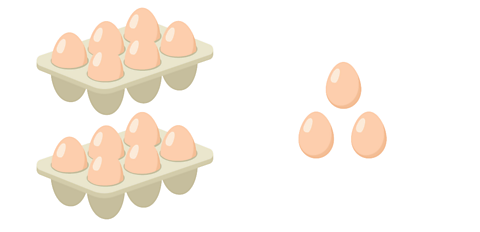
✓ She can fill 2 boxes completely.
The division calculation is:
15 ÷ 6 = 2 r3
The 3 eggs that are left cannot completely fill a box. There will be 3 spaces left without an egg.
So the number of complete boxes is just 2.
Play our fun maths game Guardians: Defenders of Mathematica. game
Use your times tables and more maths skills to defeat monsters and reclaim the Kingdom of Mathematica

More on Multiplying
Find out more by working through a topic
- count5 of 5
- count2 of 5

- count3 of 5