The present tense: How to talk about what you do in French
If you are doing something right now then that's the present tense…
Attends! J'ai un message - Wait! I have a message.
Où es-tu? - Where are you?
Je suis dans ma chambre - I'm in my bedroom.
Où es-tu? - Where are you?
Je fais is the present tense of the verb faire - 'to do' or 'to make':
je fais - I do, I am doing
tu fais - you do, you are doing
il fait - he does, he is doing
elle fait - she does, she is doing
Je fais mes devoirs. Qu'est-ce que tu fais? - I am doing my homework. What are you doing?
Je regarde les jeux vidéo des vloggers - I am watching vloggers play video games.
Je regarde is the present tense of regarder to watch.
Regarder is an -er verb and there are lots of -er verbs which follow the same pattern:
je regarde - I watch, I am watching
tu regardes - you watch, you are watching
il regarde - he watches, he is watching
elle regarde - she watches, she is watching
Je prends le bus - I'm taking the bus.
Je prends is the present tense of the verb prendre - to take:
je prends - I take, I am taking
tu prends - you take, you are taking
il prend - he takes, he is taking
elle prend - she takes, she is taking
Tu prends le bus? - Are you taking the bus?
Oui… je prends le bus - Yes, I am taking the bus.
There's nothing like living in the present.Allons-y! - Let's go!
When to use the present tense
You use the present tense to give facts, to talk about what you do on a regular basis, and to say what you are doing right now.
- Je mange une pomme - I am eating an apple OR I eat an apple.
- Tu vas au cinéma? - Do you go to the cinema? (on a regular basis) OR Are you going to the cinema (right now)?
- Il joue au hockey - He plays hockey OR He is playing hockey.
How to use regular -ER verbs in the present tense
Rule: Remove the -er from the end of the infinitive and add the appropriate ending for each pronoun.
Infinitives are the basic form of a verb, before any changes for tense or people are made - like jouer (to play) or vendre (to sell).
For example, jouer (to play):
| French pronoun | stem | ending | Example |
|---|---|---|---|
| je | jou | -e | je joue - I play |
| tu | jou | -es | tu joues - you play |
| il / elle | jou | -e | il / elle joue - he / she plays |
- Je joue au rugby le weekend, mais il joue au tennis - I play rugby at the weekend, but he plays tennis.
There are lots of other -ER verbs that follow the same rule:
- manger - to eat
- regarder - to watch
- écouter - to listen to
- habiter - to live
- aimer - to like
- parler - to speak
- détester - to hate
How to use regular -IR verbs in the present tense
Rule: Remove the -ir from the end of the infinitive and add the appropriate ending for each pronoun.
For example, finir (to finish):
| Pronoun | Stem | ending | Example |
|---|---|---|---|
| je | fin | -is | je finis - I finish |
| tu | fin | -is | te finis - you finish |
| il / elle | fin | -it | il / elle finit - he/she finishes |
- Je finis mes devoirs - I finish / am finishing my homework.
Regular -RE verbs in the present tense
Rule: Remove the -re from the end of the infinitive and add the appropriate ending for each pronoun.
For example, vendre (to sell):
| French pronoun | Stem | ending | Example |
|---|---|---|---|
| je | vend | -s | je vends - I sell |
| tu | vend | -s | tu vends - you sell |
| il / elle | vend | (no ending) | il / elle vend - he / she sells |
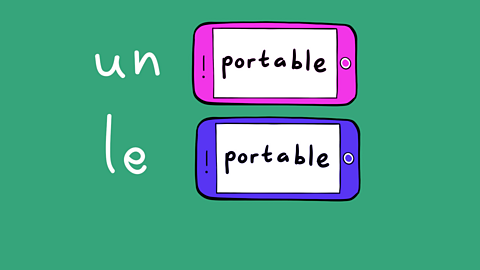
- Tu vends ton portable? - Are you selling your mobile phone?
Irregular verbs
Some common French verbs are irregular - such as avoir (to have) and être (to be) - which means they don’t have the same endings as regular verbs.
Here are some useful irregular verbs:
aller - to go
- je vais - I go
- tu vas - you go
- il / elle va - he / she goes
boire - to drink
- je bois - I drink
- tu bois - you drink
- il / elle boit - he / she drinks
faire - to do / make
- je fais - I make / do
- tu fais - you make / do
- il / elle fait - he / she makes / does
lire - to read
- je lis - I read
- tu lis - you read
- il / elle lit - he / she reads
Some verbs have regular endings, but you have to change an accent or double a consonant when you want to conjugate them in the present tense. Here are some examples of these types of verbs:
préférer - to prefer
- je préfère - I prefer
- tu préfères - you prefer
- il / elle préfère - he / she prefers
s’appeler - to be called
- je m’appelle - I am called
- tu t’appelles - you are called
- il / elle s’appelle - he / she is called
Quiz
Find out how much you know about the present tense in French with this short quiz.
Game - FestiLingo: French. game
Visit the festival and practise French language skills in this game

More on Grammar
Find out more by working through a topic
- count7 of 7

- count1 of 7
- count2 of 7