Adjectives: How to describe people, places and things in French
You're going to want to describe nouns in French.
J'ai un chien - I have a dog is nice but… J'ai un chien mignon - I have a cute dog… is better!
The first thing to notice is that adjectives in French usually go after the noun.
J'ai une porte verte - I have a green door.
The next thing to notice is that the adjective must agree with the noun.
Une porte is a feminine noun which means that the adjective vert has a feminine ending 'e'.
If you have more than one of something like deux lapins blancs - two white rabbits, lapins is plural. Which means that the adjective has to be plural too. blancs has an s at the end.
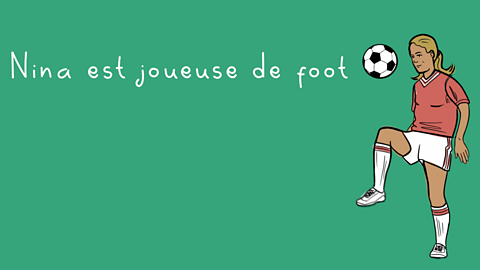
If you have more than one girl les filles then any adjective has to be feminine and plural.
So content adds an e and an s - les filles contentes - the happy girls. Usually adjectives in French come after the noun but there are a few that don't.
beau - beautiful, comes before the noun,
bon - good, un bon livre - a good book,
and grand and petit also go before the noun.
Ma petite sœur - My little sister.
Mon grand lit - My big bed.
Now where's my cute black dog? **Où est mon chien mignon et noir?**
What is an adjective?
Adjectives are describing words. They tell us more information about nouns, such as the colour, size, age, etc.
Examples of adjectives include:
| French | English |
|---|---|
| bleu | blue |
| grand | big |
| petit | small |
| nouveau | new |
| vieux | old |
Where do adjectives go in relation to nouns?
In French, adjectives usually go after the noun:
- J’ai un chat noir - I have a black cat.
- Mon père a les cheveux courts - My dad has short hair.
However, most of the BAGS adjectives go before the noun. BAGS stands for Beauty, Age, Goodness and Size.
| Beauty | Age | Goodness | Size |
|---|---|---|---|
| beau / belle (beautiful) | vieux / vieille (old) | bon / bonne (good) | grand(e) (big) |
| joli(e) (pretty) | nouveau / nouvelle (new) | mauvais(e) (bad) | petit(e) (small) |
For example:
- J’habite dans une grande maison - I live in a big house.
- Ma copine a une nouvelle tortue - My friend has a new tortoise.
How do adjectives ‘agree’ with the noun?
Most adjectives in French change depending on whether they are describing a masculine, feminine or plural noun. The usual endings are as follows:
| masculine singular | masculine plural | feminine singular | feminine plural |
|---|---|---|---|
| (no ending) | -s | -e | -es |
- J’ai un vélo vert - I have a green bike.
- Tu aimes les haricots verts? - Do you like green beans?
- Ma tante mange une pomme verte - My aunt is eating a green apple.
- Mon oncle aime les voitures vertes - My uncle likes green cars.
There are some exceptions to this rule, however:
| masculine singular | masculine plural | feminine singular | feminine plural |
|---|---|---|---|
| un jeune homme (a young man) | des jeunes hommes (some young men) | une jeune femme (a young woman) | des jeunes femmes (some young women) |
| un homme heureux (a happy man) | des hommes heur*eux * (some happy men) | une femme heureuse (a happy woman) | des femmes heureuses (some happy women) |
| un homme sportif (a sporty man) | des hommes sportifs (some sporty men) | une femme sportive (a sporty woman) | des femmes sportives (some sporty women) |
| un homme fier (a proud man) | des hommes fiers (some proud men) | une femme fière (a proud woman) | des femmes fières (some proud women) |
| un gentil garçon (a kind man) | des gentils garçons (some kind men) | une gentille femme (a kind woman) | des gentilles femmes (some kind women) |
Some of the BAGS adjectives are irregular:
| English | Masculine singular | Feminine singular | Masculine plural | Feminine plural |
|---|---|---|---|---|
| beautiful | beau, bel | belle | beaux | belles |
| old | vieux, vieil | vieille | vieux | vieilles |
| new | nouveau, nouvel | nouvelle | nouveaux | nouvelles |
Examples using BAGS
Beautiful
- Le bel homme - The handsome man.
- Le beau chien - The beautiful dog.
- La belle maison - The beautiful house.
Old
- La vieille maison - The old house.
- Un vieux vélo - An old bike.
New
- La nouvelle maison - The new house.
- Un nouveau cinéma - A new cinema.
Nouveau, vieux and beau become nouvel, vieil and bel when used to describe a masculine noun that starts with a vowel or an ‘h’:
- Un nouvel ami - A new friend.
- Un vieil homme - An old man.
- Un bel appartement - A nice flat.
Quiz
Find out how much you know about adjectives in French in this short quiz.
Game - FestiLingo: French. game
Visit the festival and practise French language skills in this game

More on Grammar
Find out more by working through a topic
- count3 of 7
- count4 of 7