Being safe
When cutting wood, it is important to be safe and accurate.
To stay safe, the correct technique must be used when using cutting tools.
A technique is a way of carrying out a particular task.
To be accurate, measuring tools can be used to make things the right size and shape.
Video: Cutting wood safely
Join Fran, Emma and Richard as they learn how to be safe when cutting wood.
Fran: Hello I'm Fran and I'm in my workshop with Richard and Emma. We've got some different shapes and sizes of wood, which we are learning how to cut safely.
First things first, we all need to wear safety goggles! Now what do we need to get started?
Richard: We have a junior hacksaw to cut out the wood, a ruler to measure out where we're going to cut and a pencil to mark it.
Emma: We'll use this this G-clamp to hold the bench hook in place while we cut the wood.
Fran: Using a junior hacksaw can be dangerous and an adult should always supervise. Preparation is, of course, important to make sure we can cut wood safely. Start with a tidy workspace, and make sure that everything you need is close by.
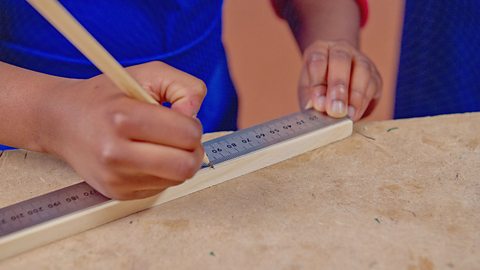
Richard: To make sure we cut the right length, I'll measure the wood and mark it with a pencil.
Emma: The pencil line is really useful, because I can see where we need to cut and I can line it up.
Fran: Good point!
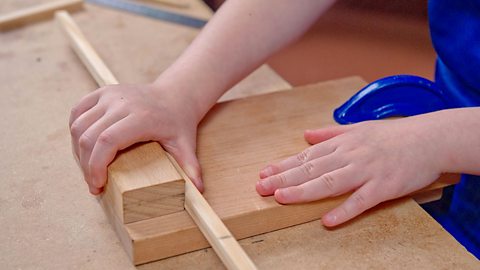
Fran: Now it is ready for me to clamp the bench hook into place. And once the bench hook is secure, you can hold the wood with your non-writing hand. The wood shouldn't move because it rests up against the bench hook.
Remember, the end of the wood that you are sawing will come out of the bench hook at a different side depending on whether you use your left hand or your right hand to saw with. For safety, an adult should always check it's secure.
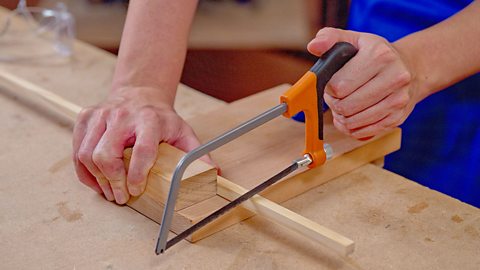
Fran: And this is good! Now take your saw in your writing hand. The saw should always point downwards. Hold the wood firmly inplace. Keeping the saw straight and upright, then pull the blade back slowly for the first few cuts, remove and re-set.
You only need to apply gentle pressure, let the saw do the work. And make sure that you're in a good position like this, looking down on where you're cutting. This helps you to get a straight cut safely. Remember to keep your other hand out of the way.
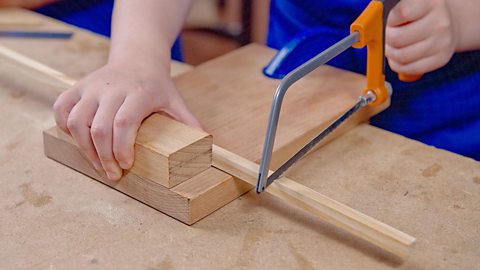
Once I have an indentation, I can start to push the saw backwards and forwards, working in a slow and steady rhythm. Continue thismotion until all the wood is cut, to avoid getting splinters towards the bottom.
Richard: Work slowly, saw pointing downwards. Pull back the blade. Remove and re-set. It doesn't take much pressure at all.
Fran: It's easy if you take your time, that stops the saw getting stuck. Be careful not to blow the sawdust as it can float in the air and go into people's eyes.
Fran: Now, remember these tips next time you're cutting wood and don't forget to tidy your tools safely away when you're finished.
Equipment
Let's look at some important equipment you need to cut wood safely.
G-clamps and bench hooks
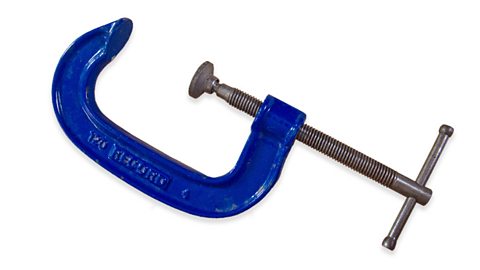
To help hold the wood while it's being cut, a bench hook and a G-clamp can be used.
A bench hook is a wooden block that hooks onto the edge of a bench or table and is used to rest wood on.
A G-clamp is always used to help hold a bench hook securely in place.
If a bench hook is not held in place by a G-clamp it could slide around. This would be unsafe when using sharp tools to cut wood.
Saws
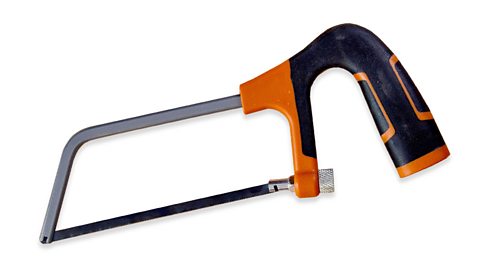
A saw is a tool that is used to cut wood. There are lots of different saws that can be used for cutting wood.
A junior hacksaw is a type of saw which is often used because it:
- is small.
- has a blade with small teeth for safety.
- cuts small pieces of wood easily.
Quiz: Woodworking tools
Can you name these different tools used to cut wood?
Measuring and marking
Wood can be cut to different sizes, lengths and shapes.
When drawing on or 'marking out' wood, always use a pencil to make sure any marks can be rubbed out.
Rulers can be used to measure lengths of wood, shapes and angles.
It can also be helpful to create a template before you start cutting. This is often made from a piece of paper cut into the shape of the required piece of wood.
Getting ready to cut
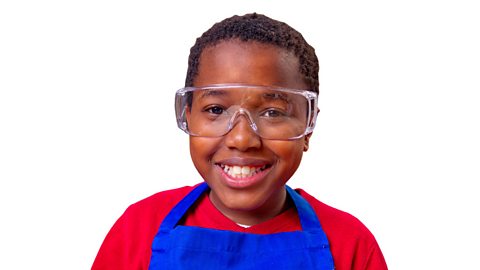
Wear safety googles to protect your eyes and roll your sleeves up to help protect your clothing from damage.
Tie up your hair if it is long and remove any loose clothing which may also get caught when sawing.
Collect all the equipment you need for the task and keep it nearby.
Keep your workspace tidy and organised.
Cutting
When all the tools are set up and the wood being cut has been marked and measured, the next job is to start cutting.
Following this clear technique, or set of steps, when cutting will help produce an accurate cut and help everyone stay safe.
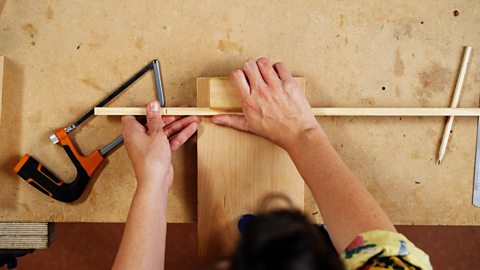
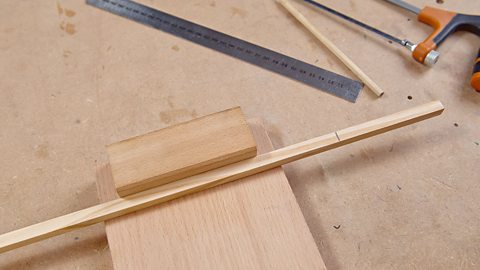
Image caption, Step 1
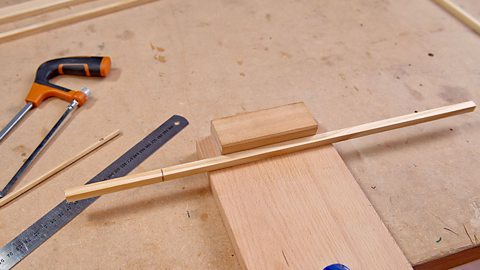
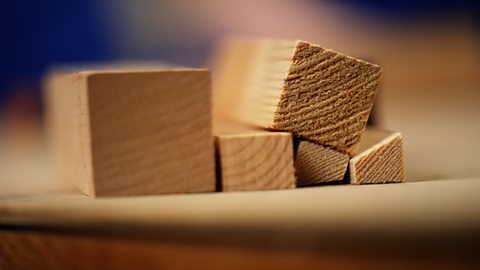
Place the wood to be cut on the bench hook and push it up against the back rest. Make sure the cutting mark, drawn in pencil, is lined up with the edge of the bench hook.
1 of 7
Key words
| Accurate | A way that is correct, exact and without mistakes. |
| Bench hook | A tool used when woodworking to help rest and hold objects against when they are being cut. It is held in place using a g-clamp. |
| G-clamp | A tool used to hold objects securely. It is often used to hold a bench hook to a table or to hold pieces of glued material in place as they dry. |
| Junior hacksaw | A small saw used to cut materials such as metal, plastic, and wood. |
| Technique | A way of carrying out a particular task. Sometimes this can include following a series of steps in order. |
| Template | A shaped piece of material used to measure and copy when cutting. |
Quiz
Take this quiz to find out what you know about safe woodworking.
More on Structures
Find out more by working through a topic
- count5 of 5
- count1 of 5

- count2 of 5
- count3 of 5