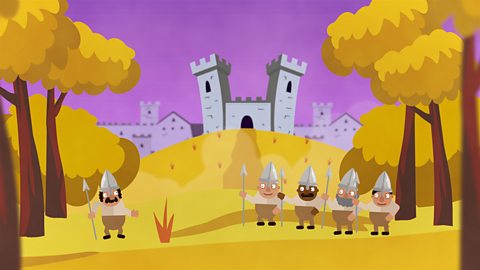
NARRATOR: Free biscuits? Who will fall for that?
When we talk about things that haven’t happened yet we call it the future tense.
We often use the word ‘will’ in front of a verb. Looks like you ‘will’ be sticky.
Seriously? You really do fall for everything.
When something is happening now we use the present tense. Now he ‘is’ sticky.
Sentences that describe something that’s already happened and use words like ‘was’, are in the past tense. He ‘was’ sticky.
Every verb has a past, present and future tense form; ‘licked’, ‘licking’ and ‘will lick’.
Oh hey! No don’t you even think about….
MONSTER LICKS
NARRATOR: Oh, yuck!
Past, present or future?
When you are writing, you can use words that show if the events have already happened, are happening now or will happen in the future.
- The past tense is used for things that have already happened.
'He was sticky.'
- The present tense is used when something is happening now or when something happens regularly.
'He is sticky.'
- The future tense is used to talk about things that haven't happened yet.
'He will be sticky.'
More on Grammar
Find out more by working through a topic
- count1 of 11
- count2 of 11
- count3 of 11
- count4 of 11