Introduction to how to use evidence from a text
- Use evidence from a text to prove your point.
- Select relevant and direct quotations to support your idea.
- Expand on your idea and explain the meaning of the quotation.
Learn how to support your points with direct quotations or examples from a text
[Typewriter bell]
MALE 1: When writing essays, it’s important to use evidence from a text to support your argument.
MALE 2: The Art of Being Normal by Lisa Williamson. It tells the story of David Piper, an outcast at school who would like to be invisible but finds that more than a little difficult. Let’s look at an excerpt.
[Serious music]
"Harry walks around me in a slow circle. I can feel my heartbeat speed up. He stops behind me, his body pressed up against mine, his chin resting on my shoulder. I can feel his breath warm on my cheek.
'Apologise to my girlfriend,' he growls in my ear.
I consider my options."
MALE 1: So, how would you describe the relationship between David and Harry?
MALE 2: I wouldn’t say they’re friends.
MALE 1: No. In fact, I’d say they are enemies.
MALE 2: I think you’re right, but how can we demonstrate that to the readers?
BOTH: Evidence.
MALE 1: You’ll need evidence to support your argument that Harry and David are enemies.
MALE 2: For example: "Harry walks around me in a slow circle. I can feel my heartbeat speed up." Aside from exercise, nervousness or fear are most likely to raise a heart rate.
MALE 1: And circling is something predators do.
MALE 2: So, David is scared of Harry.
MALE 1: The writer also says that Harry growls in David’s ear. Further likening Harry to an animal.
MALE 2: And an angry one.
MALE 1: By taking these pieces of evidence directly from the text, we are using them as quotations.
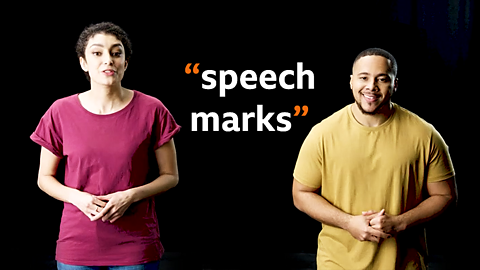
MALE 2: When you quote a small section of the text in your essay, you need to put speech marks around the words, so readers can tell what is your own writing and what is the quotation.
MALE 1: The quotation you select should support your argument.
MALE 2: You may want to write: "David likens Harry to an angry animal by saying, 'He growls in my ear'. This suggests David sees Harry as a dangerous threat."
MALE 1: So, to support your argument in your essay, you need to use evidence in the form of quotations from the text.
MALE 2: And remember to put speech marks around quotes taken directly from the text.
MALE 1: So, now that we’ve proven, with evidence, that we’re enemies, shall we get back to it?
MALE 2: Really? I actually quite like you.
How do I start?
- Look at the question you are being asked and it will help give you a clue about what to look for in the text. Our example question is “How would you describe the relationship between David and Harry in The Art of Being Normal?” so we know we need to look for clues about how David and Harry behave towards each other.
- Read the extract carefully to look for helpful words and phrases. Be detailed – even an individual word can give you a lot of information about the way someone talks or acts.
- If you find something you think is worthwhile, underline it so you know what to quote, and then make a note next to it of how you think it shows you something relevant to the question.
Look at our example notes below:
Harry Circling him like a predator me in a Taking his time, not rushing – this contrasts with David’s heartbeat going faster. They don’t feel the same, aren’t close circle.
I can feel my Indicates fear – David is scared of Harry .
He stops Scary – can’t see what he’s doing me, Harry has no respect for David’s personal space
Harry has no respect for David’s personal space
I can feel his breath warm on my cheek.
‘This is an order – he isn’t asking, he’s telling him what to do. Harry is controlling, possibly bullying David.,’ he Like a dangerous animal about to attack – fits with him circling like a predator in my ear.
I consider my options.
– The Art of Being Normal
- You now have notes related to the question and quotes to back them up. You can use these to make a point about David and Harry’s relationship, quote the evidence to support it and explain it so the reader understands exactly how you’ve figured out what the author was doing. You can even pair up notes you find to be similar to make a stronger point.
Here’s an example:
Harry shows he has no respect for David’s personal space; David says “his body pressed up against mine” which sounds uncomfortably close . He also stands “behind” him, meaning David can’t see him or what he’s doing, which is threatening behaviour. This plus the way he tells him what to do instead of asking politely – “Apologise to my girlfriend” – shows that Harry is menacing and aggressive to David and not friendly at all, helping us see their relationship is not a good one.
- BOLD shows points (things we noticed that directly relate to the question)
- ITALIC sections are quotes being used as evidence to support the points
- ITALIC BOLD text shows additional explanation so we can make clear links between what we noticed in our notes and what the question is asking us
Using evidence

When writing about a text, whether looking at character, atmosphere, setting or narrative voice, it is important to support your ideas with evidence from the text. You need to show how you have arrived at your point of view.
It is useful to use evidence to prove a point, rather than having to explain the meaning of a quotation. One way to do this is to embed a quotation in a sentence. Place the words from the text into your writing and put quotation marks around them to show they are not your own words.
Using quotation marks also helps the reader quickly see the evidence you have used. When you quote the exact words from the original writer, it is called a direct quotation. The below example demonstrates how you might use evidence from The Art of Being Normal by Lisa Williamson:
David likens Harry to an angry animal by saying, ‘He growls in my ear.’ This suggests David sees Harry as a dangerous threat.
Remember, evidence is your proof. It shows the reader how you have developed your viewpoint and that you have understood what a writer is trying to show you.
Selecting relevant quotations

Before selecting a quotation to prove a point, think about what makes it relevant. A relevant quotation demonstrates your idea - it should be closely connected to the point you are making.
In Trash by Andy Mulligan, sections of the story are narrated by the character Raphael, who lives on a rubbish dump in the Philippines. He needs to be smart and resourceful to survive. When you think about his character you might conclude that he seems sneaky, or devious, at times.
One way to show this is to select part of the text to support your ideas:
Raphael seems sneaky because he took a map of the city and ‘slipped it down’ his shorts rather than share his find with others.
Using the direct quotation, ‘slipped it down’ shows that you have looked at part of the text and used it to form a view of the character.
If we use another example from The Art of Being Normal by Lisa Williamson you might say:
Harry is threatening and intimidating. When talking to David he ‘growls’ at him to show that David is inferior and weaker.
Both examples of direct quotation help to demonstrate an interpretation of the text.
Expanding on your idea
After you have used evidence to prove your point, move on and expand your idea further. This doesn’t just involve explaining what the quotation means - it involves developing your first point.
When looking at Harry Potter and the Chamber of Secrets by J.K. Rowling you could make the point that Harry is not ‘a normal boy’ using a long quotation:
Rowling reveals Harry’s past when she says, ‘Harry Potter wasn’t a normal boy. As a matter of fact, he was as not normal as it is possible to be.’ Repetition of ‘normal’ emphasises his difference from other children.
Notice that the quotation marks are used again in the second sentence to show that ‘normal’ is another quotation.
By using evidence to expand and develop your points you show a more thorough understanding of the writer’s intention.
Where next?
Discover more from around Bitesize.
How to structure and punctuate direct speech in fiction. revision-guide
KS3 English with media
How to understand unfamiliar vocabulary
KS3 English

More from KS3 English with media. collection
BBC Bitesize

More on Critical reading
Find out more by working through a topic
- count1 of 4

- count3 of 4