What are scale factors?
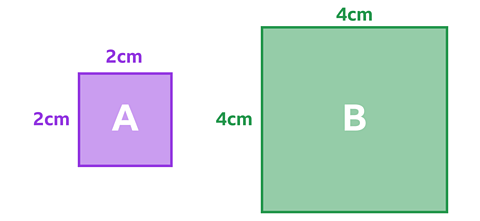
Scale factors describe how much a shape has been enlarged (made larger).
Enlarging by a scale factor of 2 means that each side of the shape has been multiplied by 2.
All the sides double in length and the shape will be twice as large.
In the image below the purple square A has been enlarged by a scale factor of 2 to make the green square B.
Quiz: Scale factors
Put your knowledge of scale factors to the test with this quiz. Then complete the rest of the page and see if you can beat your score.
Enlarging by a scale factor using grids
Using a grid can help you understand scale factors. It makes it easier to see how much a shape grows when you enlarge it.
Here is a rectangle.
It has a width of 2 squares and a length of 4 squares.

If you wanted to make the rectangle twice the size, you would multiply the width by 2 and the length by 2.
For the width calculate:
2 squares × 2 = 4 squares
For the length calculate:
4 squares × 2 = 8 squares
Here is the enlarged rectangle.
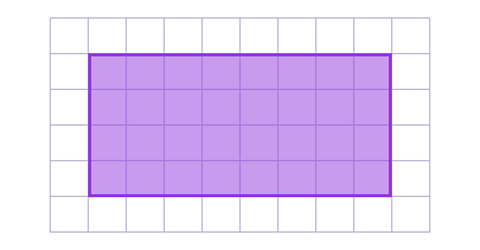
This rectangle has a width of 4 squares and a length of 8 squares.
The shape has been enlarged by a scale factor of 2.
You could also say that the rectangle has doubled in size.
Enlarging by a scale factor using multiplication
Here is a triangle.
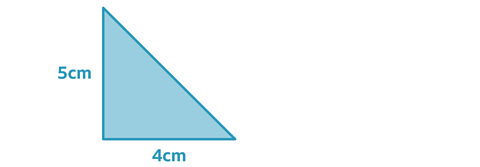
To enlarge it by a scale factor of 3, you need to multiply the dimensions by 3.
First, multiply the height:
5cm × 3 = 15cm
Then, multiply the length:
4cm × 3 = 12cm
Here is the triangle enlarged by a scale factor of 3.
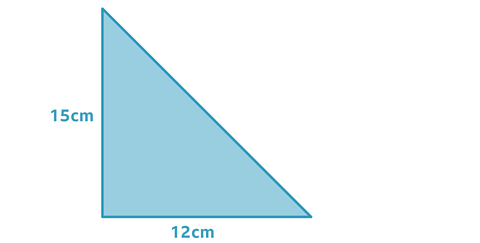
The height is now 15cm and the length is now 12cm.
Finding the original size by using a scale factor
When a shape has been enlarged by a scale factor, you can work backwards to find its original size by doing the inverse (opposite) calculation - division.
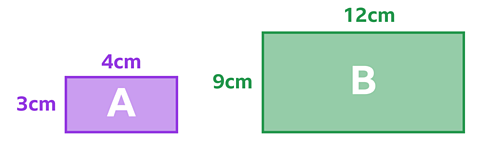
The green rectangle B has been enlarged by a scale factor of 3 and now has a width of 9cm and a length of 12cm.
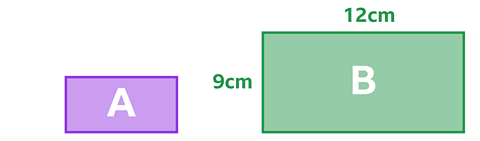
Let’s work out the original dimensions of the purple rectangle A.
To work out its original dimensions divide the new width by the scale factor:
9cm ÷ 3 = 3cm
Then, divide the new length by the scale factor:
12cm ÷ 3 = 4cm
So, the original rectangle had a width of 3cm and a length of 4cm before it was enlarged.
Explore: Scale factors
Investigate how different scale factors enlarge shapes with this interactive activity.
Example 1
When you’re working with scale factor, you need to multiply every side by the same number.
Don’t forget to calculate the number of squares for the height and the number of squares for the length.
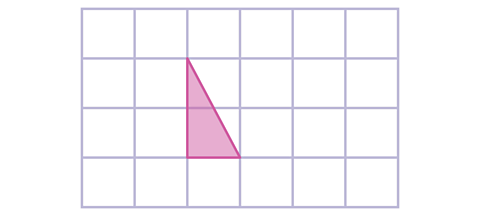
Enlarge this triangle by a scale factor of 4.
What is the height and length of the new triangle in squares?
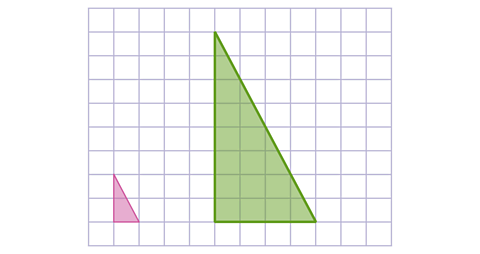
✓ The enlarged triangle has a height of 8 squares and a length of 4 squares.
The height of the first triangle was 2 squares. You have to multiply this by a scale factor of 4.
2 × 4 = 8
The enlarged triangle has a height of 8 squares.
The length of the first triangle was 1 square. You have to multiply this by a scale factor of 4.
1 × 4 = 4
The enlarged triangle has a length of 4 squares.
Example 2
Irregular shapes can be enlarged by scale factors.

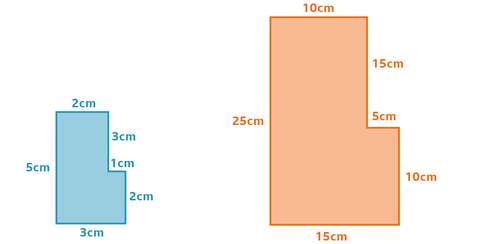
Enlarge this irregular hexagon by a scale factor of 5.
What are the measurements of the enlarged shape?
✓ To increase the shape by a scale factor of 5, all of the sides of the irregular hexagon have to be multiplied by 5.
The measurements of the enlarged shape are:
5cm × 5 = 25cm
3cm × 5 = 15cm
2cm × 5 = 10cm
1cm × 5 = 5cm
3cm × 5 = 15cm
2cm × 5 = 10cm
Here is what the enlarged shape looks like:
Example 3
The perimeter is the distance all the way around the outside of a shape.
For a rectangle, add up all four sides to find this total distance.
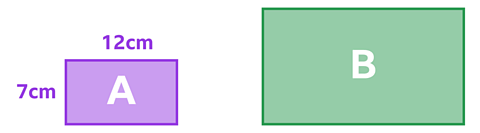
The purple rectangle A has a length of 12cm and a width of 7cm.
If the rectangle is enlarged by a scale factor of 3, what will the perimeter of the new, enlarged rectangle be?
✓The perimeter of the new, enlarged rectangle is 114cm.
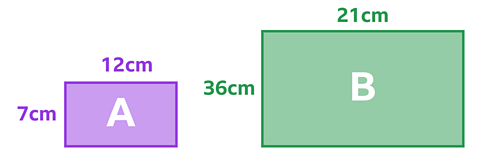
First, you need to find the new width and length of the rectangle by multiplying each original dimension by the scale factor of 3.
The original width of the rectangle is 7cm. You have to multiply this by a scale factor of 3.
7 × 3 = 21
So, the enlarged rectangle has a width of 21cm.
Next, the original length of the rectangle is 12cm. You also have to multiply this by a scale factor of 3.
12 × 3 = 36
So, the enlarged rectangle has a length of 36cm.
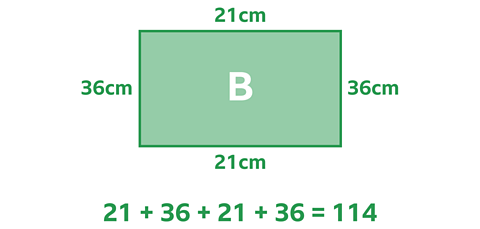
Now, add up all four sides to find the perimeter.
Two sides are 21cm and two sides are 36cm.
21 + 36 + 21 + 36 = 114
More on Ratio
Find out more by working through a topic
- count1 of 3