Types of energy store
Video: Types of energy and how it's stored
Jonny Nelson explores the different types of energy stores in this in-depth video.
JONNY NELSON: Energy. There are lots of different types and lots of different ways of storing it.
Chemical energy in a sparkler, elastic potential energy that fires a toy into the air, and many, many more.
NARRATOR: Energy can be transferred. But energy can never ever, under any circumstances, be created or destroyed.
Yeah, never ever.
There are though, lots of different ways to store energy including:
Kinetic energy
Internal energy
Elastic potential energy
Gravitational potential energy
Nuclear energy
Magnetic energy
Let's look at some of these in more detail.
Moving objects have kinetic energy. The more mass and speed they have, the more kinetic energy they have.
All objects have internal energy, including both thermal energy contained in the vibration of its particles and also chemical energy stored in the bonds between particles.
Elastic potential energy is stored when an elastic object changes shape in a reversible way, like a catapult. The stretching or squashing stores energy.
Gravitational potential energy is stored when an object is moved higher than or away from a gravitational field. The amount of energy stored depends on:
The vertical height of the object
The strength of the gravitational field
The mass of the object
Batteries are stores of chemical energy that create current and some objects, like a Van der Graaf generator, are statically charged,while others can be magnetised and store magnetic energy.
As mentioned, although energy cannot be created or destroyed, it can be transferred or converted from one type to another.
For instance, one object can heat another cooler object, transferring heat energy.
Energy can also be transferred mechanically through movement when the motion or position of an object changes, such as one ball hitting another on a pool table.
Mechanical waves such as sound waves or the seismic waves created in an earthquake can also transfer energy mechanically.
Electrical energy can be transferred when an electrical circuit is completed. The internal energy stored in a battery is transferred to moving charged particles in the wire.
Lamps transfer visible light and thermal radiation to the surroundings, and when an object falls to the ground, the gravitational potential energy it possessed is converted to kinetic energy.
Even food transfers energy. It contains chemical energy stored in the bonds between particles, and eating and metabolising food creates an energy conversion in the body.
In a similar way, burning an object like wood causes the internal energy in the wood to be converted into heat, sound, and light given out by the flames.
When it comes to energy, there are three main equations that we need to understand and remember:
Kinetic Energy
Kinetic energy = ½ × mass × velocity²
Because velocity is squared, it has a huge impact on the total kinetic energy.
Gravitational Potential Energy
Gravitational potential energy = mass × gravitational field strength × height
Elastic Potential Energy
Elastic potential energy = ½ × force × extension
or
Elastic potential energy = ½ × spring constant × extension²
JONNY: Energy can't be created or destroyed, but it can be and is stored and transferred.
There are many stores of the capacity for doing work., including:
- internal (thermal)
- chemical
- kinetic
- electrostatic
- elastic potential
- gravitational potential
- nuclear
Podcast: Energy stores and systems
In this podcast episode, James Stewart and Ellie Hurer explore the changes of energy stores when energy is transferred.
JAMES: Hello and welcome to the BBC Bitesize Physics podcast.
ELLIE: The series designed to help you tackle your GCSE in Physics and combined science.
JAMES: I'm James Stewart, I'm a climate science expert and TV presenter.
ELLIE: And I'm Ellie Hurer, a bioscience PhD researcher.
JAMES: And in this podcast, we're going to be your physics guides. Yes, we are. From forces to electricity, energy to gravity, we are going to explore some of the most important facts you need to know to revise for your exams.
ELLIE: And if you want to really get into it, be sure to grab a pen and paper so you can make notes and try out equations throughout the episode.
JAMES: This is episode one of our eight-part series all about energy, and today we'll be talking about energy stores and systems.
ELLIE: So let's begin.
JAMES: Energy is converted in a variety of ways, but the three most common ways are through heating, work done by forces, and work done when a current flows.
ELLIE: There is one key fact that you definitely need to know about energy.
Energy can't be created or destroyed. It can only be transferred usefully, stored, or dissipated.
JAMES: Dissipated means it's wasted, usually by being lost to the surroundings. So let's explore what that actually means when it comes to how we interact with energy on a daily basis.
ELLIE: So let's say you want to make a cup of tea. You go to the tap to fill the kettle up with water, plug the kettle into the wall, then switch it on until the water begins to boil.
JAMES: How is energy being transferred as you boil that kettle? What effect does the heating have here?
ELLIE: Well, the kettle is powered by electric energy, and that store of electrical energy is transferred into the thermal energy store in the water that's in the kettle.
JAMES: Any other energy transfers happening in there?
ELLIE: Well, it's not just the water in the kettle that's getting hotter. The kettle releases steam and thermal energy that heats up the surrounding area.
JAMES: But because you didn't turn on the kettle for the purpose of heating up the room, that energy is dissipated, it means it's wasted.
ELLIE: Yep, correct. When we describe the way that energy is converted, we sometimes describe the objects that are part of this process as a system. And different systems store and transfer energy differently.
JAMES: Energy is also transferred through work done. We cover work done in much more detail in our Bitesize Physics ‘forces’ series, so be sure to go back and check that one out. But for a quick definition, work done is when a force causes an object to move through a distance, when a force transfers energy from one store to another. So let's look at an example of how work done by forces changes the energy in a system.
Imagine you're at the park and decide to go and sit down on the swings. What a nice day. You push yourself up and down until you're having fun on the swings. But as you are, you're causing an energy transfer.
ELLIE: When you push, you transfer energy from the chemical energy store in your leg muscles to the kinetic store in the swing.
JAMES: Yes, and when you're up really high in the air, that kinetic energy becomes part of the gravitational potential energy store in the swing. Before being transferred back into the kinetic energy store as you come back down again.
ELLIE: So let's talk about one final energy transfer. And for this one, we're heading to the seaside.
JAMES: Ellie, imagine you're on a boat.
ELLIE: Just a boat?
JAMES: Fine, a yacht. A super yacht. Whatever you want.
ELLIE: That's better.
JAMES: Alright, imagine you're on a full blown, glamorous, mega yacht with ten bedrooms on board, swimming pool, private chef, and what about a DJ playing along with your favourite songs? Sound better?
ELLIE: Sounds like my dream.
JAMES: Good.
ELLIE: Right, we're going to give you examples and get you to answer what energy transfer you think is going on. So grab your pen and paper.
JAMES: Okay, so if the motor that drives that yacht is powered by diesel, what energy transfer is going on? I'll give you a few seconds to think about it.
ELLIE: If the motor that drives the yacht is powered by diesel, the yacht transfers energy from the chemical energy store of the fuel into the kinetic energy store of the boat as it gains speed and travels.
JAMES: But are there other energy transfers happening in there as well?
ELLIE: Yeah, some energy would also be transferred into thermal energy, heat, which is wasted energy in this case.
JAMES: Okay, let's recap the three facts we covered today. Number one, energy can't be created or destroyed. It can only be transferred usefully, converted or dissipated.
Number two, a system is an object or group of objects and there are changes in the way energy is stored when a system changes.
And thirdly, energy is converted in a variety of ways. But the three most common ways are through heating, work done by forces, and work done when a current flows.
ELLIE: Thank you so much for listening to Bitesize Physics.
If you found this helpful, go back and listen again and make some notes so you can come back to them when you revise.
JAMES: Yeah, super helpful. In the next episode of Bitesize Physics, we are going to be talking all about kinetic energy and gravitational potential energy.
ELLIE: Until next time…
BOTH: Bye!
Examples of energy stores
| Energy store | Description | Examples |
|---|---|---|
| Internal (thermal) | The total kinetic and potential energy of the particles in an object, in most cases this is the vibrations - also known as the kinetic energy - of particles. In hotter objects, the particles have more internal energy and vibrate faster. | Human bodies, hot coffees, stoves or hobs. Ice particles vibrate slower, but still have energy. |
| Chemical | The energy stored in chemical bonds, such as those between molecules. | Foods, muscles, electrical cells. |
| Kinetic | The energy of a moving object. | Runners, buses, comets. |
| Electrostatic | The energy stored when repelling charges have been moved closer together or when attracting charges have been pulled further apart. | Thunderclouds, Van De Graaff generators. |
| Elastic (strain) | The energy stored when an object is stretched or squashed. | Drawn catapults, compressed springs, inflated balloons. |
| Gravitational potential | The energy of an object at height. | Aeroplanes, kites, mugs on a table. |
| Nuclear | The energy stored in the nucleus of an atom. | Uranium nuclear power, nuclear reactors. |
Energy transfers
Systems and stores
Energy can never be created or destroyed. It can only be converted from one store to another. This is the principle of conservation of energy.
the capacity for doing work. can remain in the same store for millions of years or sometimes just for a fraction of a second. There are energy transfers going on all the time - whenever a An object or group of objects. changes there is a change in the way some or all of the energy is stored.
An object that is lifted from the ground gains energy because it can go on to do something else. A glass on the floor stays stable, one on a table can drop and smash, changing gravitational potential energy into kinetic and then sound and internal energy.
Examples of energy transfers include:
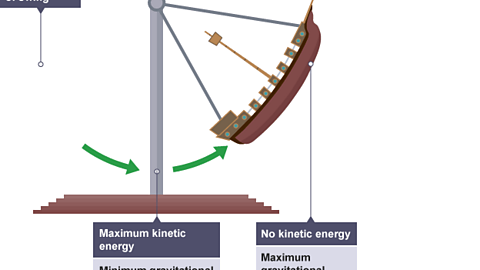
Image caption, A swinging pirate ship ride at a theme park
Kinetic energy is transferred into gravitational potential energy
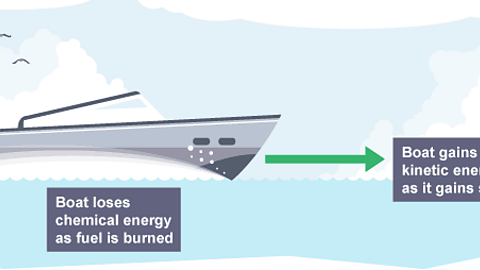
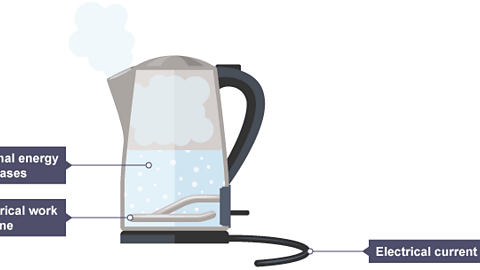
1 of 3
Transferring energy
In each of these examples, energy is When something is moved from one place to another. This may be people, objects or energy. by one of the following four types of energy transfer:
- mechanical work - a force moving an object through a distance
- electrical work - charges moving due to a The potential difference (or voltage) of a supply is a measure of the energy given to the charge carriers in a circuit. Units = volts (V). This is the voltage between two points that makes an electric current flow between them.
- heating - due to temperature difference caused electrically or by chemical reaction
- radiation - energy transferred as a wave, eg light and infrared - light radiation and infrared radiation are Energy is 'given-out' by the material and the internal energy of the material will decrease. For example, infrared radiation from the Sun is emitted into space. from the sun
Doing 'work' is the scientific way of saying that energy has been transferred. For example, a grazing cow, a firing catapult and a boiling kettle are all doing 'work', as energy is being transferred.
Energy flow diagrams
Diagrams can be used to show how energy is transferred from one store to another. Two examples are the transfer diagram and the Sankey diagram.
Transfer diagrams
In transfer diagrams the boxes show the The different ways in which energy can be stored, including chemical, kinetic, gravitational potential, elastic potential and thermal stores. and the arrows show the The different ways in which energy can be transferred from one store to another includes heating, by waves, electric current or by a force moving an object..
For example, a transfer diagram for a child at the top of a slide may be:
Gravitational energy stored in the child at the top of the slide is transferred as mechanical work done to speed up and to do work against friction. The result of this is a shift of energy from The energy stored by an object lifted up against the force of gravity. Also known as GPE. to kinetic energy and internal energy (raising the temperature of the child and the slide).
Extended syllabus content: Calculating energy in the kinetic store
If you are studying the Extended syllabus, you will also need to know the equation for calculating energy in the kinetic store. Click 'show more' for this content:
Calculating energy in the kinetic store
The amount of Energy which an object possesses by being in motion. of a moving object can be calculated using the equation:
Kinetic energy = ½ × mass × velocity²
\( E_{k} = \frac{1}{2}~m~v^{2}\)
This is when:
- energy (Ek) is measured in joules (J)
- mass (m) is measured in kilograms (kg)
- velocity (v) is measured in metres per second (m/s)
Example
An apple of mass 100 g falls from a tree. It reaches a speed of 6 m/s before landing. What is the gain in kinetic energy of the apple?
\(E_{k} = \frac{1}{2}~m~v^{2}\)
\(E_{k} = \frac{1}{2} \times 0.1 \times6^{2}\)
\(E_{k} = \frac{1}{2} \times 0.1 \times 36\)
\(E_{k} = 1.8~J\)
Question
How much kinetic energy does a 30 kg dog have when it runs at 4 m/s?
\(E_{k} = \frac{1}{2}~m~v^{2}\)
\(E_{k} = \frac{1}{2} \times 30 \times 4^{2}\)
\(E_{k} = \frac{1}{2} \times 30 \times 16\)
\(E_{k} = 240~J\)
Extended syllabus content: Calculating the change in gravitational potential energy
If you are studying the Extended syllabus, you will also need to know the equation for calculating the change in gravitational potential energy. Click 'show more' for this content:
Gravitational potential energy
An object that is lifted from the ground gains energy since it can go on to do something else. A glass on the floor stays stable, one on a table can drop and smash.
The amount of The energy stored by an object lifted up against the force of gravity. Also known as GPE. stored by an object at height can be calculated using the equation:
Gravitational potential energy = mass × gravitational field strength × height
\(\text{E}_{p} = \text{mgh}\)
This is when:
- gravitational potential energy ((\(\text{E}_{p}\)) is measured in joules (J)
- mass (\(\text{m}\)) is measured in kilograms (kg)
- gravitational field strength (\(\text{g}\)) is measured in newtons per kilogram (N/kg)
- height (\(\text{h}\)) is measured in metres (m)
Extended syllabus content: Interpreting Sankey diagrams
If you are studying the Extended syllabus, you will also need to know how to interpret sankey diagrams. Click 'show more' for this content:
Sankey diagrams summarise all the The different ways in which energy can be transferred from one store to another includes heating, by waves, electric current or by a force moving an object. taking place in a process.
The thicker the line or arrow, the greater the amount of energy involved.
This Sankey diagram for an electric A thin, high resistance wire that gets hot and glows when a current flows through it causing it to emit heat and light. Filaments are used in some types of bulb and electrical heaters. lamp shows that most of the electrical energy is transferred as heat energy rather than light energy.
The Principle of Conservation of Energy
Key fact: Energy can be changed from one form to another but cannot be created or destroyed. The total amount of energy does not change.
In the above Sankey diagram, note that 100 J of electrical energy is supplied to the lamp.
Of this, 10 J is transferred to the surroundings as useful light energy.
The remainder, 90 J (100 J – 10 J) is transferred to the surroundings as wasted heat energy.
The energy transfer to light energy is the useful transfer.
The rest is ‘wasted’.
It is eventually transferred to the surroundings, making them warmer.
This ‘wasted’ energy eventually becomes so spread out that it becomes very difficult to do anything useful with it.
Energy and work
When a A push or a pull. The unit of force is the newton (N). causes a body to move, work is being done on the object by the force. Work is the measure of energy transfer when a force (F) moves an object through a distance (d).
So when work is done, the capacity for doing work. has been transferred from one energy store to another, and so:
energy transferred = work done
Energy transferred and work done are both measured in joules (J).
Calculating work done
The amount of work done when a force acts on a body depends on two things:
The size of the force acting on the object.
The Numerical description of how far apart two things are. For example, the distance from Edinburgh to Glasgow is approximately 50 miles. through which the force causes the body to move in the direction of the force.
The equation used to calculate the work done is:
work done = force × distance
\(W=F\times d=∆E\)
This is when:
Work done (\(W\)) is measured in joules (\(J\))
Force (\(F\)) is measured in newtons (\(N\))
Distance (\(d\)) is in the same direction as the force and is measured in metres (\(m\))
∆E is the change in energy measured in joules (\(J\))
In this example, a force of 10 N causes the box to move a horizontal distance of 2 m, so:
\(W=F \times d\)
\(W=10 \times 2\)
\(W=20~J\)
A horizontal force of 50 N causes a trolley to move a horizontal distance of 30 m. How much work is done on the trolley by the force?
\(W=F \times d\)
\(W=50 \times 30\)
\(W=1,500~J\)
12,000 J of energy is supplied to move a small truck a distance of 80 m. What is the size of the force applied?
\(W=F \times d\)
\(F= \frac{W}{d}\)
\(F = \frac{12,000}{80}\)
\(F = 150~N\)
Types of energy resources
Renewable and non-renewable resources
Key fact: A renewable energy resource is one that is being (or can be) replenished as it is used.
Renewable resources are replenished either by:
human action - eg trees cut down for biofuel are replaced by planting new trees
natural processes - eg water let through a dam for Electricity generated from water. is replaced through the The continuous movement of water on, above and below the Earth..
A non-renewable energy resource is one with a Something that has a limited number of uses before it is depleted. For example, oil is a finite resource. amount. It will eventually run out when all reserves have been used up.
The table below shows the main features of the most common energy resources used today.
| Energy resource | Energy store | Renewable or non-renewable | Uses | Power output | Impact on environment |
|---|---|---|---|---|---|
| Fossil fuels (oil, coal and natural gases) | Chemical | Non-renewable | Transport, heating, electricity generation | High | Releases carbon dioxide (causes global warming) |
| Nuclear fuels | Nuclear | Non-renewable | Electricity generation | Very high | Radioactive waste (needs to be disposed of safely) |
| Biofuel | Chemical | Renewable | Transport, heating, electricity generation | Medium | 'Carbon neutral' - little or no effect on the environment. Although growing biofuels can take up land that could be used for farming. |
| Wind | Kinetic | Renewable | Electricity generation | Very low | The Sun is the source of wind energy |
| Hydroelectricity | Gravitational potential | Renewable | Electricity generation | Medium | Local habitats are affected by the large areas that need to be flooded to build dams |
| Geothermal | Internal (thermal) | Renewable | Electricity, generation, heating | Medium | Very low |
| Tides | Kinetic | Renewable | Electricity generation | Potentially very high, but hard to harness | Tidal barrages can block sewage which needs to go out to sea. Local habitats also affected |
| Sun | Nuclear | Renewable | Electricity generation and heating water in solar panels | Dependent on the weather and only available during daylight | Very little |
| Water waves | Kinetic | Renewable | Electricity generation | Low | Very low |
Comparing energy resources
There are different Useful supply or store of energy. in the world and the amount of the capacity for doing work. stored by them varies greatly. For example, the nuclear energy within 1 kg of uranium contains a very large amount of energy, but the The energy stored by an object lifted up against the force of gravity. Also known as GPE. stored by many thousands of tonnes of water held back by a dam contains less.
Fossil fuels
Fossil fuels are a chemical store of energy and include coal, oil and natural gas.
Using fossil fuels to produce electricity
- Fossil fuel is burnt to boil water and turn it into steam.
- The steam rises past turbines and causes them to spin.
- The turbines are connected to generators which are spun to generate electricity.
- Transformers are used to step up the voltage before feeding the electricity into the National Grid.
- Transformers are used to step down the voltage before feeding electricity into homes.
Advantages and disadvantages of fossil fuel power
| Advantages | Disadvantages |
|---|---|
| Readily available (at the moment) | Non-renewable source – will eventually run out |
| Relatively easy to produce energy from them | Increasing fuel costs |
| Releases carbon dioxide when burnt – greenhouse gas | |
| Releases sulphur dioxide when burnt – acid rain |
Nuclear power
Electricity is generated in nuclear power stations using a fission reactor powered by uranium fuel. 22% of the UK's electricity is generated using The splitting of a large nucleus to produce two smaller ones. Two or three neutrons are also released in the process. The energy from the neutrons powers a nuclear reactor..
Advantages and disadvantages of nuclear power
| Advantages | Disadvantages |
|---|---|
| No release of carbon dioxide – greenhouse gas | Non-renewable source – will eventually run out |
| No release of sulphur dioxide – acid rain | Expensive to commission and decommission power stations |
| 1 kg of uranium produces millions times more energy than 1 kg of coal | Hazardous radioactive waste produced |
| Danger of release of radioactive materials into the environment |
Comparing renewable sources of energy
Energy from plants
Biofuels are fuels made from plant materials. These include biodiesel, made from plant oils, and bioethanol, made by fermenting sugar and wheat.
Energy from the wind
Humans have been taking advantage of the wind for thousands of years. Sailing ships and windmills are both examples of wind power.
Even though sailing ships are still used today, the major use of wind is to generate electricity using wind Revolving machine with blades that are turned by wind, water or steam. Turbines in a power station turn the generators..
The turbine consists of a generator in a The part at the top of the tower of a wind turbine. The blades of the turbine are joined to the nacelle, which contains gears linked to a generator. at the top of a high tower. The wind turns the blades of the turbine and these, in turn, spin the Device that converts kinetic energy into electrical energy..
Energy from falling water
Energy in the gravitational store of a body of water held above sea level can be used as the water is allowed to run down pipes containing turbines. There are two ways of doing this:
Tidal
The Moon's gravitational pull lifts the level of the seas twice a day and this is the force that gives us When a rivers flow and level is influenced by tides. power.
At high tide, the sea is trapped behind a A dam that is used to generate energy from moving water in and out of a bay or river due to tidal forces./dam.
The water is allowed to run out through pipes that lead back to the sea.
As the water runs through the pipes it spins turbines that are linked to generators.
Extended syllabus content: Nuclear fusion
If you are studying the Extended syllabus, you will also need to know about nuclear fusion. Click 'show more' for this content:
The joining together of two smaller atomic nuclei to produce a larger nucleus. Radiation is released when this happens. Nuclear fusion happens in stars like our Sun, and in hydrogen bombs. is when two small, light The nucleus controls what happens inside the cell. Chromosomes are structures found in the nucleus of most cells. The plural of nucleus is nuclei. join together to make one heavy nucleus. Fusion reactions occur in stars where two hydrogen nuclei fuse together under high temperatures and pressure to form a nucleus of a helium Atoms of an element with the same number of protons and electrons but different numbers of neutrons..
There are a number of different nuclear fusion reactions happening in the Sun. The simplest is when four hydrogen nuclei become one helium nuclei.
\(4_{1}^{1} H \rightarrow _{2}^{4}He\)
The combined mass of four hydrogen nuclei is 6.693 × 10⁻²⁷ kilograms (kg). The mass of one helium nucleus is 6.645 × 10⁻²⁷ kg. This means that there is a missing amount of mass equalling 0.048 × 10⁻²⁷ kg.
The missing mass is converted to energy, which Spreads out from a source. Energy is transferred as a wave.away. This is seen happening in the Sun.
Research is being carried out to investigate how energy released by nuclear fusion can be used to produce electrical energy on a large scale.
Extended syllabus content: Efficiency
If you are studying the Extended syllabus, you will also need to know about efficiency and how to calculate it. Click 'show more' for this content:
Devices are designed to waste as little energy as possible. This means that as much of the input energy as possible should be transferred into useful energy stores.
How good a device is at transferring energy input to useful energy output is called The fraction of the energy supplied to a device which is transferred in a useful form..
A very efficient device will waste very little of its input energy.
A very inefficient device will waste most of its input energy.
The efficiency of a device is the proportion of the energy supplied that is transferred in useful ways. The efficiency can be calculated as a decimal or a percentage, using the equations:
\(efficiency = \frac{useful~energy~transferred}{total~energy~supplied}\)
\(percentage~efficiency = efficiency \times 100\)
\((percentage~efficiency = \frac{useful~energy~transferred}{total~energy~supplied} \times 100)\)
This is when both useful energy transferred and total energy supplied are measured in joules (J).
Example
The energy supplied to a light bulb is 200 J. A total of 28 J of this is usefully transferred. How efficient is the light bulb?
\(efficiency = \frac{useful~energy~transferred}{total~energy~supplied}\)
\(efficiency = \frac{28}{200}\)
\(efficiency = 0.14\)
\(percentage~efficiency=efficiency \times 100\)
\(percentage~efficiency=0.14 \times 100\)
\(percentage~efficiency=14\%\)
The light bulb is not very efficient since most of the energy supplied is not transferred usefully. Most of the energy isThe spreading out and transfer of energy stores into less useful forms, such as thermal energy causing the surroundings to heat up. Dissipated energy is often referred to as 'wasted' energy, since it is not transferred to a useful output. as infrared radiation and only 14% is transferred usefully as light radiation.
As power is equal to useful energy transferred per second, another way to calculate efficiency is to use the formula:
\(efficiency = \frac{useful~power~transferred}{total~power~supplied}\)
\(percentage~efficiency = efficiency \times 100\)
This is when both useful power transferred and total power supplied are measured in watts (W).
Question
\(efficiency = \frac{useful~power~transferred}{total~power~supplied}\)
\(efficiency = \frac{190,000}{200,000}\)
\(efficiency = 0.95\)
\(percentage~efficiency = efficiency \times 100\)
\(percentage~efficiency = 0.95 \times 100\)
\(percentage~efficiency = 95\%\)
Preventing unwanted energy transfers
Devices waste energy for various reasons including A force that opposes or prevents movement and converts kinetic energy into heat. between their moving parts, electrical resistance, and unwanted sound energy.
In most cases, this waste energy is energy that has been shifted into the environment and raises the temperature of the surroundings. In order to make further use of this energy it has to be retrieved from each individual air particle. Clearly, this is very difficult, if not impossible. It is much better to prevent the energy being shifted, or The spreading out and transfer of energy stores into less useful forms, such as thermal energy causing the surroundings to heat up. Dissipated energy is often referred to as 'wasted' energy, since it is not transferred to a useful output., to the surroundings.
It is impossible to completely prevent unwanted energy transfer, the best that can be done is to reduce them. Some of the most common ways to reduce these unwanted energy transfers are:
Lubrication
Frictional forces cause surfaces to heat up resulting in an unwanted energy transfer. Reducing the friction between two surfaces can reduce this unwanted energy transfer.
Friction is sometimes reduced by placing rollers or ball bearings between the surfaces but, most often, oil is used to lubricate the surfaces and allow them to slide smoothly over each other.
Thermal insulation
Heating a house, for example, can be a problem. A great deal of energy is wasted through the windows, doors and roof.
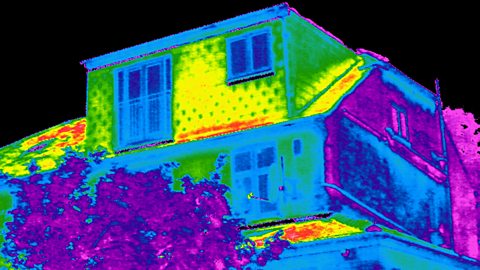
There are some simple ways to reduce this loss, including fitting carpets, curtains and draught excluders.
Energy loss through windows can be reduced using double glazing. These kinds of windows have air or a vacuum between the two panes of glass. Air is a poor conductor, while a vacuum can only transfer energy by radiation.
Energy loss through walls can be reduced by using cavity wall insulation. This involves blowing insulating material into the gap between the brick and the inside wall, which reduces the loss by air circulating inside the cavity, therefore reducing loss by convection through the cavity. Overall the heat loss conducting through the bricks and cavity is reduced; it can be said that the A measure of how well a material conducts energy when it is heated. has been reduced.
Sometimes walls do not have a cavity. Thicker walls transfer heat by conduction more slowly than thinner walls. Adding a material of low thermal conductivity to these solid walls on either the inside or the outside reduces the heat loss because the lower the thermal conductivity of a material, the slower heat passes through the material.
Energy loss through the roof can be reduced by laying loft insulation. This works in a similar way to cavity wall insulation.
Extended syllabus content: Different energy resources
If you are studying the Extended syllabus, you will also need to know about different energy resources. Click 'show more' for this content:
Radiation from the Sun is the main source of energy for all our energy resources except geothermal, nuclear and tidal.
Geothermal is a renewable resource, where heat from the Earth is used to heat water to generate electricity. Nuclear is a non-renewable resource, where the energy stored in nuclear fuels is used to heat water to generate electricity. Tidal electricity is a renewable resource, where kinetic energy from the tides turns turbines to generate electricity. Tides are caused by the gravitational pull of the moon.
Nuclear fusion in the Sun
The joining together of two smaller atomic nuclei to produce a larger nucleus. Radiation is released when this happens. Nuclear fusion happens in stars like our Sun, and in hydrogen bombs. is when two small, light The nucleus controls what happens inside the cell. Chromosomes are structures found in the nucleus of most cells. The plural of nucleus is nuclei. join together to make one heavier nucleus. Fusion reactions occur in stars where, for example, two hydrogen nuclei fuse together under high temperatures and pressure to form a nucleus of a helium Atoms of an element with the same number of protons and electrons but different numbers of neutrons..
There are a number of different nuclear fusion reactions happening in the Sun. The simplest is when four hydrogen nuclei become one helium nucleus.
\(4 _{1}^{1}\textrm{H} \rightarrow _{2}^{4}\textrm{He}\)
The combined mass of four hydrogen nuclei is 6.693 × 10⁻²⁷ kilograms (kg). The mass of one helium nucleus is 6.645 × 10⁻²⁷ kg. This means that there is a missing amount of mass equalling 0.048 × 10⁻²⁷ kg.
The missing mass is converted to energy, which Spreads out from a source. Energy is transferred as a wave. away. This is seen happening in the Sun. In all Changes that occur in the nucleus of an atom. Eg due to radioactive decay, nuclear fission or nuclear fusion., a small amount of the mass changes to energy.
However, the issue with fusion is that it requires the fusing of nuclei, which are positive particles. As two nuclei approach each other, they will Objects that tend to push apart because of a force between them repel each other.because they have the same Property of matter that causes a force when near another charge. Charge comes in two forms, positive and negative. For example, a negative charge causes a repulsive force on a neighbouring negative charge.. The fusion of the nuclei has to happen under intense pressure and very high temperatures in order to force the nuclei together and overcome this electrostatic repulsion.
This need for a very high temperature and pressure makes it very difficult to build a practical and economic fusion power station. For fusion to occur at the lower pressures in a reactor on Earth, the temperature would need to be between 100 and 200 million degrees.
Energy and power
When work is done on an object, energy is transferred. The Per unit time or ‘per second’. For example, if 2,000 J are transferred over a period of 10 s, then the rate of transfer is 200 J/s or 200 W. This value is the power rating.at which this energy is transferred is called The energy transferred each second, measured in watts (W). Power = work done ÷ time taken.. So power is work done per unit of time, and also energy transferred per unit time.
Calculating power
The equation used to calculate power is:
\(power = \frac{work~done}{time}\)
\(power = \frac{W}{t}\) \( = \frac{∆E}{t}\)
This is when:
power (P) is measured in watts (W)
work done (W) is measured in joules (J)
time (t) is measured in seconds (s)
change in energy (∆E) is measured in joules (J)
One watt is equal to one joule per second (J/s). This means that for every extra joule that is transferred per second, the power increases by one watt.
Example
Two electric motors are used to lift a 2 N weight through a vertical height of 10 m.
Motor one does this in 5 seconds.
Motor two does this in 10 seconds.
For both motors:
\(W = F \times d = 2 \times 10 = 20~J\)
\(P = \frac{W}{t} = \frac{20}{5} = 4~W\)
\(P = \frac{W}{t} = \frac{20}{10} = 2~W\)
Since twice as much energy is transferred by motor one each second, it is possible to say that motor one is twice as powerful as motor two.
Question
A hair dryer transfers 48,000 J of energy in one minute. What is the power rating of the hairdryer?
\(P = \frac{W}{t}\)
\(P = \frac{48,000}{60}\)
\(P = 800~W\)
Podcast: Power
In this podcast episode, James Stewart and Ellie Hurer share the equations you need to know to calculate an object's power and compare how powerful two different electrical motors are.
JAMES: Hello and welcome to the BBC Bitesize Physics podcast.
ELLIE: The series designed to help you tackle your GCSE in Physics and combined science.
JAMES: I'm James Stewart, I'm a climate science expert and TV presenter.
ELLIE: And I'm Ellie Hurer, a bioscience PhD researcher.
JAMES: And today we're going to be talking about power, how to calculate it and compare how much power different electrical devices use. Let us begin.
Ellie, if you could have any superpower in the world, what would it be?
ELLIE: Hmm, I think probably teleportation. Could you imagine being able to blink and go from London to, you know, the Amazon rainforest?
JAMES: Oh, wouldn't that be amazing? I think I would probably choose time travel. I'd love to go back in history and see like the first thing humans created or hang out with my great-great-great-grandfather, stuff like that.
But I didn't ask you that question because we're doing a spin-off show about superheroes. I asked you that because in this episode we are talking about power and to do that let's start with a scientific definition of power.
So power is the rate at which energy is transferred or the rate at which work is done. That means that the more powerful a device is, the more energy is transferred, or more work is done, each second.
ELLIE: To calculate power, you need a certain formula, so grab your pen and paper because you'll want to write this down.
So, power equals energy transferred, divided by time. So, let me repeat that with the units. Power, which is measured in watts, equals energy transferred, which is measured in joules, divided by time, which is measured in seconds. This means that an energy transfer of one joule per second is equal to one watt.
JAMES: If you want to learn more about power and energy transfer, be sure to listen to the energy transfer episode of our Bitesize Physics electricity series.
ELLIE: Yes, definitely go back and look at that. Right, so let's look at an example. So James, imagine it's a really hot summer's day so you buy an electric fan.
JAMES: The electric fan transfers 3,000 joules of energy in one minute. So how would you calculate the power of the fan if the equation to calculate the power is: power equals energy transferred divided by time.
ELLIE: If you missed a measurement or the equation, be sure to rewind, but we'll give you a few moments to pause, write that down and calculate it.
JAMES: Okay so to calculate the power rating of the fan, you would divide 3,000 joules by 60 seconds to get the answer, 50 watts.
ELLIE: What?
JAMES: Wahey. Therefore, the power rating of the fan is 50 watts. And you can often find the power rating of an appliance on a label, handily attached to its wires.
ELLIE: But, there's also another equation you can use to calculate power. So, let's grab your pen and paper. Okay, so power equals work done, divided by time. Let me repeat that with the units. Power, which is measured in watts, equals work done, which is measured in joules, divided by time, which is measured in seconds.
JAMES: Yeah, the main difference between those is instead of talking about energy transferred, we talk about work done. And to learn more about work done, be sure to listen to the work done episode of our BBC Bitesize Physics series on forces.
ELLIE: Let's look at another example. Imagine you're at a construction site and you're watching two different electric motors lift weights.
They both lift a 2 Newton weight by 10 metres. Motor one does it in 5 seconds, whereas motor two does it in 10 seconds.
JAMES: So to calculate how much energy they use, you would use the equation work done equals force multiplied by distance. So in this case, you multiply 2 newtons by 10 metres to get the answer 20 joules. But, how would we calculate how powerful each motor is?
ELLIE: Well, the equation for power is: power equals work done divided by time. So, I'm going to give you a few seconds to try and calculate the power of motor one and two using the equation.
JAMES: To calculate the power of motor one, you would divide its work done, which is 20 joules, by the time it takes, that was 5 seconds, to come up with the answer, 4 watts. And then to calculate the power of motor two, you would divide its work done, which was 20 joules, by its time, 10 seconds, to come up with the answer, 2 watts. That calculation would help you to understand why they both lift the same weight, but do it at different rates, because motor one is twice as powerful. Yeah, so if you need to move house and do some heavy lifting to get your furniture moved around, you'd probably use motor one to help you do that, otherwise you'd be very tired.
Let me just recap some of the key facts we learned today. So firstly, power is the rate at which energy is transferred or the rate at which work is done.
Secondly, the first equation to calculate power is: power equals energy transferred, divided by time. And the second equation to calculate power is: power equals work done, divided by time.
And finally, power is measured in watts. Work done is measured in joules. And time is measured in seconds.
ELLIE: So that's our introduction to power. In this next episode, we're going to be talking about the conservation and dissipation of energy, which is how it's used and wasted.
JAMES: Thank you for listening to Bitesize Physics. If you found this helpful, and I hope you did, go back and please listen again, make some notes as you go along the way, and always come back here whenever you want to revise from.
ELLIE: There's also a lot more resources available on the BBC Bitesize website, so be sure to check it out.
BOTH: Bye!
Quiz
Test your knowledge with this quiz on energy stores.
Teaching resources
Are you a physics teacher looking for more resources? Share these short videos on energy with your students:
More on Motion, forces and energy
Find out more by working through a topic
- count8 of 11
- count9 of 11
- count10 of 11
- count11 of 11