How to draw and measure accurately
How accurate you need to be when you measure depends on the situation.
To measure and draw well, you need to know how to use a ruler and understand the different units of measurement, such as millimetres and centimetres.
Sometimes, you need to be very exact, so you might have to measure to the nearest millimetre.
At other times, it might be better to round up or down to the nearest centimetre.
Activity: Draw and measure accurately
Complete this interactive activity to understand how to draw and measure accurately. Then put your knowledge to the test.
Measuring in centimetres and millimetres
When measuring length you can use centimetres (cm) and millimetres (mm).
Take a look at this ruler. You can see there are ten millimetres in one centimetre (cm).
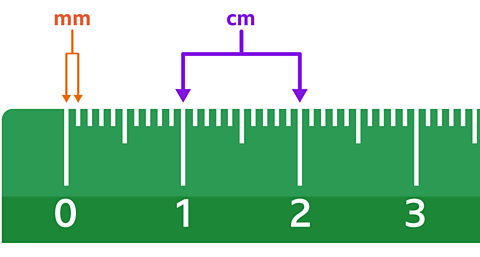
To measure something to the nearest centimetre, you look at the centimetre closest to the end of the object you are measuring.
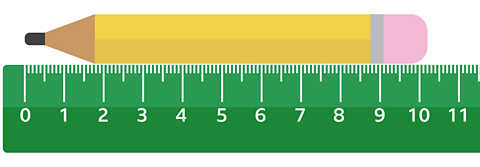
In this next picture, look at the end of the pencil with the rubber on it and take a measurement using the ruler below:
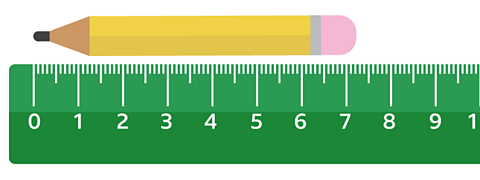
The length would be 7cm to the nearest centimetre. You can see it doesn't pass the half way mark, so it is closer to 7cm than to 8cm.
However, you won't always have to round down to the nearest centimetre. Sometimes you will have to round up. It depends on the length of the object.
Take a look at this book and ruler:
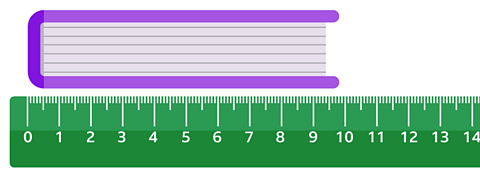
The book is 10cm to the nearest centimetre because it is closer to 10cm than to 9cm.
If you need to be really accurate, measure and give your answer in centimetres and millimetres.
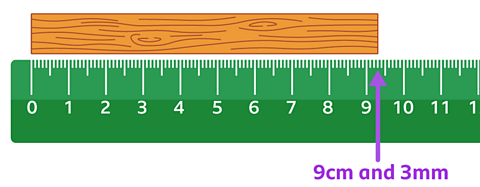
Take a look at the piece of wood below. You can find its length by looking closely at the marks for centimetres and millimetres. The arrow shows its exact length is 9cm and 3mm.
Example 1
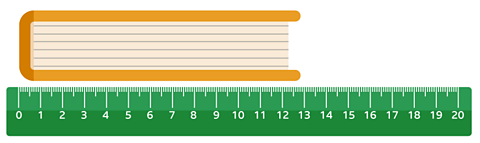
To measure the length of this book to the nearest centimetre (cm), will you need to round up or down?
✓ You will need to round up.
When you look at the ruler, you can see that the edge of the book is between 12cm and 13cm long.
You are measuring to the nearest centimetre (cm).
The measurement is closer to 13cm than to 12cm, so the length of the book to the nearest centimetre is 13cm.
Example 2
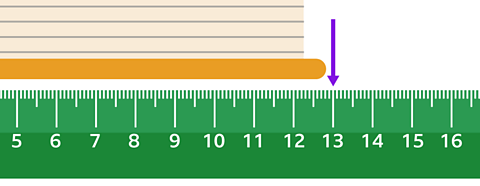
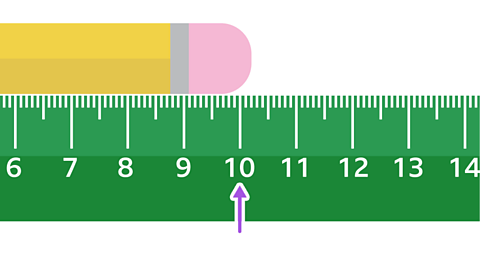
Should you round up or down when measuring this pencil to the nearest centimetre (cm)?
✓ You should round down.
When you look at the ruler, you can see that the end of the pencil is between 10cm and 11cm long.
You are measuring to the nearest centimetre (cm).
The measurement is closer to 10cm than to 11cm, so the length of the book to the nearest centimetre is 10cm.
Example 3
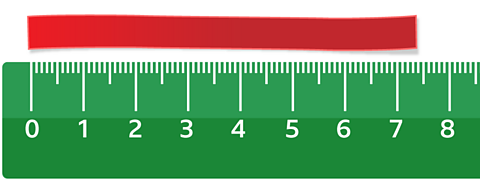
What units of measurement can you use to measure the exact length of this piece of ribbon?
✓ You can measure in centimetres (cm) and millimetres (mm).
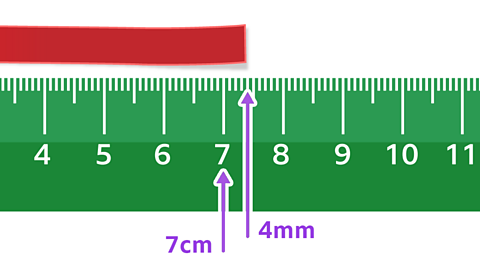
The ribbon is longer than 7cm but shorter than 8cm.
To be exact, you need to count how many millimetres past the 7cm mark it is.
It measures 7cm and then another 4mm.
So the exact length is 7cm and 4mm.
Primary maths teaching resources
Visit BBC Bitesize for Teachers to see videos, activities and more resources to use in maths classes for KS1 and KS2.

More on Length and distance
Find out more by working through a topic
- count3 of 6
- count4 of 6
- count5 of 6
- count6 of 6