Crime in Scotland and the UK
Quick version
The definition of crime is an act that violates the law.
Laws are created by democratically-elected politicians, allowing citizens to influence the legal system through regular elections.
Laws evolve over time as new legislation is passed by the Scottish and UK parliaments.
In Scotland and the rest of the UK, individuals accused of a crime have the right to a fair trial and are presumed innocent until proven guilty.
The two main types of crime are:
- Property crimes: These include vandalism, motor vehicle theft, housebreaking, and personal theft (excluding robbery).
- Personal crimes: Are generally viewed as more serious due to their violent nature.These involve violence or threats of violence, such as assault, robbery, and murder.
Cyber-crime is linked to internet use and has accounted for a significant portion of certain crimes including sexual crimes, crimes of dishonesty and of non-sexual violent crimes.
Not all crimes are reported to the police; in 2022-23, only 40% of crimes were estimated to be reported.
Learn in more depth
What is crime?
A crime is an offence against the law of the land.
In Scotland and the UK, laws are made by politicians who are elected democratically. As individuals, we may not agree with the law but regular elections allow citizens to change the people who represent them and thereby bring about changes within the law.
Over time, the law changes as the Scottish and UK parliaments pass new legislation or laws.
For example, it was not a crime to smoke in a car with someone aged under 18 years before 2016, but the Smoking Prohibition (Children in Motor Vehicles) (Scotland) Act made this illegal from 2016.
If someone is accused of a crime in Scotland:
- they have the right to defend themselves in a court of law
- they are presumed to be innocent until proven guilty after a trial in a criminal court
For those who are found guilty after trial, punishment traditionally reflects the seriousness of the crime. The most serious crimes are those which involve violence and/or loss of life.
What types of crime are there?
There are two main types of crime -
- property crimes - crimes involving theft or damage of property
- personal crimes - crimes that cause harm to people
What is property crime?
Property crime includes the following:
- vandalism, including motor vehicle and property vandalism
- motor vehicle theft-related incidents
- theft by housebreaking
- other household thefts including bicycle theft
- personal theft excluding robbery
What is personal crime?
Personal crime includes:
- assault
- robbery
- murder
Crimes against people are considered as more serious types of crime as they usually involve violence or threats of violence.
What is the difference between theft, burglary and robbery?
- theft means taking someone's property without their permission
- burglary means entering someone's property illegally in order to steal property from it
- robbery means using or threatening force in order to steal someone's property.
Both theft and burglary are property crimes.
Robbery is a personal crime because a person is threatened with violence or experiences violence when a robbery is carried out.
How much crime is there in Scotland?
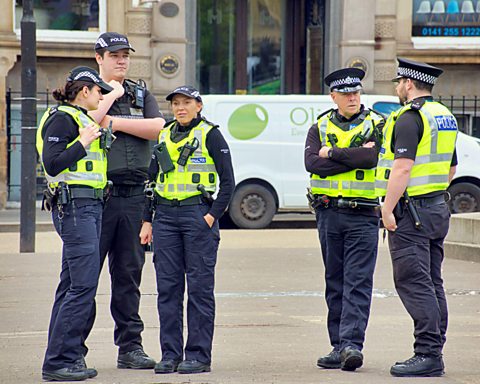 Image source, Gerard ferry / Alamy
 Recorded crime levels are currently at around the lowest level since 1974:
- Police Scotland recorded 289,362 crimes in 2022/23
- 172,207 offences were also recorded by Police Scotland.
This was a 5% decrease from 2021-22.
Offences are less serious crimes, such as speeding and anti-social behaviour. These are still crimes, but recorded separately in statistics.
Image source, Gerard ferry / Alamy What is cyber-crime?
Increasingly, criminals and criminal gangs are using the internet and information technology to commit crime.
There are many types of cyber-crime, some target individuals, some target businesses and other organisations.
Cyber-crime can involve:
- stealing confidential information, such as personal data, for example names, addresses, bank details or even health information. This data can be used to commit fraud.
- threatening to publish personal information unless money is paid. For example, sextortion is growing form of blackmail in which criminals threaten to publish sexual pictures, videos or information.
- using scam emails, texts and websites to commit fraud
- using social media to threaten and harass
Some criminal gangs target businesses and other organisations. If they gain access to confidential data, they can threaten to publish or sell this data unless the organisation involved pays a ransom, as happened to NHS Dumfries and Galloway in 2024.
Gangs can also use ransomware to prevent devices working, or stop companies from accessing the data they need. If an organisation pays the ransom, there is no guarantee that the criminals will return stolen data, or allow a service to work again.
How much cyber-crime is there in Scotland?
Official police-recorded crime statistics now include the rates of Crime related to, or carried out using the internet, social media and communications such at text massaging and email. in Scotland.
In 2022-23, an estimated 14,890 cyber-crimes were recorded by the police in Scotland (Source: Scottish Government).
These were estimated to account for the following proportions of different types of crime:
- 26% of sexual crimes
- 8% of crimes of dishonesty
- 3% of non-sexual crimes of violence
- less than 1% of damage and reckless behaviour
Overall, 5% of crime is recorded as cyber crime.
What is the proportion of different types of crime in Scotland?
In 2022/23, Police Scotland recorded crime as:
| Percentage of crimes recorded | Type of crime |
|---|---|
| 36% | dishonesty e.g. theft. Crimes of dishonesty are the largest single type of crime |
| 24% | non-sexual crimes of violence e.g. assault |
| 21% | crimes against society e.g. drug possession and supply |
| 15% | damage and reckless behaviour e.g. vandalism |
| 5% | sexual crimes |
The crime statistics above are the official figures as recorded by Police Scotland.
Official figures only record crimes which have been reported. It does not record all crimes that have been committed, as not all crimes are reported to the police.
People do not always contact the police when they are the victims of crime. This could be because the crime is minor or because they don’t believe the police will be able to catch the offender.
In 2022-23, Police Scotland estimated only 40% of crime was reported to the police.
Other studies of crime also indicate that there is more crime in Scottish society than is officially recorded by the police. For example, the Scottish Crime and Justice Survey (SCJS), which surveys people on their experiences of crime.
In 2022-23, the Clear up rate (or clearance rate) is the ratio of crimes which result in a charge being brought divided by the total number of recorded crimes. for official recorded crime was 53.3%, slightly down from the previous period (54%).
Although there are some exceptions, a crime or an offence is recorded as cleared up where the police have collected sufficient evidence for the Procurator Fiscal to consider criminal proceedings.
All statistics in this section are from the Scottish Government unless otherwise stated.
Quiz
Recap what you have learned
Crime is defined as an act that violates the law.
Laws evolve over time as new legislation is passed by the Scottish and UK parliaments.
In Scotland, individuals accused of a crime:
- have the right to a fair trial
- are presumed innocent until proven guilty.
The two main types of crime are:
- Property crimes: including vandalism, motor vehicle theft, housebreaking, and personal theft (excluding robbery).
- Personal crimes: including violence or threats of violence, such as assault, robbery, and murder.
Crime statistics in Scotland (2022-23):
- Dishonesty (e.g., theft): 36% of total crimes
- Non-sexual violence (e.g., assault): 24%
- Crimes against society (e.g., drug offences): 21%
- Damage and reckless behaviour (e.g., vandalism): 15%
- Sexual crimes: 5%
Cyber crime is linked to internet use and online technology. In Scotland in 2022-23 it accounted for:
- 26% of sexual crimes
- 8% of crimes of dishonesty
- 3% of non-sexual violent crimes
Total crimes recorded by Police Scotland: 289,362
- this represents a decrease from the previous year.
Not all crimes are reported to the police; in 2022-23, only 40% of crimes were estimated to be reported. This gap means actual crime rates may be higher than official statistics suggest.
The clear-up rate (solving and taking sufficient action on a crime) was 53.3%, slightly lower than the previous year's 54%.
More on Crime and the Law
Find out more by working through a topic
- count2 of 9

- count3 of 9

- count5 of 9