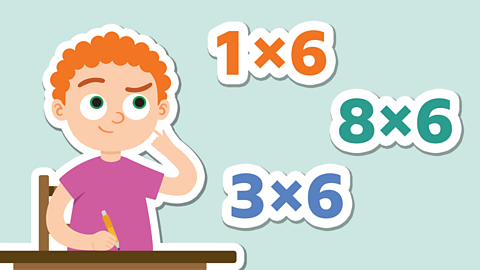
Using the multiplication symbol
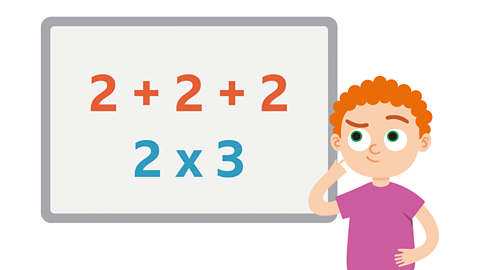
Multiplication is calculating the sum of groups of the same size.
There are lots of ways to build and describe multiplication problems.
Using repeated addition, you can add equal groups together, one by one.
A faster way would be to use some multiplication words like 'times' or 'multiplied by'.
This approach uses the multiplication symbol (×).
Activity: How do you describe multiplication?
Complete this interactive activity to understand how to describe and use the multiplication sign in a maths problem. Then put your knowledge to the test.
Solving multiplication problems
When objects are placed in equal groups, it helps us to add or multiply them.
Look at these strawberries. There are 5 strawberries in each bowl and there are 4 bowls altogether.

There are the same number of strawberries in each group, which means the groups are equal.
When calculating the sum of groups of objects, you can add the numbers together. For example:
5 + 5 + 5 + 5 = 20
Adding together equal groups like this is called repeated addition.
But you can also use multiplication:
4 × 5 = 20
The 4 represents the number of groups and the 5 represents the number of strawberries in each group.
When writing a multiplication sentence the multiplication symbol means ‘times’, ‘multiplied by’ or ‘groups of’.
Repeated addition and multiplication are two different ways of finding the same answer.
Example 1
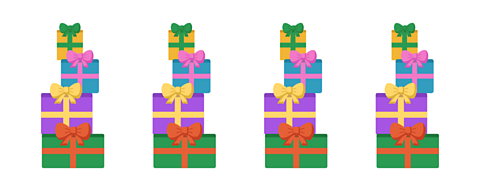
Are these groups equal?
✓Yes.
The groups are equal. One way to think about multiplication is to think about repeated addition.
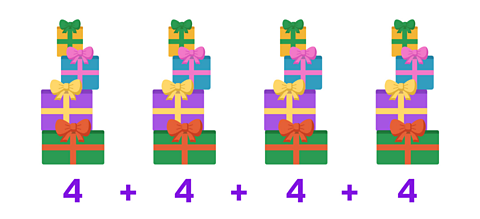
To solve this problem, you can add the equal groups together as one long addition calculation.
4 + 4 + 4 + 4 = 16
Example 2
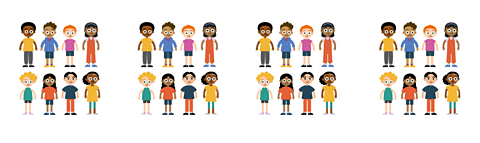
How many groups are there?
✓There are 4 equal groups of 8.
You can write 4 groups of 8 like this.
4 × 8 = 32
There are 32 children altogether.
Example 3

There are 6 stars in each group. How many times are they repeated?
✓5 times.
There are 5 groups of 6 stars.
6 stars have been multiplied 5 times.
6 × 5 = 30
There are 30 stars in total.
Karate Cats Maths game. game
Train with the Karate Cats to become an expert in addition and subtraction, multiplication and division, place value and more!

More on Multiplying and dividing
Find out more by working through a topic
- count8 of 32
- count9 of 32
- count10 of 32
- count11 of 32