What is the book about?
This guide is produced in partnership with Blue Peter.
Poems Aloud, written by Joseph Coelho and illustrated by Daniel Gray-Barnett, is the fifth title in the Blue Peter Book Club. A book full of poems to read, shout, whisper and enjoy. Poems that rhyme, poems that don't, long poems and even short poems - get ready to enjoy them by yourself or with friends!
You can get a sneak peek of the book over on Blue Peter.
Jump in and start performing your poems aloud.
Try twisting your tongue,
Then tuning your teeth,
Try taking your tonsils from a tummy, tickling thief,
My breather in your ear may delight,
Make you squirm and laugh and wiggle.
But I have something lovely to say a little thought to brighten your day.
We are a screeching melody,
THUMPING reverberations.
We are louder than crashing planets.
We are the thunderous cry of constellations.
How can you perform a poem in an interesting and exciting way?
The poems in this book are written to make you laugh, smile and think.
Most importantly, they aim to grow your confidence when reading and performing poetry.
But what's the best way to perform a poem?
Watch: Performing poems in different ways
Joseph Coelho, the author of Poems Aloud shows some of the interesting ways you can perform poetry.
How to perform poetry from BBC Teach.
Joseph: What I love about poetry is that you can perform it anywhere.There are performance spaces all around us — in the bedroom, in the playground, on a balcony. Even from outer space.
Through poetry, I get to play with words and experiment with how I say different things.Sometimes I perform a poem loudly:“The war drums boom and shake the metal from the land.”
Sometimes I perform a poem quietly:“The tiny mouse peeks and creeps as you sleep.”
Sometimes I perform a poem quickly:“Fantastic, fireworks fizz with fiery flames.”
Or slowly:“Yeah, I was at the end of the race, about to cross the finish line.”
Or mix it up:“The rain was pattering. Then the thunder boomed! The lightning zipped, zapped, snapped. I was drenched to the bone.”
When I'm performing a poem, I like to think about the tone of the poem.Is it a happy poem or a sad poem?Is it an angry poem or a confused poem?
Thinking about emotions in this way can help make the meaning of the poem more easily understood, by making the tone clear:“The grey clouds wept a bucket of rain down on me on the stone, grey streets.”
Sometimes a poem is written in the actual voice of a character, and if so, I will think about what that character might sound like:“I am the troll that lives under the bridge. I eat all manner of things. I once ate a fridge.”
As well as using your voice, you can also use your body when performing poems.You can perform a poem sitting:“My grandad's chair was a big leather, dusty thing where coins hid down the cushions.”
Or even laying down:“Gazing up at the winter sky, I saw the snowflake fall.”
You could also use actions.Your body can help bring a poem to life.Instead of just hearing the words, a body can help an audience see the world that the words create.
I often learn a poem off by heart to free up my hands, using simple actions and gestures to highlight certain words and phrases:“I crept past a tiger, ran up a mountain, leapt over a canyon and landed in a swamp.”
It's always lovely to notice the positive in a performance — to focus on what you noticed, what stood out, what made you smile and what you remember.
Sometimes when I perform a poem, I run out of things to say about the poem.I find it helpful to keep a list of words nearby — words like:interesting, dynamic, exciting, thrilling, emotional, hard-hitting.
Growing up, I used to love putting on a show, but it took me a while to realise that you can put on a show with poetry just about anywhere.Using all your acting skills to entertain friends or even tell someone that you miss them can be a whole lot of fun.
When performing poetry, you can experiment with:
- Volume: How loud you say the words; from a whisper to a shout.
- Mix it up: Mix up the volumes you use depending on the different parts of the poem.
- Tone: Think about the feeling of the poem to make the tone clear. Is it happy, sad, excited or angry?
- Body position: Think about what the poem is about. Would it be better to stand, sit or lay down?
- Actions: Use actions and gestures to emphasise important words or phrases.
Do poems have to rhyme?

Do you think that poems always have to rhyme? Well guess what? They don't always have to!
Sometimes, people try to force their poems to rhyme; this can make a poem boring and can sometimes mean it doesn't make any sense!
It's important that you choose the style of poem and words that make sense when using Words with the same ending sound such as cat and bat..
'Try' (page 4) from Poems Aloud is an example of a well-written rhyming poem.
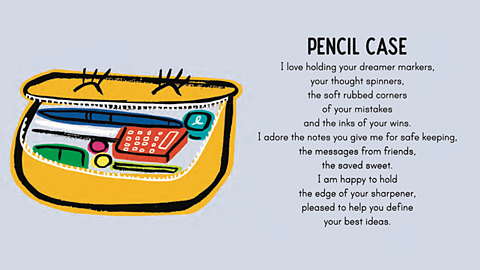
On the other hand, 'Pencil Case' (page 26) is an example of a Poems that don't rhyme or have a set structure. that doesn't rhyme.
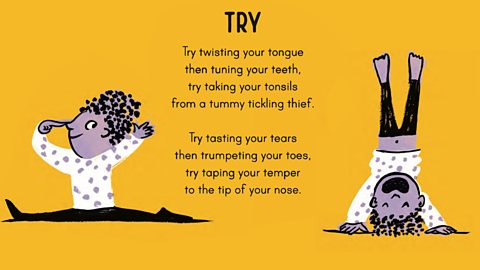
Image caption, 'Try' from page 4 of 'Poems Aloud'.
1 of 2
You can find out more about rhyming and non-rhyming poems with Joseph Coelho, in this video on BBC Bitesize for Teachers.
What is onomatopoeia and how do poems use it?

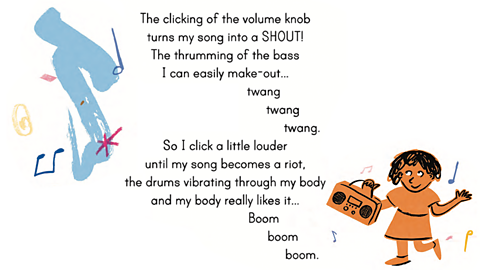
You will spot lots of sound words whilst reading Poems Aloud. When a word sounds like the noise it's describing, it's called Words that sound like the noise that they are describing..
Thud, crash, bang and buzz are all examples of onomatopoeia.
Onomatopoeia is a device (tool) that can help bring a poem to life! These words also help to create a The regular pattern of sounds that you can hear. within poems that makes them more interesting to read out loud.
Sometimes, onomatopoeia adds humour, especially in weird and wonderful Poems that have no structure and might not make sense.!
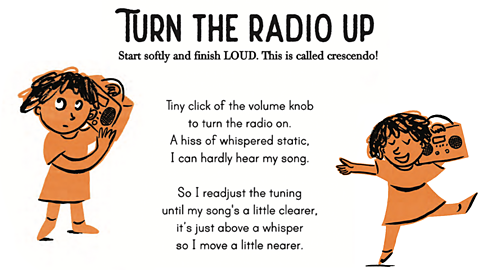
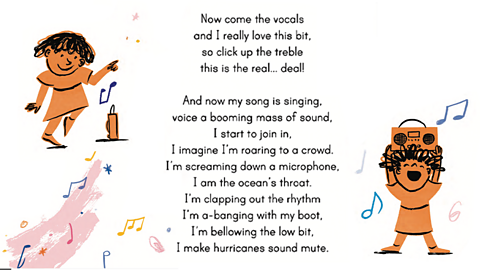
Image caption, Onomatopoeia is used very effectively in 'Turn the Radio Up' from Poems Aloud.
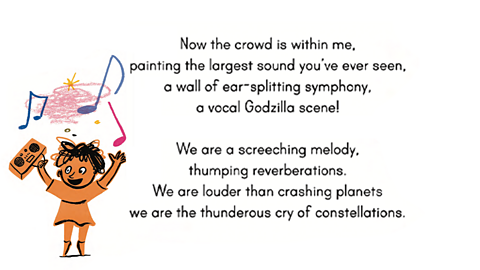
1 of 4
You can find out more about onomatopoeia from the author of Poems Aloud, Joseph Coelho on BBC Bitesize for Teachers.
How do you write a poem?
What's your favourite poem in Poems Aloud? The poems in the book are about lots of different topics; from robots, to bears, to chillies and puppets.
Poems can be written about anything and anywhere. Poetry can tell a story or be about your thoughts and feelings. They can be serious or silly, happy or sad.
Sometimes, you can give your poems a rhythm. Like a beat in music, the rhythm of your poem might be fast or slow depending on the words you choose.
Poems can rhyme, but they don't always have to. When a poem rhymes, it means that certain words have similar end sounds.
For example:
- break and lake
- cat and mat
- loud and proud

You can also use When more than one word starts with the same first letter or sound. in a poem. This is when more than one word starts with the same first letter or sound.
For example:
The slimy, sneaky snake slithered silently towards the feisty, furry fox.
Joseph Coelho imagines that writing a poem is like painting a picture with words. He likes to experiment with words as he writes his poems, so that the reader experiences different feelings depending on what he is writing about.
Explore more about how Joseph Coelho writes his poems, with this clip on BBC Bitesize for Teachers.
Activity 1
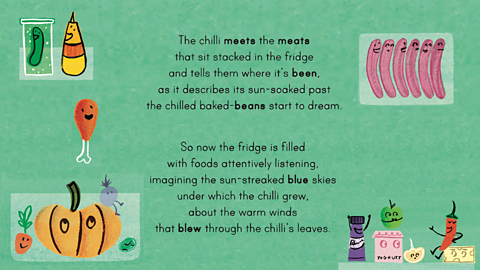
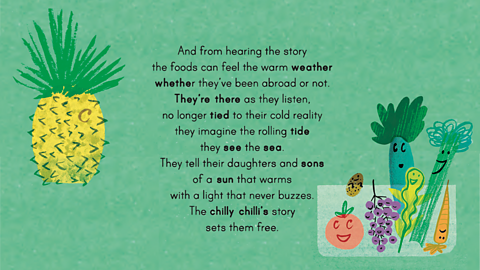
Read 'The Chilly Chilli' (pages 6 and 7).
Practise performing it using some of Joseph Coelho's tips.
Remember, you can perform poems anywhere and for everyone.
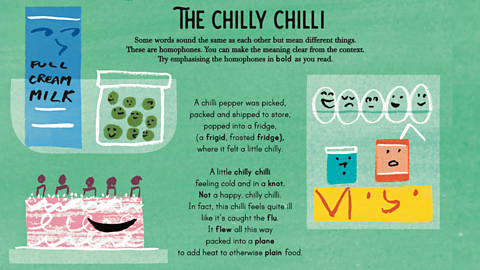
Image caption, 'The Chilly Chilli' from page 6 and 7 of 'Poems Aloud'.
1 of 3
Activity 2
Read 'Something Wondrous' (pages 8 and 9).
It's an example of how a well-written rhyming poem can be exciting and interesting to read.
Have a go at the quiz below, matching all the rhyming words from the poem together.
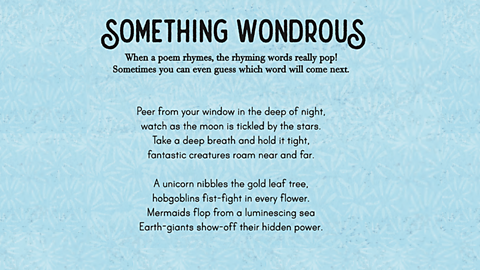
Image caption, 'Something Wondrous' from pages 8 and 9 of 'Poems Aloud'.
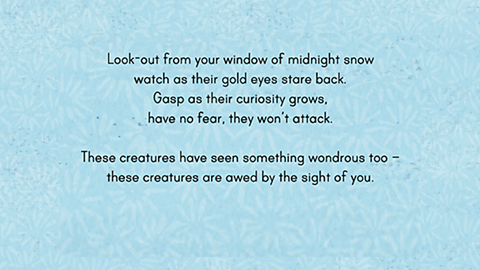
1 of 2
Activity 3
After reading Poems Aloud you might feel inspired to become a poet! Now it's your turn to have a go at writing a poem yourself.
You can write a poem about anything you want, wherever you want.
Start off by noting down some ideas about the subject of your poem. Perhaps you can write about something you enjoy, an object that you can see in front of you, a hobby or a feeling you have right now!
Next, think about the poetic devices (tools) that you can use, such as:
- rhyme
- free verse
- onomatopoeia
- alliteration
Remember, you don't have to use them all.
Most importantly, remember you might not write your poem perfectly on your first try! Spend time experimenting with different words, poetic devices (tools) and structures.

After reading Poems Aloud you might feel inspired to become a poet! Now it's your turn to have a go at writing a poem yourself.
You can write a poem about anything you want, wherever you want.
Start off by noting down some ideas about the subject of your poem. Perhaps you can write about something you enjoy, an object that you can see in front of you, a hobby or a feeling you have right now!
Next, think about the poetic devices (tools) that you can use, such as:
- rhyme
- free verse
- onomatopoeia
- alliteration
Remember, you don't have to use them all.
Most importantly, remember you might not write your poem perfectly on your first try! Spend time experimenting with different words, poetic devices (tools) and structures.
More on Blue Peter Book Club
Find out more by working through a topic
- count7 of 11

- count8 of 11

- count9 of 11