What is a cam?
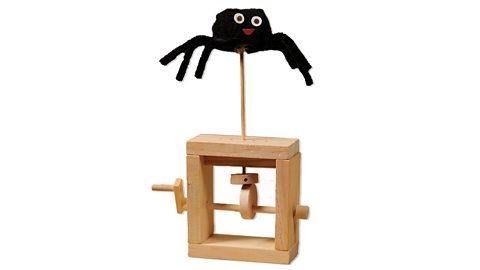
A cam is a simple mechanism that converts rotary motion (movement that goes round in a circle) into linear motion (movement in a straight line).
These mechanisms can be found in car engines, printing machines and sewing machines.
Video: Cam mechanisms
Join Sam in the workshop as he finds out about what cam mechanisms are and how they work.
Inside many machines and engines, there are cam mechanisms.
Cam mechanisms convert circular motion, turning around and around, into linear motion, which might be side to side, or up and down in a straight line.
As the cam mechanism turns, the linear motion is repeated over and over again, and this is called reciprocating motion.
Let’s take a closer look at how a cam mechanism works.
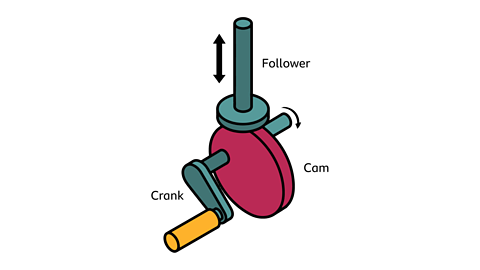
A cam mechanism is made up of three main parts: a cam, a follower and a slide.
Cams can be different shapes.
This one is shaped like a circle, but as you can see, the hole isn’t in the middle.
The cam is attached to a shaft, like this, and we can now use a crank handle to turn the shaft and cam round and round: the circular motion.
Next, we have the follower that is guided by the slide. As we turn the crank handle, the shaft and cam turn too.
The follower follows the edge of the cam, which pushes the follower up and down: the reciprocating motion.
The shape of the cam is what affects the motion of the follower, and cams come in all shapes and sizes. Round, oval, triangle, and even snail-shaped.
Each cam will create a slightly different type of reciprocating motion.
This is a triangle cam mechanism. As the cam turns, the triangular shape of the cam means the follower drops after each point of the triangle.
Cams are pretty hard to spot in real life, as they are often hidden inside machines such as engines, printing machines, sewing machines, or toys.
This walking toy, for example, has cam mechanisms attached to the legs, that help it walk.
Remember, cam mechanisms help convert circular motion into reciprocating motion.
What is reciprocating motion?

As the cam turns around over and over again, it changes the rotary motion of the cam into reciprocating movement.
Reciprocating motion means that the linear movement, in a straight line, is repeated again and again.
This movement could be forwards and backwards, up and down or side to side - as long as the movement is repeated and in a straight line.
What are the parts of a cam mechanism?
The cam is the part of the mechanism that rotates. A crank can be used to turn the cam.
The outer edge of the cam is in contact with a follower. As the cam rotates, it pushes the follower.
The movement of the cam causes the follower to move in a direction that is different to that of the cam.
The follower is often supported by a slide which keeps it in position.
How do different cam mechanisms work?
Cams come in many different shapes and sizes. Here are three common types.
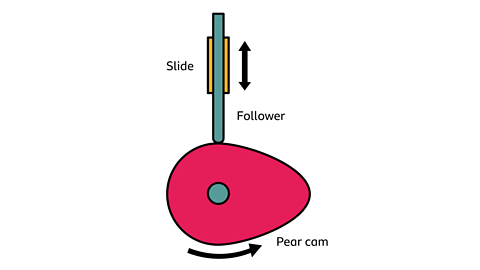
Pear cams
Pear cams are shaped like the fruit. When the cam turns, the top end of the pear cam pushes the follower up.
The follower falls and remains still when the bottom end of the pear cam makes contact with it. This makes an up and down movement with short pauses.
Pear cams can be found in fairground rides, sewing machines and printers.
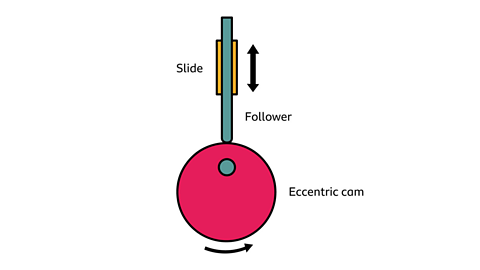
Eccentric cams
Eccentric means ‘not in the centre’. So, eccentric cams rotate at a point that is not the centre of the cam.
This type of cam will make the follower move up and down.
If a circular cam had a rod through its exact centre the follower would not move up and down.
Snail cams
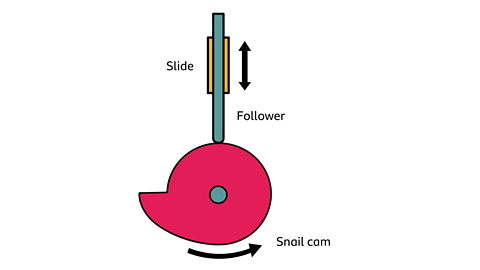
A snail cam has a spiral shape like the shell of a snail.
As it turns, the follower keeps still until it meets the top of the spiral. This pushes it up, before it drops down the flat edge of the snail shape.
Snail cams can be used to make an action happen at a regular time. For example, they can be used to make a clock sound a bell every hour.
Cam shapes
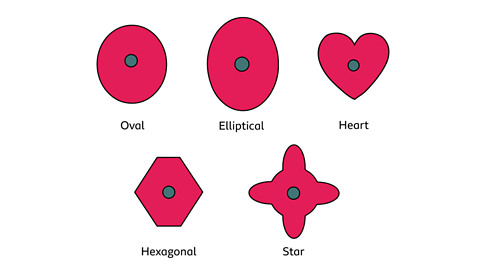
Cams can have many different shapes and each one will create a slightly different motion of the follower.
Take a look at some of these different cams and think about how they might make the follower move up and down.
Key words
| Cam mechanism | A cam mechanism is a mechanical device that converts rotary motion into linear or reciprocating (back and forth) motion. |
| Rotary | Rotary is where objects or components move in a circular path or spin around a central point. |
| Linear motion | Linear motion refers to the movement of an object in a straight-line path. |
Quiz
Can you remember the names of some common cam types?
More on Mechanical systems
Find out more by working through a topic
- count1 of 5
- count2 of 5
- count3 of 5
- count4 of 5