MR SMITH:
Hello, I’m Mr Smith and today we’re going to be looking at how we use the prefix “un” to change the meaning of a word.
The prefix “un” is placed at the beginning of a word, and it’s simply a case of adding “un” at the start of certain words.
But what does adding “un” actually do to a word?
Well, the “un” gives a word the opposite of its original meaning.
So, if you’re happy, you have a thumbs up.
But if you’re unhappy, then it’s a thumbs down.
When we add “un” to a word it makes it mean the opposite.
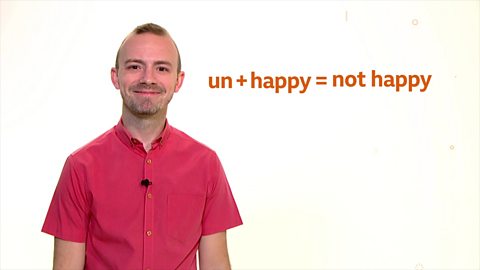
So, “un” plus “happy” equals “not happy”.
It’s the same with the word “tidy”.
If your bedroom is organised, then it’s tidy.
However, if your bedroom is messy and not organised, then it is untidy.
And “un” plus “tidy” equals “not tidy”.
Now it’s your turn.
Look at these words and their meanings.
Can you match them?
Take a good look.
Pause the video if you like.
Okay, let’s have a look and see if we can match them:
Unwell means not well.
Unfair means not fair.
Unhealthy means not healthy.
Unlucky means not lucky.
Uncertain means not certain.
There are some words that we can’t add “un” to.
And we’re going to test you on these now.
Here are six words.
We can add “un” to three of these words.
Which three words do you think they are?
The words are:
beautiful,
sure,
fluffy,
afraid,
friendly,
and heavy.
Have a think which three we can add the prefix “un” to.
OK, which three did you guess?
The correct answers are:
Unsure, which means not sure.
Unafraid, which means not afraid.
Unfriendly, which means not friendly.
Well done if you got those right!
Now we’re going to see if we can use words that contain the prefix “un” correctly in a sentence.
Take a look at these prefix “un” words: unpack,
unsure,
untidy,
unwell.
Here are some sentences that have a missing word.
Your job is to choose which word with the prefix “un” will complete the sentence.
The sentences are:
“After painting, the classroom was really…”
“Yasmin was… if she was going swimming on Monday or Friday”
“My sister is not going to school as she is feeling…”
“I need to… my clothes and put them away.”
Have you got the right words?
Well, the complete sentences are:
“After painting, the classroom was really untidy.”
“Yasmin was unsure if she was going swimming on Monday or Friday.”
“My sister is not going to school as she is feeling unwell.”
“I need to unpack my clothes and put them away.”
How did you get on? Brilliant!
So, now you know what role the prefix “un” plays in changing the meaning of a word.
Well done for all of your hard work today.
You’ve been “un-believable”!
For more help, challenges and games on this subject visit bbc.co.uk/bitesize
Description
The prefix un- usually means ‘not’, so the new word means the opposite of the original. For example, unkind means ‘not kind’. Mr Smith tells you more in this video.
Now playing video 5 of 7
- 1 of 7
- 2 of 7
- 3 of 7
- 4 of 7
- 7 of 7