DNA structure
The structure of DNA
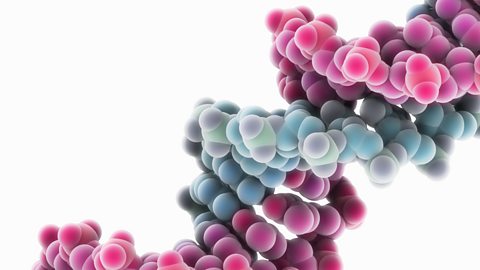
James Watson and Francis Crick worked out the structure of Deoxyribonucleic acid. The material inside the nucleus of cells, carrying the genetic information of a living being. in 1953. By using data from other scientists (Rosalind Franklin and Maurice Wilkins) they were able to build a model of DNA. The X-ray crystallography data they used showed that DNA consists of two strands coiled into a The shape of the DNA molecule, with two strands twisted together in a spiral..
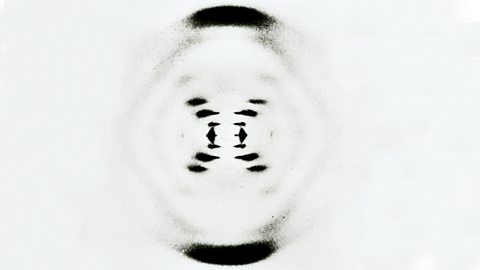
Image caption, The famous X-ray diffraction photograph of DNA taken by Rosalind Franklin, known as photograph 51
1 of 2
DNA is a polymer made from four different The units or molecules of which DNA is composed.Small molecule, usually containing a C=C bond, that can join end to end with other monomers to form a polymer molecule.. Each nucleotide monomer consists of a deoxyribose sugar and phosphate group with one of the four different Part of a nucleotide. Four bases (A,T,C, and G) are found in DNA. The base U replaces T in mRNA. attached to the sugar. The nucleotides are arranged in a repeating fashion to create DNA.
Base pairs - Higher
Each rung of the Deoxyribonucleic acid. The material inside the nucleus of cells, carrying the genetic information of a living being. 'ladder' is made of chemicals called bases. Note that these are different to bases in relation to acids and alkalis in chemistry.
There are four different bases in DNA:
- thymine, T
- adenine, A
- guanine, G
- cytosine, C
They always pair up in a particular way, called Refers to the specific way that the bases in DNA pair with each other ( A-T and G-C). base pairing:
- thymine pairs with adenine (T-A or A-T)
- guanine pairs with cytosine (G-C or C-G)
There are weak bonds connecting the pairs of bases between the two strands of the DNA.
The genetic code - Higher
A sequence of three bases (a triplet) is the code for a particular amino acid. This is why it is sometimes called the A sequence of three bases in DNA or mRNA which codes for a particular amino acid.. The four bases - A, T, C and G - can be arranged in 64 different ways. As there are only 20 possible amino acids, there is more than one code for each amino acid. There are also codes which mean 'start and 'stop'. The order of the bases controls the order in which amino acids are assembled to produce a particular protein.
