Electric fields
All electrically charged objects have an electric field around them.
There are two types of electrical charge:
- positive
- negative
In an electric field a charged particle, or charged object, experiences a force. If the forces acting on any object are unbalanced, it will cause the object to accelerate.
With this in mind:
- If two objects with the same charge are brought towards each other the force produced will be repulsive, it will push them apart.
- If two objects with opposite charges are brought towards each other the force will be attractive, it will pull them towards each other.
The three diagrams above are examples of electric fields.
The lines in the diagrams are lines of force. These show how charged particles will move in the electric field.
The direction of the arrow shows the direction in which a positively charged particle will move. The spacing between the field lines gives an indication of the strength of the force. If the lines are close together the force will be greater, eg close to a charged particle in a radial field.
In a uniform field the field lines are parallel. This indicates that the force is equal at all points in the field.
Negatively charged particles, for example electrons will move in the opposite direction to the arrow.
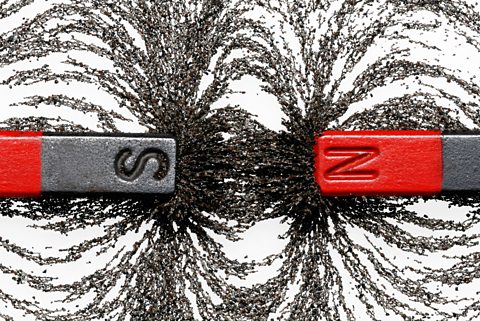
Here are two bar magnets with iron filings showing magnetic attraction between opposite poles: