Finding the EMF and internal resistance of a cell
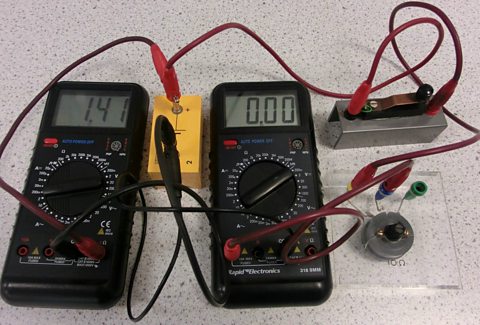
Watch this video to see how the EMF and internal resistance of a cell can be measured.
As shown in the video, to find the EMF and internal resistance of a cell, the following circuit is set up.
The A resistor where the value of the resistance can be changed. is altered and readings of potential differences across the terminals of the cell and current through the cell are taken. A graph of these results is then drawn as shown below.
At the point at which the line meets the terminal potential difference axis there is no current drawn from the cell. This is called the open circuit potential of the circuit.
Because there is no current there will be no lost volts so this value is the EMF of the cell. So the point where the line meets the terminal potential difference axis, (the y-axis intercept) is the EMF of the cell.
At the point where the line meets the current axis, (the x-axis intercept) the maximum current is drawn from the cell. This happens when the load resistance, \(R= 0\Omega.\)
This would be achieved by short circuiting the cell (this should be avoided as the cell could overheat and it is potentially dangerous). The maximum current is called the short circuit current, \(I_{SC}\).
To find the internal resistance of the cell the gradient of the line is calculated. This has a negative value. The internal resistance of the cell is the same value but without the negative sign. For example, if the slope of the line is \(- 4\) then the internal resistance is \(4\Omega\).
The internal resistance can also be found by dividing the EMF, \(E\), by the short circuit current, \(I_{SC}\).
