The purpose of punishment in public over time
Until the 19th century, punishments focused on ensuring that the population followed the rules of society. For example, the Tudors strongly believed that individuals should be able to look after themselves. Therefore, they punished Homeless, unemployed person who wandered the streets. for not following the rules and failing to support themselves independently.
However, when it became clear that public punishments weren’t working as a deterrent and that there were sometimes genuine reasons why individuals couldn’t support themselves. As a result, attitudes began to change and punishments began to move away from the public sphere.
Harsh punishments in the Saxon and medieval periods
To begin with, violence dominated Saxon punishments. The blood feud allowed a victim’s family to take To get revenge. on an offender. When this led to escalating violence, it was replaced with a fine - the wergild - paid to the victim’s family. Serious offences like The crime of betraying one's country, sovereign or government. and Deliberately setting fire to something, which is a crime. were punished by public execution as a warning to others.
After the Norman Conquest, the new king, William I, kept the system of fines but fines were now paid to the king rather than the victim. He also introduced the A law under which a whole village was responsible for finding a murderer and had to pay a fine to the king unless they could prove that the victim was not a Norman.
Many of the physical punishments that were used in later eras began in medieval times. The threat of physical pain, humiliation or death was used to deter people from committing crimes. Whipping or A punishment that involves a public beating, usually with a flexible stick. the A wooden frame with holes to hold the feet of someone convicted of a crime. and the A wooden frame with holes to hold the head and hands of someone convicted of a crime. and physical mutilation were all used in the medieval period. People who had committed serious offences were hanged, A belief or opinion which disagrees with the teachings of the Church. was punished by being burned alive, and traitors were hanged, drawn and quartered, known as a To die through being hanged (until near death), drawn (have their intestines pulled out) and quartered (body chopped into four pieces).
Public punishments in the 16th and 17th centuries
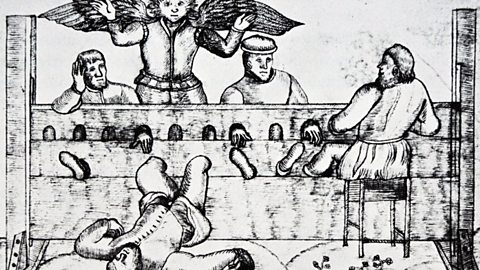
Between 1500 and 1700, nearly all punishments took place in public. For example, vagrants were whipped and sent back to their place of birth. Petty criminals were placed in stocks and pillories. ‘Sturdy beggars’, were vagrants who were well enough to be able to carry out work. They were branded with a hole through the ear if they were repeatedly caught begging.
Public punishments in the 18th and 19th centuries
Punishment in public continued into the 18th century. However, it gradually became less common. A Royal Commission on Capital Punishment (1864) concluded that executions should no longer be done publicly.
- Huge crowds were attending executions. These provided more opportunities for crimes such as pickpocketing. The crowds were often difficult to control.
- The crowds were seeing the execution as a form of entertainment. The government started to see that public executions were no longer having the effect of deterrence.
- The publicity of executions sometimes made the criminal famous and appear heroic.
Other forms of public punishment also stopped in the 19th century. Flogging was carried out inside prisons. The stocks and pillory were no longer used.
Public punishments in the 20th and 21st centuries
In modern times, community service is the only punishment carried out in public. In December 2008, the Home Secretary, Jack Straw, introduced the wearing of high-visibility vests as a response to public pressure to make this punishment more visible.
However, the media also provides a vehicle for public humiliation as it can report on punishments ordered by the courts. Local papers often report on recent sentences that have been passed, whereas national papers have been known to publish images of celebrities, or people from high-profile criminal cases, who have been sentenced to community service.
