Principle of moments
We utilise the turning effect of forces (moments) on a daily basis, for example when we use devices such as levers. However, in some circumstances we need to prevent the turning effect of forces by balancing them with an opposing moment. Understanding the principles involved allows us to both utilise and prevent the turning effect of forces.
Moments
A moment is the turning effect of a force around a fixed point called a A point around which something can rotate or turn.. For example, this could be a door opening around a fixed hinge or a spanner turning around a fixed nut.
The size of a moment depends on two factors:
- the size of the force applied
- the At right angles to. distance from the pivot to the line of action of the force
This explains why less force is needed to open a door by pushing at the side furthest from the hinge than at the side closest to the hinge. To push at the hinge side of the door requires more force to be exerted because the distance is smaller.
A moment can be calculated using this equation.
\(\text{M} = {\text{F}}\times{\text{d}}\)
where:
- M = the moment of the force in newton-metres, Nm
- F = the force in newtons, N
- d = the perpendicular distance from the line of action of the force to the pivot in metres, m
Worked example
A spanner is used to undo a nut. A force of 25 N is applied to the end of the spanner, which is 10 cm away from the centre of the nut. Calculate the moment when the spanner is horizontal.
10 cm = 10 ÷ 100
= 0.10 m
\(\text{moment} = {\text{force}}\times{\text{distance}}\)
moment = 25 × 0.10
= 2.5 Nm
Balancing moments
Where an object is not turning around a pivot, the total clockwise moment must be exactly balanced by the total anti-clockwise moment. We say that the opposing moments are balanced.
\(\text{sum of the clockwise moments} = {\text{sum of the anti-clockwise moments}}\)
See-saws
A see-saw has a pivot in the middle, which means that:
- the person on the right exerts a force downward – which causes a clockwise moment
- the person of the left exerts a force downward – which causes an anti-clockwise moment
If the people are identical weights and sit identical distances from the pivot, the see-saw will balance. This is because the total clockwise moment is balanced by the total anti-clockwise moment.
The see-saw can still be made to balance even if the people are different weights. To do this, the person who weighs the most must sit closer to the pivot. This reduces the size of the moment so the opposing moments are once again balanced.
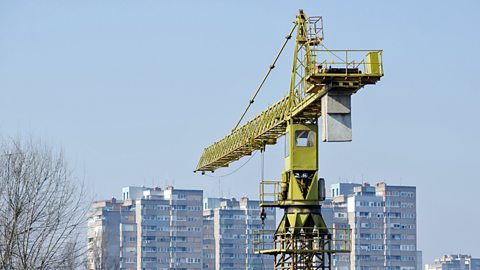
Cranes
Construction cranes lift heavy building materials using a horizontal arm called a jib. To prevent the crane toppling over, concrete blocks are suspended at the other end of the jib. They act as a counter-weight to create a moment that opposes the moment due to the load.