Changes in care and treatment - surgery
Surgery improved in the years c.1800 to c.1900 as a result of the work of James Simpson, on anaesthetics, and Joseph Lister, on antiseptics.
Surgery in 1800
Operations were very dangerous in the early 19th century. Common surgeries included The removal of a limb, for example an arm or leg. and the removal of growths. Surgeons had to work quickly because these surgeries caused pain as there was no A drug that causes loss of feeling or consciousness. Patients could die from shock and infections spread in the operating theatre.
James Simpson and anaesthetics
In the early 19th century, surgeons experimented with chemicals to find an effective anaesthetic:
- Laughing gas (nitrous oxide) was used but could not get rid of pain completely.
- Ether had side effects that irritated the eyes and lungs, causing coughing and sickness.
A more effective anaesthetic was found in 1847 by James Simpson, a professor of midwifery at the University of Edinburgh. He wanted to find a better anaesthetic to ease the pain women experienced in childbirth. One evening he was experimenting at home with his colleagues by inhaling different chemicals. Simpson realised very quickly that chloroform was an effective anaesthetic.
I poured some of the fluid into tumblers ... Before sitting down to supper we all inhaled the fluid, and were all “under the mahogany” [the table] in a trice [very quickly], to my wife's consternation and alarm.
Simpson wrote about his discovery so that other surgeons could use it when operating. However, there was some opposition to the use of chloroform:
- Some surgeons preferred their patients to stay awake so that they could fight for their lives.
- Religious people believed God intended for humans to experience pain, especially in childbirth.
- Some people were worried when Hannah Greener died during an operation on her toenail after being given too much chloroform.
In 1848, John Snow, who also discovered that A bacterial infection caused by contaminated drinking water. spread in dirty water, invented an A device used to breathe in a medicine. to measure the dosage given. In 1854, Queen Victoria used chloroform during the birth of one of her children. This led to its usage being more accepted.
Black period of surgery
With pain relief now available during surgery, some surgeons carried out longer and more complex operations. However, this could have a negative impact. When procedures were longer and more complicated, infections could develop deeper within the body and there could be more blood loss. The number of deaths from surgery may have increased between the 1850s and 1870s. This is known as the ‘black period’ of surgery.
Joseph Lister and antiseptics
Surgeons sometimes still wore dirty clothes to the operating theatre. Handwashing before operating was not always done because it was not known that bacteria caused infections in operations. Great progress came when A substance that kills or stops the growth of germs which cause disease. were discovered in 1867 by a surgeon called Joseph Lister. Lister knew about Pasteur’s germ theory and went on to discover that carbolic acid killed the bacteria in open wounds.
Lister recommended that:
- doctors and nurses should wash their hands in carbolic acid before an operation
- bandages and Threads used to tie blood vessels. should be soaked in carbolic acid
- a carbolic spray should be used to clean the area of an operation
Lister used these methods and the death rate in his operations fell from 46 per cent to 15 per cent.
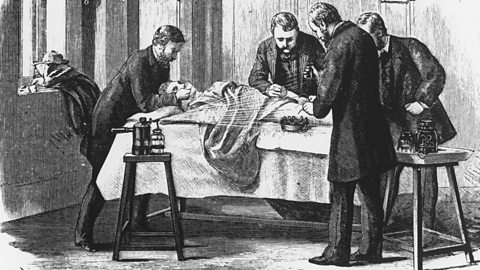
By the late 19th century, Lister’s antiseptic methods of killing the germs on a wound had led to the introduction of Surgery using precautions to lower the risk of infection from sepsis. This meant that even more germs were removed from the operating theatre, with the aim of creating a totally germ-free environment. Aseptic surgery included many aspects:
- the thorough cleaning of operating theatres before and after surgery
- the frequent cleaning of other areas of a hospital
- surgeons wearing To kill any living organisms, usually microbes that might cause disease, on an object or in a substance. gowns, masks and gloves
- all surgical instruments being sterilised using steam
