Types of volcano - composite and shield
There are two main types of volcano - composite and shield. The two types of volcano form in different places and have very different characteristics.
Composite volcanoes
Composite volcanoes, also known as stratovolcanoes, are found on When two tectonic plates move towards each other and collide., where the oceanic crust When one crustal plate is forced beneath the other. beneath the continental crust.
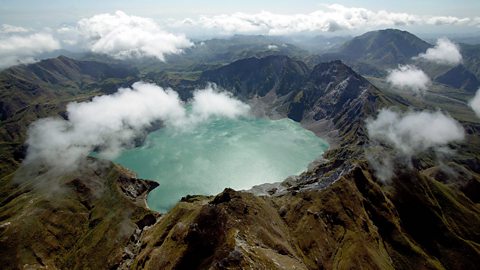
Composite volcanoes have the following characteristics:
- Andesitic magma, which is lower in temperature, has more silica and a lot of dissolved gases and is more likely to explode when it reaches the surface.
- Acidic lava, which is very viscous (sticky).
- Steep sides as the lava doesn't flow very far before it solidifies.
- Alternate layers of ash and lava. For this reason, they're also known as A volcano made up of alternate layers of ash and lava.. Strato means layers.
- Violent eruptions.
- Longer periods between eruptions.
Shield volcanoes
Shield volcanoes are found on An area where two tectonic plates are moving away from one another., where two plates move away from one another.
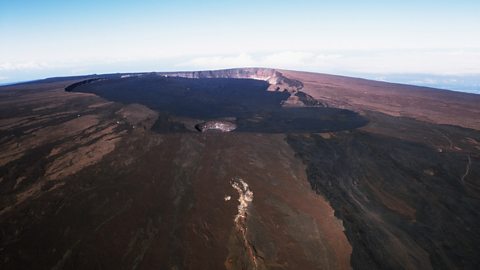
Shield volcanoes have the following characteristics:
- Basaltic magma, which is high in temperature, very low on silica and with low gas content. This type of magma produces fluid lava with very little explosive activity.
- Basic lava, which is non-acidic and very runny.
- Gentle sides as the Molten rock that is released from the Earth's core in a volcano or fissure. flows for long distances before it solidifies.
- No layers, as the volcano just consists of lava.
- Less violent eruptions.
- Shorter periods between eruptions.
Ash released from shield volcanoes often builds up around the vent forming a steep, round hill known as a cinder cone. A lava tube may also form, beneath the surface of the ground, when low viscosity lava develops a hard crust through which lava flows.
Caldera
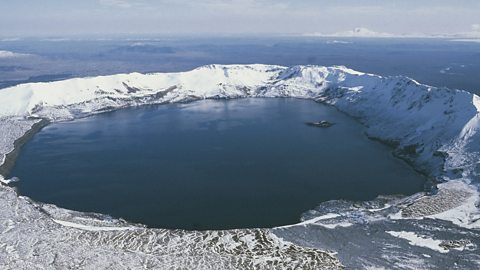
A A cauldron / depression shaped tectonic feature usually formed from the collapse of a magma chamber. is a large-scale volcanic crater that could be several kilometres in diameter. It is formed either when the magma chamber is emptied and the roof collapses, or through a massive explosive volcanic eruption. Many calderas fill with water to form large circular lakes.