Reactions of metals with water
When metals react with water, metal hydroxides and hydrogen gas are formed.
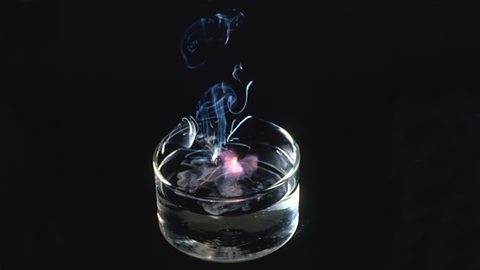
Potassium reacts quickly with water producing a lilac-coloured flame
For example, when potassium is added to water, the metal melts and floats. It moves around very quickly on the surface of the water. The metal self-ignites, which also ignites the hydrogen gas. This results in sparks and a lilac flame. There is sometimes a small explosion at the end of the reaction.
This can be represented in different ways as shown:
Word equation
potassium + water → potassium hydroxide + hydrogen
Chemical equation
2 K(s) + 2 H2O(l) → 2 KOH(aq) + H2(g)
