China's international political role
The United Nations
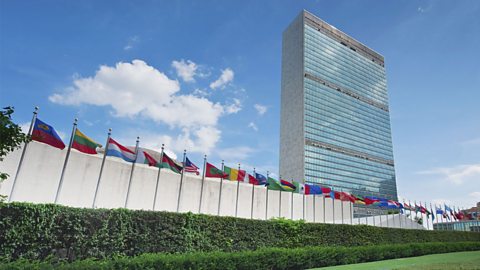
China joined the The successor to the League of Nations, the United Nations was established in 1945 as an international organisation designed to keep peace, uphold international law and set standards in human rights. in 1971 and has permanent membership on the UN A council in the United Nations, made up of fifteen member states that is responsible for maintaining international peace and security. (one of the permanent five, P5).
As China has grown wealthier, its contribution to the UN budget has increased. China will be the second-largest contributor to UN regular budget 2020, with its assessed contribution accounting for 12 percent.
However, although China has the world's second largest economy (in 2015), the UN recognises that per capita income is low (outside top 100 in world). As many as 100-150 million of the Chinese population live on or below the UN poverty line. It is for that reason that China cannot be expected to match the contribution of the US.
As one of only five permanent members of the UN Security Council, China has the opportunity to veto any proposal put forward by the Security Council. The Security Council is the part of the UN responsible for peacemaking and peacekeeping, as well as international sanctions. China's role on the Security Council makes it very influential within the UN and around the world.
In May 2022, Russia and China vetoed a US-drafted United Nations Security Council resolution to strengthen sanctions on North Korea, arguing the new sanctions on would not stop its weapons program and may instead increase its level of testing. US ambassador to the UN, Linda Thomas-Greenfield, called the veto a threat to the peace and security of the entire international community
. (Source: United Nations)
Chinese diplomatic contacts have helped to influence the North Korean government to adopt a more moderate position over its nuclear program. Over recent years, in an effort to defuse international tension over North Korea's nuclear ambitions, China has imposed economic sanctions on its dependent neighbour in order to apply pressure.
G7 and G20 Group
China is a member of the G7 and G20 economic groups. These groups contain most of the countries in the world with the largest economies.
Summits or meetings of the leaders of the G7 countries offer the opportunity for China and other group members to develop closer economic ties to expand trade. Membership also allows China another forum to discuss issues of global concern such as climate change, terrorism or trade.
The G20 has similar aims to the G7 but includes an additional 12 members to reflect the growing economic importance of countries such as Brazil, India and Indonesia.
The growth of the Chinese economy has resulted in an increase in the global political influence China, under Xi JingPing, now holds.
