Herbert Hoover versus Franklin D Roosevelt
President Herbert Hoover thought the Great Depression had been caused by worldwide problems that were beyond America’s control. He believed that it would be over quickly. As a self-made millionaire, Hoover believed in Personal liberty and free competition, and the idea that people should be self-reliant. However, many Americans lost faith in Hoover’s ability to lead them out of the Depression. During the 1932 presidential election, Franklin D Roosevelt offered an alternative perspective on the Depression, as was subsequently elected to become the next President.
Hoover’s response to the Great Depression
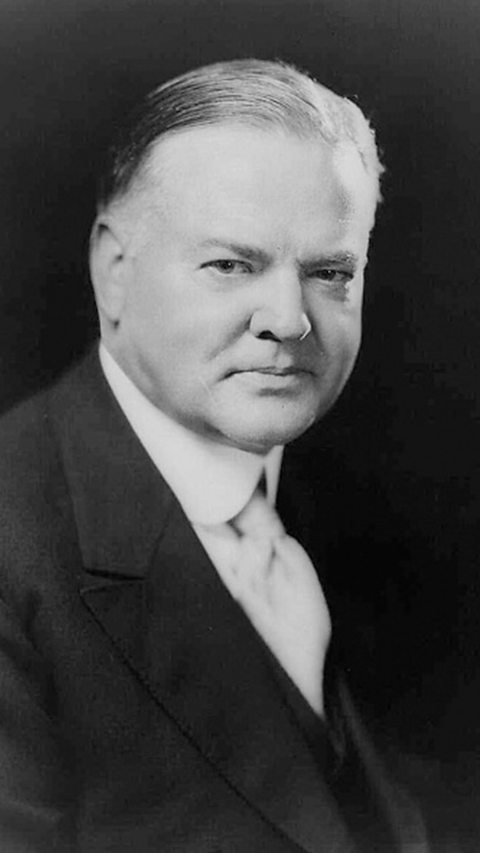
When the Depression hit, Hoover optimistically declared that “prosperity is just around the corner”. He believed that the solution was not Part of the government of the USA as a whole rather than relating to an individual state. government intervention but rugged individualism, private charity and local communities helping those in need. He was also keen to keep a Not spending more money than the amount of money coming in.
However, Hoover did take some action:
- The 1930 Hawley-Smoot Tariff Act added more taxes to foreign goods to make US goods appear cheaper and encourage the American people to buy them. The intention was to help to put money back into the economy.
- The Reconstruction Finance Corporation was set up in 1932 to lend money to businesses in need.
- Hoover made $300 million available to states for public works projects, such as building roads and schools. However, only $30 million was used.
There was a view that Hoover did too little, too late.
Hoover’s unpopularity
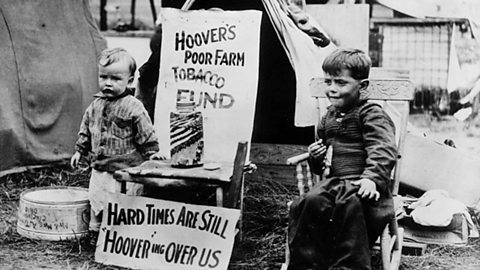
Despite these interventions, the economy did not get back on track. Hoover was increasingly mocked and blamed for the continued hardships. He became very unpopular. On the edges of many American cities, homeless people lived in shacks made from cardboard and any other waste material they could find. These A shanty town, slum or favela is a name given to a spontaneous settlement. It is an illegal occupation of terrain in a city where dwellers often have to live without basic infrastructure, such as water, sewage, electricity, garbage collection and mail. and shacks became known as ‘Hoovervilles’. Newspapers used as blankets were called ‘Hoover blankets’.
The 1932 Bonus March
In June 1932, around 20,000 unemployed A person who has served in the armed forces. asked for their war bonuses of $1,000 to be paid early. They protested and set up a camp in Washington, DC, and they became known as the Bonus Army. However, President Hoover had little sympathy for their proposal. He ordered General Douglas MacArthur to drive them away with guns, tanks and tear gas.
The 1932 presidential election
Hoover’s opponent in the 1932 presidential election was Franklin D Roosevelt of the Political party in the United States. Democrats tend to hold a more liberal viewpoint on politics and society. Roosevelt had been elected A person who is elected to lead a state’s government in the USA. of New York in 1928.

In contrast to President Hoover, Roosevelt was charismatic and an effective public speaker. He toured the country meeting voters and campaigning to persuade Americans to vote for him. In 1921 he had contracted polio (a spinal disease), which had left him permanently paralysed from the waist down. Some of the voters believed that Roosevelt’s ability to overcome personal difficulties made him more relatable to ordinary Americans.
During the election campaign, Roosevelt pledged what he called a New Deal for the American people. If elected, he proposed the following policies:
| Policy | Description |
| Relief | Help for the homeless, sick, elderly and unemployed |
| Recovery | Creating jobs and getting the economy back on track |
| Reform | Measures to protect Americans against another depression |
| Policy | Relief |
|---|---|
| Description | Help for the homeless, sick, elderly and unemployed |
| Policy | Recovery |
|---|---|
| Description | Creating jobs and getting the economy back on track |
| Policy | Reform |
|---|---|
| Description | Measures to protect Americans against another depression |
The election outcome
With President Hoover and One of the two major American political parties. Republicans tend to hold a more conservative viewpoint on politics and society. being blamed for the Depression, Roosevelt won the election in a huge victory. Only 6 out of the 48 states voted for Hoover.
