Metals, non-metals and metalloids
Moving from left to right across a A row of elements in the periodic table., the A substance made of one type of atom only. become less metallic. This is related to the increase in the number of Subatomic particle, with a negative charge and a negligible mass relative to protons and neutrons. in the outer shell of their All elements are made of atoms. An atom consists of a nucleus containing protons and neutrons, surrounded by electrons.. The atoms become more likely to gain or share electrons, rather than lose them when they form A substance formed by the chemical union of two or more elements..
Metals
Metals tend to have similar The characteristics of something. In chemistry, chemical properties include the reactions a substance can take part in. Physical properties include colour and boiling point.. They are always good A material which allows charge to move easily through it. of electricity and heat, and they are always lustrous (shiny when cut). The majority of metals usually share these properties:
- high melting point
- hard (difficult to scratch)
- malleable (can be beaten into shape)
- ductile (can be pulled into wires)
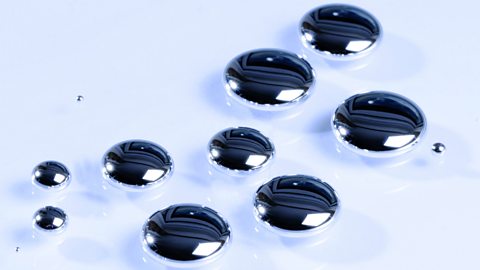
There are some exceptions though. For example, mercury is a liquid at room temperature. The metals in Group 1, such as lithium, sodium and potassium, are all soft.
Non-metals
Non-metals have a variety of properties, but very few are good conductors of electricity. Graphite (a form of carbon) is a rare example of a non-metal that To allow electricity, heat or other energy forms to pass through. electricity very well.
Many non-metals have low melting and boiling points. When non-metals are in a solid state, they are usually brittle so you can’t beat them into shape.
Metalloids
Some elements between the metals and non-metals in the periodic table have properties which are a mixture of the properties of metals and non-metals. These elements are called metalloids or semi-metals.These elements are found close to the zig-zag line that separates the metals from the non-metals.
Examples of metalloids
- Carbon – a dull, dark grey solid and is brittle (non-metallic properties) but has a high melting point and is a conductor of electricity and heat (metallic properties).
- Silicon – a shiny grey solid, an electrical conductor and has a high melting point (metallic properties) but is very brittle and has a low density (non-metallic properties).
