Explorers - Francis Drake, John Hawkins and Walter Raleigh
Who were the explorers?
There were several men who tried their luck at sea-voyages. It was a dangerous business, but the potential rewards were huge, so it attracted men from all walks of life. Some of the most notable included:
Sir Francis Drake
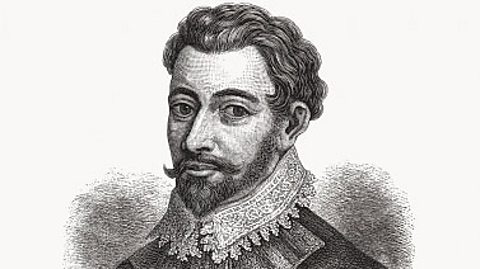
Sir Francis Drake was the first Englishman to sail around the world, To travel all the way around the circumference, of the world. the globe between 1577 and 1580. He went on to play a role in the Spanish Armada by attacking Cadiz in 1587 and delaying preparations. He was also Vice-Admiral of the Navy during the Armada.
As a result of his travels, Drake launched successful attacks on the Spanish Empire, bringing back gold, silver and jewels, making a huge profit.
Sir Walter Raleigh
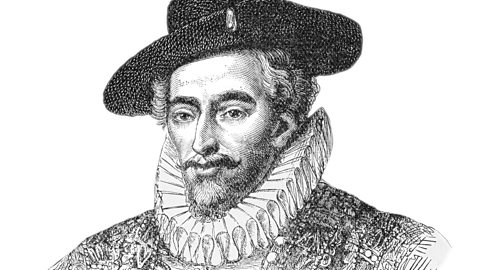
Walter Raleigh was a famous sailor, explorer and courtier . Queen Elizabeth I invested in his privateering expeditions against the Spanish. He wanted to establish colonies for Elizabeth in North America to open up trade routes in Asia. The area was thought to have a very large supply of wine, oil, sugar and flax; it would reduce England’s trading dependence upon Europe.
He also wanted to build an English empire to rival those of Spain and Portugal. Raleigh hoped that gold might be found in North America, just as it had been in Spanish colonies in Central and South America. In 1584, Queen Elizabeth I gave Raleigh permission to explore and colonise parts of North America , in return, she would receive one fifth of any gold or silver discovered.
Other explorers
Dr John Dee
Dr John Dee was an expert in navigation, astronomy, mathematics and astrology, and an advisor to Queen Elizabeth I. Dee believed that England should challenge the power of Spain and Portugal by building its own overseas empire. In 1577, he presented the idea of a British Empire that stretched across the Atlantic. John Dee produced a map and books to justify the colonisation of North America. He argued that the Atlantic voyages of John and Sebastian Cabot after 1497, gave Elizabeth a claim on the land and therefore England had a right to colonise it. Dee’s knowledge of navigation also helped English sailors learn how to cross the oceans.
Humphrey Gilbert
Humphrey Gilbert was an explorer and soldier. He wanted to find a north-west passage to China and dreamed of building an English empire in North America. He also hoped to weaken Spain by using colonies as bases to attack Spanish ships. In 1578, Queen Elizabeth I gave Gilbert permission to establish a colony in North America. In 1583, he sailed to Newfoundland and claimed it for England. However, due to illness, food shortages and storms, the colony failed. On the return journey, Gilbert’s ship sank and he was lost at sea.
Ralph Fitch
In 1583, English merchant Ralph Fitch, together with a group of London merchants, sailed to Syria and then travelled over 3,000 miles to India — one of the first English attempts to trade with the powerful Mughal Empire. The Portuguese were already firmly established in India and closely guarded their trading interests, so the English made little progress at first. However, Fitch’s long journey provided valuable information about India, its markets, and trading opportunities. His experiences would later help other English merchants, including those who founded the East India Company.
