Population density – Intermediate and Higher tier
Population density (often abbreviated PD) is a compound measure that tells us roughly how many people live in an area of known size. It is commonly used to compare how 'built-up' two areas are.
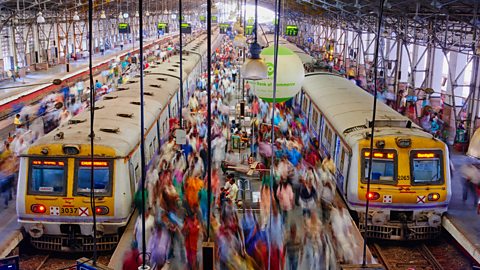
For example, Mumbai is one of the most densely populated cities on earth with roughly 29,650 people/km2. London, on the other hand, has a population density of around 5,100 people/km2, not even a fifth of that of Mumbai!
The equation for population density is:
\(\text{population~density}=\frac{\text{population}}{\text{land~area}}\)
It is most commonly measured in population per square kilometre.
Question
Athens, the capital city of Greece, has a population of 3,685,000 and a land area of 684 km2. What is the population density of Athens? Give your answer to 2 decimal places.
\(\text{population density}=\frac{\text{population}}{\text{land area}}\)
\(\text{population density}=\frac{\text{3,685,000 people}}{\text{684}~\text{km}^{2}}\)
\(\text{population density = 5,387.43}~\text{people/km}^{2}\)
Question
Calculate the area of Las Vegas if it has a population density of 1,750 people/km2 and a population of 1,300,000 people. Give your answer to 2 decimal places.
\(\text{population~density}=\frac{\text{population}}{\text{land~area}}\)
So rearranging:
\(\text{land~area}=\frac{\text{population}}{\text{population~density}}\)
\(\text{land~area}=\frac{\text{1,300,000}}{\text{1,750}}~\text{km}^{2}\)
\(\text{land~area}=\text{742.86}~\text{km}^{2}\)
More guides on this topic
- Loci and constructions - WJEC
- Pythagoras' theorem - Intermediate & Higher tier - WJEC
- Trigonometry – Intermediate & Higher tier - WJEC
- Enlargements/Similar shapes - Intermediate & Higher tier - WJEC
- Maps - WJEC
- Conversion between metric and imperial units - WJEC
- Dimensional analysis - Intermediate & Higher tier - WJEC
- Perimeter and area - WJEC
- Surface area and volume - WJEC
- Video playlist
