The medical Renaissance of the 16th and 17th centuries
The Renaissance led to renewed interest in the knowledge of the ancient Greeks and Romans. Their medical books could now be spread more easily following the invention of the mechanical printing press in around 1440.
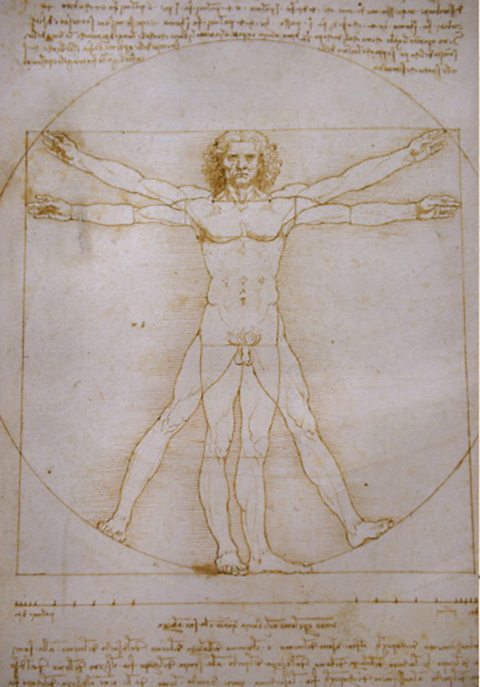
The Vitruvian Man is a drawing by Leonardo da Vinci that shows the proportions of the human body
The voyages of discovery of Christopher Columbus from 1492 brought new plants for herbal remedies as well as tobacco to Britain. Renaissance artists, such as Michelangelo and Leonardo da Vinci, studied the human body closely to replicate it in art. This helped to further medical knowledge.
However, these ideas also encouraged people to think for themselves. Soon, they began to challenge old ideas, eg the teachings of Hippocrates and Galen. For example:
- Doctors such as Andreas Vesalius and William Harvey began to experiment and to develop new ideas about anatomy and the circulation of blood.
- The invention of printing meant that medical textbooks with accurate sketches of the human body could now be produced more cheaply. This helped ideas to spread rapidly.
- New weapons, eg gunpowder, forced battlefield doctors to think about new ways to treat wounds.
