The importance of limiting factors – Higher
Limiting factors of photosynthesis reduce yields of crops and other economically-important plants. Conditions can be set up in greenhouses and outside tunnels to reduce the effects of limiting factors.
Light
Increasing the light intensity in greenhouses will increase the growth of crop or horticultural plants.
Plant growers can:
- use greenhouses constructed from glass or alternative materials that enable maximum transmission of light
- position plants for maximum light absorption
Artificial lighting systems can be used:
- with increased light intensities
- that provide optimum The length of a single wave, measured from one wave peak to the next. of light for photosynthesis
- that lengthen a plant's growing season so that crops can be grown in more months of the year
Carbon dioxide
Many plants have the capacity to use additional carbon dioxide.
The table shows an example of data collected by Robb and Wittwer (1964) on plants grown in normal, and carbon dioxide-enriched greenhouses.
| Normal yield | Enriched yield | |
| Lettuce | 0.9 kg | 1.1 kg |
| Tomatoes | 4.4 kg | 6.4 kg |
| Lettuce | |
|---|---|
| Normal yield | 0.9 kg |
| Enriched yield | 1.1 kg |
| Tomatoes | |
|---|---|
| Normal yield | 4.4 kg |
| Enriched yield | 6.4 kg |
To increase the carbon dioxide concentration in a growing area, plant growers:
- use paraffin heaters on a small scale
- on a larger scale, use carbon dioxide wastes from industrial processes that has been cleaned up before use
- can use liquid carbon dioxide, applied through pipes, though this can be expensive
- sometimes use A large group of eukaryotic organisms that contain single-celled yeasts, moulds and mushrooms., grown as a The network of hyphae produced by a fungus. in bags around the greenhouse, that add carbon dioxide through their respiration
The concentration of carbon dioxide in greenhouses is often kept at around 0.1 per cent. Above one per cent, carbon dioxide changes cell Scale of acidity or alkalinity. A pH (power of hydrogen) value below 7 is acidic, a pH value above 7 is alkaline. – it makes it more Having a pH lower than 7. – and it becomes Poisonous..
In greenhouses at higher temperatures, photosynthetic production declines, and carbon dioxide supplements have no effect.
Water
The channelling of water from rivers and streams to fields in order to help crops grow. systems in greenhouses help to increase yields. Plants in greenhouses are often sprayed with water to keep the The amount of water vapour in the atmosphere measured as a percentage. high.
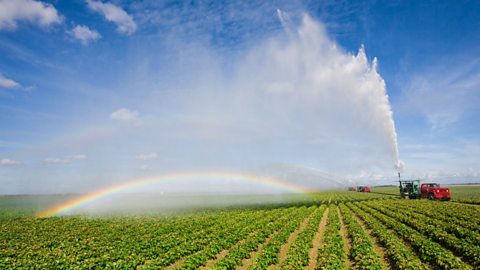
Growers must find a balance as high humidity will promote the growth of Microorganism that causes disease. fungi.
Irrigation systems are also used outdoors.
Plants are sometimes grown in liquid systems called hydroponics. A system that involves growing plants in a porous material (other than soil) and allowing water containing nutrients to filter through it. allow the grower to optimise mineral Naturally occurring, inorganic chemical substances. Minerals are necessary for both plant and animal health. given to plants. Mineral ions are required to synthesise other essential molecules from the glucose produced during photosynthesis.
Temperature
Heat is often used in greenhouses and makes plant growth possible when the weather is cold outside.
Increased temperatures in greenhouses increase the rate of photosynthesis. Temperature regulation is important – note that cooling may also be required.
