Joseph Haydn and chamber music
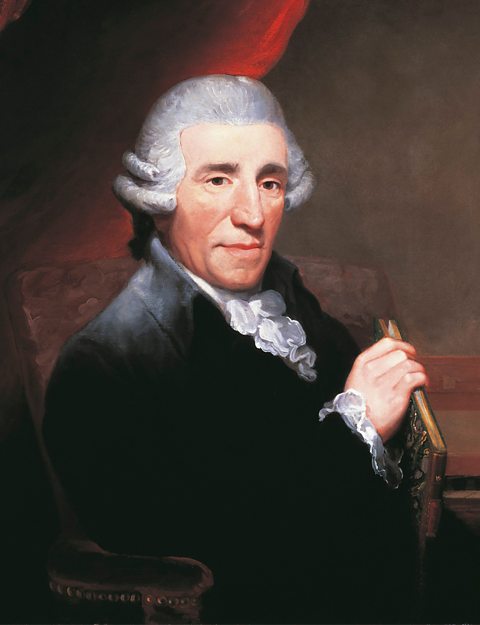
Franz Joseph Haydn
Joseph Haydn was known as the father of the string Music written for four players. as he turned what used to be considered background music into well-respected pieces of music for performance. He composed a conversational style of playing where each part had its own role.
Chamber music
In the 1600 - 1750. , wealthy aristocrats began to employ professional musicians as part of their household staff. These musicians would compose and perform music to a small audience as a small ensemble, with one player per part and no conductor. This is the beginning of what we now call Music written for a small ensemble..
The string quartet developed out of the Baroque A piece for two solo instruments and a continuo part.. This featured two violins and a basso continuo accompanying part - a cello or bassoon, and a harpsichord, organ, lute or other chordal instrument. Basso continuo means continuous bass, which was a feature of Baroque and early Classical music. Baroque music often had Interweaving melodic parts, also known as polyphonic. or A texture where lines of music move independently. layers. When textures in the 1750 - 1825. became clearer, the complex continuo part was dropped in favour of the more balanced string quartet, which became very popular.
During the 1825 - 1900. , which followed the Classical period, chamber music continued to be popular, but was played in larger public concert settings as well as smaller venues. The string quartet remained a common feature, but the new pianoforte was often introduced. Composers experimented with instrumental combinations and the music became more complex as the construction of instruments advanced over time. Romantic music was lyrical and expressive, and this was reflected in chamber music writing.
Haydn’s String Quartet No.2 in E♭ major
Haydn’s String Quartet No.2 in E♭ major was first performed on Christmas day 1781. The Opus.33 Quartets are known as the Russian Quartets and String Quartet No.2 is known as The Joke because it is unclear when the ensemble has finished. This piece of music has features typical of a Classical string quartet.
