Manifestations of the Divine - the Trimurti
Hindus perceive In Hindu belief, the absolute reality that is the true essence of all existence, God. in various forms. Hindus worship Brahman through both male and female In Hinduism, deity is one god or goddess. Deities is the word for gods and goddesses many Hindus believe are different aspects of the one Supreme Spirit, (Brahman).. Each Hindu worships their own preferred form of Brahman, known as The god that a Hindu prefers to worship.. There are three main male deities known as the The three main deities of Hinduism. Refers to Brahma, Vishnu and Shiva., which means ‘three deities’. The three main male deities are A Hindu deity, considered one of the Trimurti, and in charge of creative power; not to be confused with Brahmin or Brahman. Not widely worshipped by Hindus. (who is linked to A Hindu goddess associated with art, music and learning.), Vishnu is the aspect of Brahman responsible for the preservation of the world. Vishnu forms one part of the Trimurti, along with with gods, Brahma and Shiva. (who is linked to The goddess of wealth.) and A Hindu deity. The aspect of Brahman responsible for destruction and renewed creation. Some Hindus regard Shiva as the one Supreme Deity. (who is linked to A Hindu goddess often portrayed as Lord Shiva's romantic partner and Lord Ganesh' mother. Parvati represents the continuity of life. ).
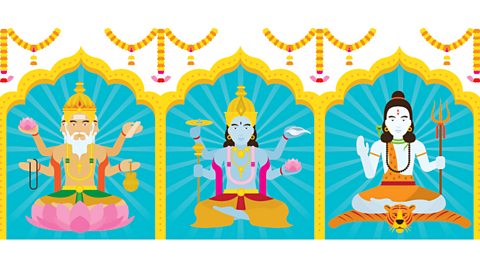
The three aspects of the Trimurti represent different parts of the continuous cycle of In Hinduism, Buddhism and Sikhism, this is the cycle of life, death and rebirth.. Firstly, Brahma is the creator. Secondly, Vishnu is the protector. Finally, Shiva is the destroyer. The different parts of the Trimurti link to three key human qualities or gunas which are:
- tamas - ignorance
- rajas - passion
- sattva - goodness
Brahma
Brahma is the father of creation. He is shown as having four heads and four arms, with the different heads turned towards the four directions of space. In his hands, Brahma is often depicted holding five objects:
- a rosary - symbolising time
- a water pot - showing the potential for creation
- a sceptre in the form of a spoon - representing the pouring of holy oil during prayer, showing that Brahma is the lord of sacrifices
- sacred texts (the Vedas) - showing that Brahma makes all knowledge possible
- a lotus flower - to represent the lotus that Brahma evolved from
Brahma is often shown seated on a divine swan, signifying the journey of the individual soul as it travels onward to its true home – union with Brahman. Only one temple devoted exclusively to Brahma exists in India, in Rajasthan.
Vishnu
Vishnu (otherwise known as the Pervader) incarnates in multiple forms, or The Hindu word for incarnation of a god in a human (or animal) form on Earth. The spelling ‘avatara’ comes from the Sanskrit., to fulfil his role as protector of the universe. Hindus believe that there are ten avatars of Vishnu and that, to date, he has incarnated nine times. Many believe that the tenth avatar (known as Kalki) is yet to appear on Earth. The Vishnu Purana, which is a detailed text about Vishnu, states that Kalki will appear at the end of this present cycle of creation. He will carry a sword and ride on a white horse, and he will travel to the four corners of the Earth to hand out justice and punishment to those who have done wrong.
Vishnu is a very important deity. He is portrayed as dark blue in colour and is usually shown standing upright. This suggests he is always watching over creation. He has four arms, representing his supreme power. In his hands he holds four items:
- A conch (a shell). This is often blown at the start of Hindu ceremonies. It is linked with the sound ‘om’ or ‘aum’, which is said to hold all of creation.
- A discus (or chakra). This represents the power of Vishnu’s divine thoughts. Hindus also believe it has been used to cut off the heads of demons who threatened The duties a Hindu should follow in life. with their evil thoughts.
- A mace, which represents Vishnu’s control over time. Some Hindus also view it as a symbol of knowledge.
- A lotus flower, which is a sign of Vishnu’s purity, serenity and creative ability.
Hindus who prefer to worship Vishnu are known as Vaishnavites.
Shiva

Shiva is known to Hindus as both the Destroyer and the Transformer. His acts of destruction brings about rebirth and change. He represents internal understanding or self-awareness. Shiva is also the god of yogis and Any form of religious practice. Often used to mean meditation or adopting various forms of posture for the purpose of spiritual development..
Shiva is shown with a third eye in the middle of his forehead. This reminds Hindus that he has the ability to see beyond what humans take at face value. Many Hindus believe that Shiva’s third eye opens when he intends to destroy that which is evil, expired or outdated. The king of serpents, Vasuki, is coiled around his neck. It is a sign of Shiva’s tranquil, gentle nature that such a creature feels comfortable enough to place itself around his neck. It is also evidence that Shiva has conquered all fear and feels no threat from a creature most people would avoid. Some Hindus see the snake as a symbol of the need for mental alertness. Upon Shiva’s head rests a crescent moon, which represents the mind achieving spiritual wisdom.
Shiva is known as the Lord of Dance, and classical Indian dancers always offer worship to him on stage before they perform in public. Shiva holds a trident or trishul, whose three spikes represent the three gunas. Shiva’s possession of the trishul reminds Hindus that he is beyond these three qualities and also beyond the three states of waking, dreaming and sleeping.
