Radial symmetry
Not all symmetry in art and design is based on balancing the left and right of a composition. Radial balance relates to elements that spread out from a central point. When the visual weight of these elements is evenly spread, the result is radial symmetry.
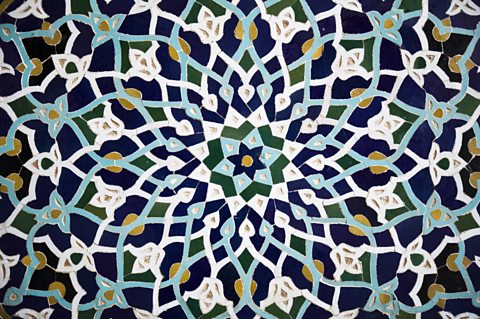
This mosaic from the Jameh Mosque of Isfahān in Iran is arranged around a central point. Star and flower shapes radiate out from here.
The design is very symmetrical but the level of detail and sense of shapes flowing into each other keeps the composition interesting.
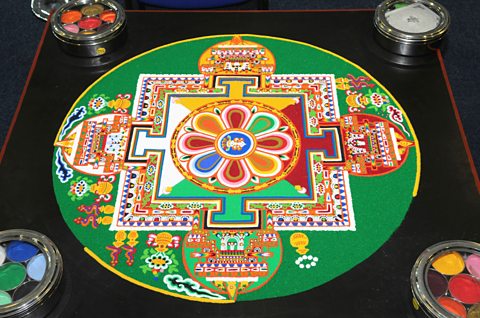
Radial symmetry creates a sense of order and harmony in this Vajrasattva sand mandala.
Although different colours and details are used in different directions, the Relating to geometry and featuring straight lines and regular mathematical shapes and forms such as squares, circles, triangles, cubes and spheres. shapes grouped around a central point create an arrangement that feels perfectly balanced.
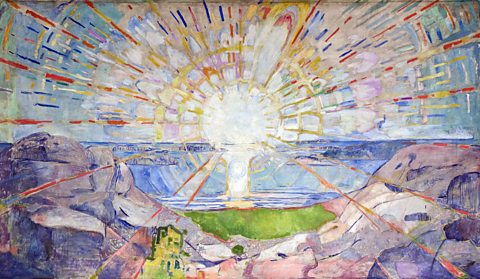
The Sun (Edvard Munch, 1911-16) features asymmetrical balance in the shapes used to show the rocks and shoreline. But the painting is dominated by radial symmetry created by the lines of sunlight that spread out from the bright centre and fill the entire frame.
