Carbon dating
Carbon-14 is radioactive and is found in all living organisms.
Plants absorb carbon dioxide from the atmosphere and animals eat plants.
This means all living things have radioactive carbon-14 in them.
When an organism, eg a tree, dies it stops taking in carbon dioxide.
The amount of carbon-14 in the wood decreases with time as it decays into nitrogen with a half-life of about 5730 years.
By comparing how much carbon-14 there is in the dead organism with the amount in a living one, the age of the dead organism can be determined.
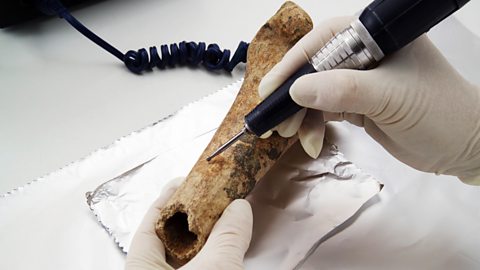
Sample being removed from bone for carbon dating using accelerator mass spectrometry
Half life graph showing carbon dating
