Progressive rhythm
Progressive rhythm features elements that are changed every time they repeat
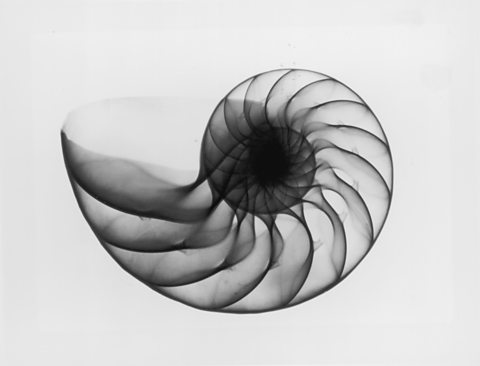
X-ray of Nautilus Shell (Edward Charles Le Grice, c.1910) shows how progressive rhythym can be found in nature.
The shell is made up of a series of identically-shaped sections that grow larger as they spiral out from the centre. The regular way these shapes change creates a progressive rhythm.
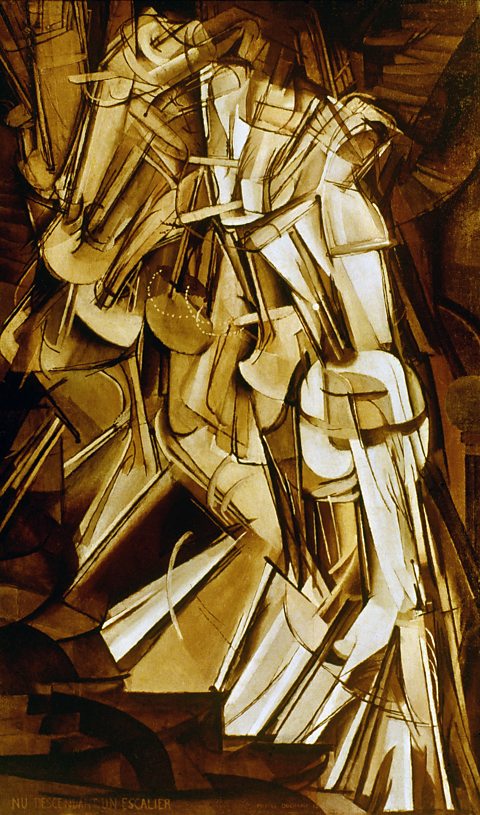
Nude Descending a Staircase (Marcel Duchamp, 1912) features progressive rhythm created through repeated but changing shapes and lines.
By trying to capture the figure moving down the stairs, Duchamp avoids creating one specific focal point. Instead, the viewer’s eye follows the movement of the figure from the top left of the canvas to the bottom right.
Although the shapes are abstract they suggest the changing The position in which someone holds their body. of a walking figure.
The consistent use of a limited colour palette of yellow and brown ties the shapes together. They read as one developing, moving arrangement with a progressive rhythm.
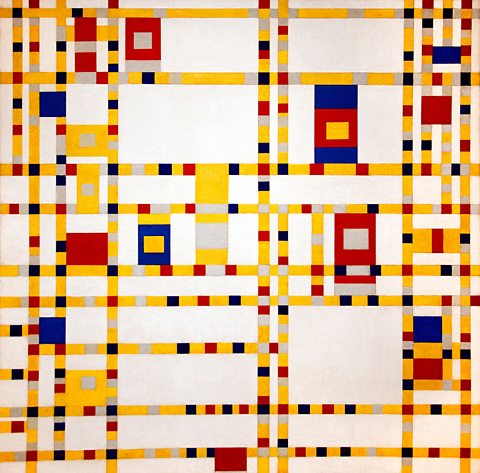
Broadway Boogie Woogie (Piet Mondrian, 1942-43) was inspired by the regular grid patterns of Manhattan streets and also by a piece of jazz music.
Mondrian wanted to show both structured order and free-flowing musical rhythm. He did this by dividing the canvas into lots of different sized squares.
The resulting composition is Relating to geometry and featuring straight lines and regular mathematical shapes and forms such as squares, circles, triangles, cubes and spheres. but irregular. The size of the squares and the position of the different colours keeps changing. The resulting rhythm is progressive.
The viewer’s eye moves up and down the lines, and from left to right across the whole canvas. By randomly placing larger red, yellow and blue squares around the canvas, Modrian ensured that there is not one particular focal point or area of the painting that attracts specific attention.
