The Last Guru – the Guru Granth Sahib
The The Guru Granth Sahib is the most important Sikh holy book. It is a collection of songs, prayers and hymns from the Sikh Gurus and other holy men, as well as teachings from other faiths. It is treated as a living Guru. is a collation of many hymns, poems, A hymn or verse in the Guru Granth Sahib. and other writings from many different People who study a particular subject or topic, and have in-depth knowledge., including the Gurus and Hindu and Muslim writers. Every Guru Granth Sahib has 1,430 pages, and every copy is identical.
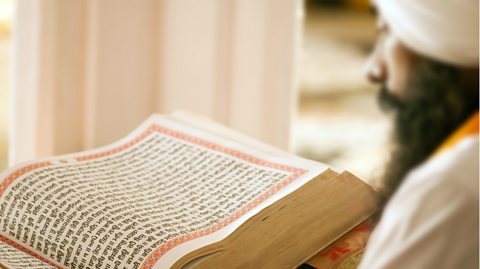
The Guru Granth Sahib is not just the holy scripture of Sikhism. It is also considered as the living Guru. Before Guru Gobind Singh died, he declared that there would be no more human Gurus and that the Guru Granth Sahib would be the The Guru Granth Sahib, known as the Eternal Guru because God would be present through its teachings..
Significance of the Guru Granth Sahib
- It contains the words spoken by the Gurus. This is known as The message within the Guru Granth Sahib, which is considered to be the word of God., which means ‘from the Guru’s mouth’.
- It is believed to be the word of God and is therefore Cannot make mistakes and is not flawed..
- It is written in The script in which the Guru Granth Sahib is written. It is the script used for Punjabi in India’s Punjab state.. This is the script the Punjabi language is written in.
- It is placed in the prayer hall within the Sikh place of worship. Literally, the 'doorway to the Guru'.. Any building that has a copy of the Guru Granth Sahib is considered a gurdwara.
- It is considered as the Living Guru, because the Gurmukhi scripture is considered the word of God and therefore treated with respect as a human might be.
Compilation and contents of the Guru Granth Sahib
- Many of Guru Nanak’s hymns and prayers were preserved and complied by The second of the ten Sikh Gurus. and Guru Arjan was the fifth Sikh Guru. He was born in 1563 and was executed in 1606 on the orders of the Mughal Emperor Jahangir, and was the first Guru to be martyred. . This collection became known as the The first collection of Sikh writings, compiled by Guru Arjan. It can also refer to the Guru Granth Sahib..
- The Adi Granth also included writings from Hindu and Muslim writers who believed in the oneness of God. Some of these writers were from lower The anglicised term for varna; originally a Hindu social order of higher and lower class. Also followed by some Sikhs., which shows the inclusiveness of Sikhism.
- The Guru Granth Sahib was completed in 1604 and installed in the City in North-Western part of Indian. Spiritual centre for Sikhs.. This original copy is written in many different languages, reflecting its many different authors.
- Every other copy of the Guru Granth Sahib is identical.
- The first A hymn or verse in the Guru Granth Sahib. of the Guru Granth Sahib is the (Mool Mantar or Mul Mantra) The basic statement of belief that appears at the beginning and throughout the Guru Granth Sahib. . This is the statement of belief for Sikhism. It outlines the belief in one God.
- The first line of the Guru Granth Sahib is “Ik Onkar”. This literally means ‘there is only One God’.
Respect for the Guru Granth Sahib
As the Guru Granth Sahib is considered to be the Eternal Guru, Sikhs believe it should be treated in the same way the human Gurus were treated. This means it must be treated with the utmost respect.
There are various ways in which respect for the Guru Granth Sahib must be shown:
- Sikhs remove their shoes and wash their hands before entering the gurdwara.
- Sikhs wear head coverings inside the gurdwara in the presence of the Guru Granth Sahib.
- The Guru Granth Sahib is placed on a Raised dais or platform on which the Guru Granth Sahib is placed in the gurdwara. , which is a raised platform. This is under the A small bed on which the Guru Granth Sahib is placed in the prayer hall. It has a wooden frame covered with webbed material, with three pillows and a white cloth. The Guru Granth Sahib rests upon the pillows. , which is a bed for the Guru Granth Sahib to be placed on. Above this there is the The domed structure used to cover the raised area in the prayer hall where the Guru Granth Sahib is kept., which is a domed structure that covers the area that holds the Guru Granth Sahib. This is covered by the A canopy made from decorated cloth above the Guru Granth Sahib in the prayer hall inside the gurdwara, which is a canopy made from decorated cloth known as the Beautiful cloths or coverings which cover the Guru Granth Sahib when it is not being read..
- The Congregation in a Sikh gurdwara. sit on the floor in the The prayer hall in the gurdwara, which is the Sikh place of worship. to ensure their heads are not higher than the Guru Granth Sahib.
- Sikhs make offerings to the Guru Granth Sahib when they enter the prayer hall.
- Sikhs never turn their backs on the Guru Granth Sahib.
- A Reader of the Guru Granth Sahib, who officiates at ceremonies. This can be a man or a woman. is a person appointed to read the Guru Granth Sahib. When the Guru Granth Sahib is being read, a Fan waved over scriptures, made of yak hairs or nylon; symbol of the authority of the Guru Granth Sahib., which is a special fan made from yak hair, is waved above it.
- The Guru Granth Sahib is placed in a separate room at night.
