Higher tier: The expanding universe
Scientists have gathered a lot of evidence and information about the Universe.
They have used their observations to develop a theory called the Big Bang.
The theory states that about 13.8 billion years ago, all the matter in the Universe was concentrated into a single, incredibly tiny point.
From this tiny point, the whole Universe expanded outwards to what exists today.
The Big Bang
- The Universe is thought to have originated 13.8 billion years ago from a very small, extremely hot and dense region called a singularity. The Big Bang was a massive expansion that blew space up like a gigantic balloon.
- Initially the universe expanded rapidly. Rapid expansion is always accompanied by cooling, so, as the Universe got bigger, it cooled down. This enabled A subatomic particle with a relative mass of 1 and a relative charge of +1., Uncharged subatomic particle, with a mass of 1 relative to a proton. The relative charge of a neutron is 0. and A subatomic particle with relative mass of 1/1840. The relative charge of an electron is -1. to form.
- Further expansion and cooling allowed protons and neutrons to combine to form Nuclei is the plural of nucleus. The nucleus is the central part of an atom. It contains protons and neutrons, and has most of the mass of the atom..
- The universe continued to expand, although now more slowly. As it cooled still more, electrons combined with neutrons and protons to form atoms of hydrogen.
- The force of gravity acted on the atoms of hydrogen, pulling them together into bigger and bigger clumps.
- Some 400,000 years later the first stars form from the clumps of hydrogen and begin to light-up the Universe.
Evidence for the Big Bang includes:
- all other galaxies are moving away from us;
- the further away a galaxy is, the faster it is moving away.
These two features are found in explosions - the fastest moving objects end up furthest away from the explosion.
Scientists have also detected cosmic microwave background radiation or CMBR.
This is received from all parts of the Universe and is thought to be the heat left over from the original explosion.
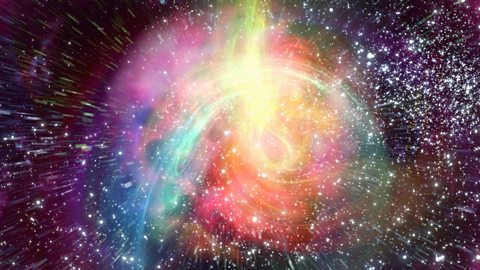
An artist’s impression of what the Big Bang might look like
Key points
- During the Big Bang, the universe expanded and cooled.
- Galaxies are moving away from each other.
- The further away the galaxies are, the faster they are moving apart.
- Space is expanding.
- The universe is expanding.
