Polymerase chain reaction
The Polymerase Chain Reaction (PCR) is a technique for the amplification of DNA in vitro (this describes experiments with cells outside their normal environment).
PCR amplifies DNA using complementary primers for specific target DNA sequences.
This technique allows scientists easily and cheaply to turn a specific target sequence of DNA into millions of copies which can then be used for analysis.
The practical applications of PCR are to amplify target sequences of DNA to:
- provide DNA samples for criminal investigations
- settle paternity suits (legally prove the identity of a child's father)
- diagnose genetic disorders
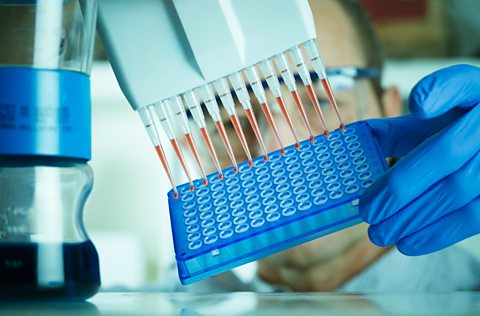
Requirements for PCR
- DNA – the original strand of DNA which needs amplified.
- complementary primers – primers are short complementary sequences of nucleotides needed to start DNA synthesis
- thermal cycler – equipment that varies the temperature of the reaction
- heat-tolerant polymerase – an enzyme which will add nucleotides to the growing strand and which is not To change the shape of an enzyme's active site, for example because of high temperatures or extremes of pH. Denatured enzymes no longer work. by the high temperatures used in the reaction
- supply of nucleotides – to synthesise the new strands of DNA
The PCR process
- DNA heated to between 92 and 98°C - to denature the DNA and separate the two strands.
- DNA cooled to between 50 and 65°C - to allow primers to bind to target DNA sequences.
- Complementary primers added - which are complementary to the target sequences at the two ends of the region to be amplified.
- Heated to betweeen 70 and 80°C - tolerant DNA polymerase added - which replicates the region of DNA to be amplified. Two strands are formed.
- Repeated cycles of heating and cooling amplify the target region of DNA.
Image caption, DNA separated by heating
1 of 4
End of image gallery
The thermal cycler allows this process to be automated. The reaction mixture is added, and then repeated cycles of heating and cooling cause the DNA to be continually denatured and replicated.
