Case study of a global disease
AIDS - location
AIDS (Acquired Immunodeficiency Syndrome) is caused by Human Immunodeficiency Virus, a disease which damages cells in the immune system. which, over time, eventually wears down the The body's defence system against entry of any foreign body, including pathogens and agents such as pollen grains. The role of the immune system is to prevent disease.. This lack of The body's natural ability to fight off disease. makes an infected person extremely prone to picking up viruses which, in most cases eventually leads to death.
Every country in the world has or has had someone living with AIDS. However, the distribution of cases around the world is very uneven, with over 70 per cent in A continent containing many countries.. Even then the vast majority of the cases found in Africa are located south of the The line around the centre of the Earth, parallel to the Tropics of Cancer and Capricorn., with most of these in A country located in southern Africa. itself.
Question
Look at the map above.
Describe, in detail, the global distribution of AIDS.
- The distribution of AIDS is very uneven throughout the world.
- The highest percentage of people with the disease is located in African countries.
- There are between 0.1-0.5% of people in the UK living with AIDS.
- Some countries eg China have less than 0.1% of its population with the disease.
HIV/AIDS is usually passed on through contact with the blood or body fluids of an infected person. The main ways people contract HIV/AIDS are:
- Drug users sharing drug injection equipment, such as needles and syringes.
- Having When people have intercourse without using a condom. with an infected person.
- Babies drinking the breast milk of an infected woman.
- Infected When people are given blood via a drip..
- Infection can be passed on from mother to An unborn baby. Usually eight weeks from conception. during pregnancy.
- Having unprotected sex with multiple sexual partners increases the chance of being exposed to the virus.
- Lack of Health provision that aims to stave off disease before it strikes., advice or medication.
- Lack of education on how the disease is transmitted.
- Sexual tourism, eg Bangkok.
Effects of AIDS
In a developed country AIDS is often found within specific groups such as drug addicts who use needles. Younger people may be afraid or wary with new partners. Loss of life and indeed news of someone contracting the virus can have a negative emotional impact on relatives and families as well as the individual.
In a developing country the cost of medicine to control the disease (there is still no cure) means that most people go without. AIDS is a weakening disease which means that eventually those infected will not be able to work. The The number of people who die per thousand per year. will increase and life expectancy decreases.
In countries like South Africa or A country located in eastern Africa. where AIDS is common, children may be left without parents and brought up by their grandparents, meaning entire middle-aged populations may be missing from societies. There may also be a loss of Money made from visitors. if it becomes known that there are specific problems with disease in the area.
Strategies adopted to manage AIDS
There is still no The end of a medical condition when people are made better. for AIDS so most efforts concentrate on prevention. The introduction of Schemes which are set up to make people aware of issues relating to their health and wellbeing. warn of the risks of unprotected sex and shared needles. These programmes include advertising on TV and radio, as a number of people in the affected areas may not be able to read or write. The distribution of free condoms was also designed to help people practise safe sex.
AIDS awareness Work in an organised and active way toward a particular goal, eg raise awareness of the risks of smoking., such as UNAIDS World AIDS Day, are used to highlight the dangers and causes of AIDS. Compulsory testing for AIDS is also used to identify those with the disease.
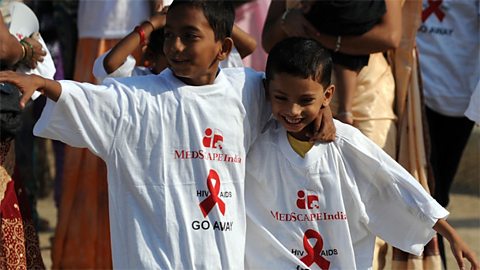
Large-scale projects such as the An organisation set up to save the lives of people suffering from HIV and AIDS around the world. and national initiatives, eg in South Africa, were started with the aim of providing drugs such as ARV – antiretroviral therapy. Free condoms were given to communities along with educational campaigns. There is increased funding to tackle the disease from sources such as the An international bank set up to help poorer countries develop. This might be through lending them money for development projects.. Some of this will be put into Investigations into the causes, effects and potential new ways to treat diseases. into developing an AIDS Substances containing disabled antigens of a particular disease, usually administered via injection. Vaccines stimulate the body to produce antibodies to provide immunity against that disease..
In developed countries Treatment that involves using medication to treat disease. do help to control the disease and prolong the lives of AIDS sufferers. Blood is also screened before use in transfusions and A simple piston pump that contains a plunger that is pushed to administer an injection; thrown away after use. are used in hospitals. Availability of testing is also important so that people know if they have the disease and can take action to ensure it is not spread.
Effectiveness of strategies
Although there has been a significant increase in funding for AIDS research, there is still not enough, so there has been no breakthrough in the development of a vaccine to cure the disease. Therefore the effectiveness of current methods used to control AIDS have varied significantly between developed and developing countries, with much more success in developed countries.
Developed countries
- Can afford the drugs available.
- Can afford to research and trial new drugs.
- Countries with good quality health services have managed to reduce the spread of the disease, although drug therapy can produce serious side effects.
- Medication has so far not been overly effective.
Developing countries:
- Drugs are available but not enough staff are trained in administering them, eg in South Africa.
- There are many isolated areas which are difficult to access.
- Many people are not aware they have the disease which causes it to spread.
- There are many misconceptions about the spread of HIV.
- There is a high birth rate, even among infected women.
- Testing facilities are often poor.
- Some people try to avoid being tested.
- Newer, more effective drugs or those with fewer side effects are too expensive and drug companies are not willing to reduce prices.
- Large numbers of the population cannot read or write which makes educational campaigns difficult.
- There may also be many different languages spoken.
- Countries may have other priorities in terms of spending.
