The gurdwara in the community
As Sikhism does not have a priesthood or a hierarchy, the Sikh place of worship. Literally, the 'doorway to the Guru'. is run by the Congregation in a Sikh gurdwara.. Sikhs are selected to run the gurdwara. They organise and coordinate the daily running of the gurdwara, including its finances, events, maintenance and cleaning.
Most of the work and organisation are done voluntarily by the sangat as part of Selfless service to the community.. However, a Reader of the Guru Granth Sahib, who officiates at ceremonies. This can be a man or a woman. is appointed to oversee the running of the gurdwara. There are many ways that the gurdwara is used by the local community, to support and serve the sangat.
The langar
The The kitchen and place where food is eaten in a Sikh Gurdwara. Often volunteers provide and cook food that is served to all as an act of sewa (charity). (or free kitchen) was introduced by Guru Nanak was the founder of Sikhism and the first of the ten Gurus, who lived from 1469 to 1539., who was the founder of Sikhism and the first Guru, because of his belief in the The Sikh belief that all humans are equal because Waheguru created everyone equally.. He offered free meals to everyone, regardless of their The anglicised term for varna; originally a Hindu social order of higher and lower class. Also followed by some Sikhs., gender or wealth. It was a place where everyone gathered and ate together. The langar is also the free food that is served in the kitchen. Many Sikhs serve langar to people outside the Sikh place of worship. Literally, the 'doorway to the Guru'..
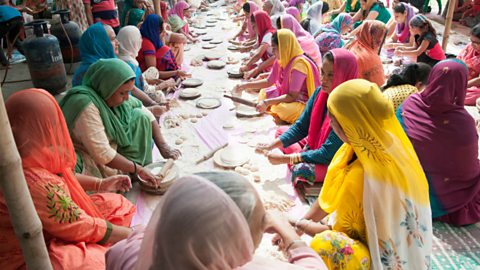
The langar has several key features:
- the langar is run by volunteers, who can be male or female
- it is seen as a privilege to help with the running of the langar
- the langar serves only vegetarian food, to make it inclusive of all faiths
The Langar – the kitchen of the Guru’s shabad has been opened, and its supplies never run short.
