Joseph Lister and the use of antiseptics
Until the acceptance of germ theory in the 1860s, surgeons did not take any precautions to protect open wounds from infection. They did not wash their hands before operating, sterilise their equipment or clean the operating table.
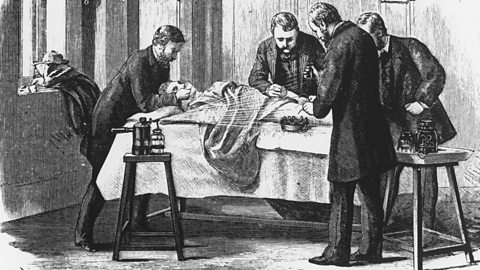
This began to change in 1867, when Joseph Lister discovered that carbolic spray was very effective in stopping wounds from developing The death of tissue in part of the body. He developed A substance that kills or stops the growth of germs which cause disease. surgery by spraying medical instruments, A tough cord made from the intestines of certain animals and used for surgical ligatures. and bandages with a 1-in-20 solution of carbolic acid.
As always, there was some opposition.
- Many surgeons claimed that Lister’s antiseptic methods slowed things down at a time when speed was still essential because of blood loss.
- Lister could be very critical of other surgeons. Therefore, some were reluctant to accept his ideas.
- Many surgeons lived with the fact that lots of patients would die - for them it was an acceptable part of surgery.
Despite this opposition, it was soon obvious that Lister’s methods were a success. In just three years, he reduced the death rate among his patients from 46 to 15 per cent. Others soon copied his methods. In the 1880s An operation to remove the appendix. were being carried out, and in 1896 surgeons performed the first major cardiac surgery when they repaired a heart damaged by a stab wound.
Reducing the death rate
In the latter part of the 19th century, there were other developments that further reduced the death rate from surgery:
- In the 1860s, standards of hospital cleanliness and nursing care rose rapidly once Florence Nightingale returned to the UK. She had been nursing in the Crimean War. She enforced high standards of cleanliness to reduce infection among wounded soldiers.
- The 1890s saw the beginnings of Surgery using precautions to lower the risk of infection from sepsis. Surgical instruments were steam- sterilised. Surgeons started using sterilised gowns, rubber gloves and face masks to further reduce the risk of infection.
- In the early 20th century, X-rays allowed surgeons a look inside the body before operating.
Blood loss
The one remaining problem, blood loss, was overcome in the early 20th century. In 1901 an Austrian, Karl Landsteiner, discovered blood groups. When people are given blood via a drip. had been tried before but usually killed the patient because giving them a different blood group resulted in blood clotting inside the body.
Matching blood groups stopped this from happening. World War One acted as a catalyst for the rapid development of blood banks and transfusion techniques. In 1938 the National Blood Transfusion Service was set up in Britain.
