Baptism
Rite of initiation involving immersion in, or sprinkling or pouring of water; a sacrament marking the start of Christian life. is an important sacrament because Jesus was baptised, and after his The Christian belief that Jesus rose from the dead on the third day after the crucifixion. The rising from the dead of believers on the Last Day in a new, or risen, life. he told his A person who follows and learns from someone else. that they too should be baptised. Jesus also commanded his disciples to use the act of baptism to welcome new disciples into the Church. This is known as the Great Commission.
Therefore go and make disciples of all nations, baptising them in the name of the Father and of the Son and of the Holy Spirit, and teaching them to obey everything I have commanded you. And surely I am with you always, to the very end of the age.
No one can enter the kingdom of God unless they are born of water and the Spirit.
John the Baptist was the first Jew to use baptism to symbolise the To pardon someone for something that they have done wrong. of sins. It was John who baptised Jesus. Christians believe that baptising cleanses people from The tendency to sin in all human beings, believed to be inherited from Adam, 'the first man'. and marks a person’s official entry into the Church.
Infant baptism
Catholic Christians believe that baptism makes someone a member of God’s family. In many A group within a religion. Christian denominations include, for example, Roman Catholic and Anglican denominations. babies are baptised, and this is known as infant baptism.
For A group of Christians who accept the Pope in Rome as their leader., infant baptism usually takes place on a Sunday morning during A Roman Catholic service of worship that involves receiving Holy Communion.. The baby is usually dressed in white, which symbolises purity. The sacrament of baptism is carried out by a priest, who begins by To rub water or oil on a person as a ceremony of blessing. Typically an honour reserved for royalty. the child’s head with holy oil, making the sign of the cross. This is followed by pouring holy water on the child’s head three times.
Other elements in the baptism service include promises made by Someone who promises to guide their godchild in religious matters in a Christian baptism ceremony. to reject evil on behalf of the child. The priest also gives the child’s family a lit candle to symbolise them receiving the light of Christ.
Christians also believe that the baptised person receives the Holy Spirit.
Believers’ baptism
Many Group, or church, placing particular emphasis on the gospel and the scriptures as the sole authority in all matters of faith and conduct. denominations, including many Baptists and A Church that emphasises certain gifts, eg healing the sick, which were granted to the first believers on the Day of Pentecost., believe baptism should only occur once somebody is an adult, as it is then that they can accept Christianity for themselves. This type of baptism is called believers’ baptism.
It is done using total immersion, where the person being baptised walks down into a pool and is fully submerged three times before walking out into their new life.
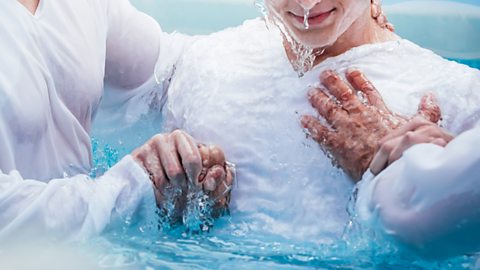
Some Christians prefer believers’ baptism because Jesus was baptised as an adult and because, as an adult, you are able to make decisions for yourself.
Question
Which Christian denominations practice believers’ baptism?
Both Baptists and Pentecostals practice believers’ baptism as they believe that only as an adult can an individual accept Christianity for themselves.
